


The first time I took a train was when I was 6 years old. It was my dad, mom, and older brother returning to Hanoi after a weekend getaway. The sky was already dimming, and the journey seemed to stretch on infinitely.
I sat leaning against the window seat, watching the orange streetlights flicker between the dark bushes pass by in monotony, wondering: “Will we ever get home?“.
Until I became too anxious to bear it any longer, I looked up at my dad and asked: “Are we almost home, Dad?“.
“Don’t whine”, my brother said. “It’s only been half an hour since we got on the train“.
Obediently shrinking back into my seat, I pulled out some souvenirs from my backpack, including a maze ruler. After rolling some small metal marbles around for a while, I became bored and fell asleep.
It was a long sleep, but when I woke up, I still couldn’t believe my eyes that we hadn’t reached home yet. The sound of the train wheels thumping against the gaps in the tracks continued endlessly. It felt as if I had been trapped in some alternate dimension, forever.

The train from Haiphong to Hanoi 18 years ago took over 3 hours, but now it has been shortened to just 2 and a half hours. Even so, when I experienced this journey again at 25, I suddenly couldn’t believe it was so quick.
Three hours felt almost eternal when I was 6, but now it is just enough time for me to skim through a book. By the time I close that book, the train has already blown its whistle at the final station.
A terrifying feeling suddenly enveloped my mind – What happened to the last 2 and a half hours? I felt like my time had been stolen.
***
Perhaps I am not the only one in this world to experience this strange feeling about time. When I asked friends and even older individuals around me, almost everyone admitted that they felt time was moving faster.
We all feel that time drags on slowly when we are young and gradually speeds up as we grow older. A friend told me he feels like each year passes faster and Tet seems to come sooner every year.
Every day, we go to work in the morning and return home in the evening. Every week, we hit the gym every Monday and go to the movies every Saturday. Every month we receive our salary once, and every year there’s a Tet holiday…
In fact, all these effects have been confirmed by psychological experiments. When psychologists put an older person and a younger person in a closed room without a clock, the older person always estimates the time they spent in there to be shorter.
Psychological surveys also show that we tend to feel time passes more quickly when we compare it to when we were half or a quarter of our current age. This means if you are 24 this year, you will find a year is noticeably shorter compared to when you were 12 or even 6.
Generally, people will experience this effect for the first time in their mid-20s to 30s, which is when most of the 9x generation begins to have a stable life.
We have a job, many have spouses and children. Our lives begin to be packed into dizzying loops. Every day, you go to work in the morning, come home in the evening, or every week, you go to the gym every Monday and watch movies every Saturday night. Every month we receive our salary once, and every year there’s a Tet holiday…

After a few years caught in these spirals marked only by those events, we begin to notice that the time between events seems to be getting shorter and shorter. Every evening comes faster, just like every Monday morning and each Tet. It’s as if we have been placed on a carousel, with positive acceleration making it spin faster and faster.
The acceleration of time in your mind is the cause of a phenomenon that psychologists call “the forward telescope“, in which we tend to think that past events happened more recently than they actually did.
Those moments of surprise when you look back, realizing you graduated 5 years ago, have been married for 3 years. A relative of yours has been gone for a whole decade, yet it seems their death just happened in a flash. This Tet, pay attention to the children when you give them lucky money. The niece or nephew you used to hold in your arms is now in first grade.
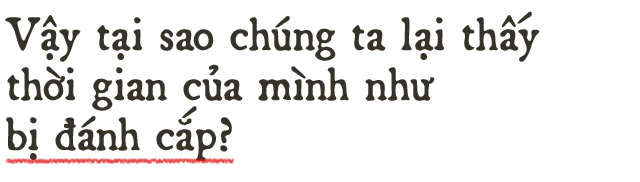
It’s not just the 9x generation today; the experience of the acceleration of time has been studied since the 19th century. A theory called “the ratio theory” was proposed by French philosopher Paul Janet in 1897 to explain the phenomenon of time seeming to pass faster as we age.
Janet argued that each absolute time period constituting your life will continuously shrink when you measure it relatively, based on the ratio. For instance, when you are 10 years old, a year passing then is calculated as 1/10 or 10% of your life. But when you are 20, a year then is only 1/20 or 5% of your life.
For a 50-year-old man, 1 year is only 2% of the life he has lived. Thus, when looking back, the older you get, the more you will feel that time shortens and loses its meaning.
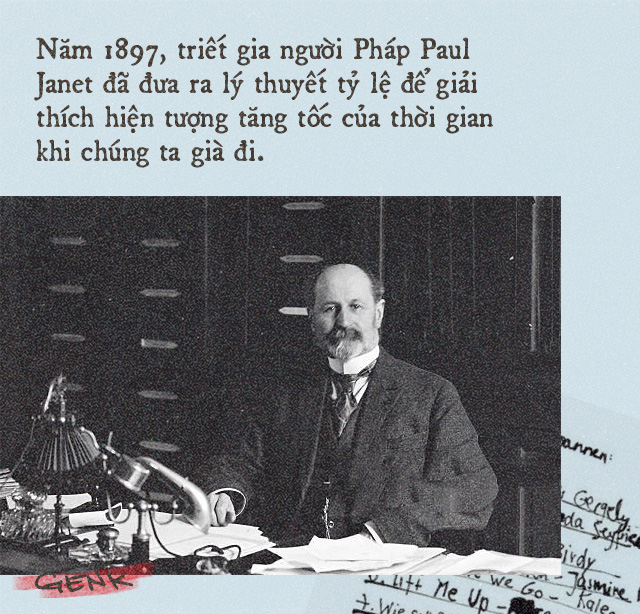
In 1897, French philosopher Paul Janet proposed the ratio theory to explain the acceleration of time as we age.
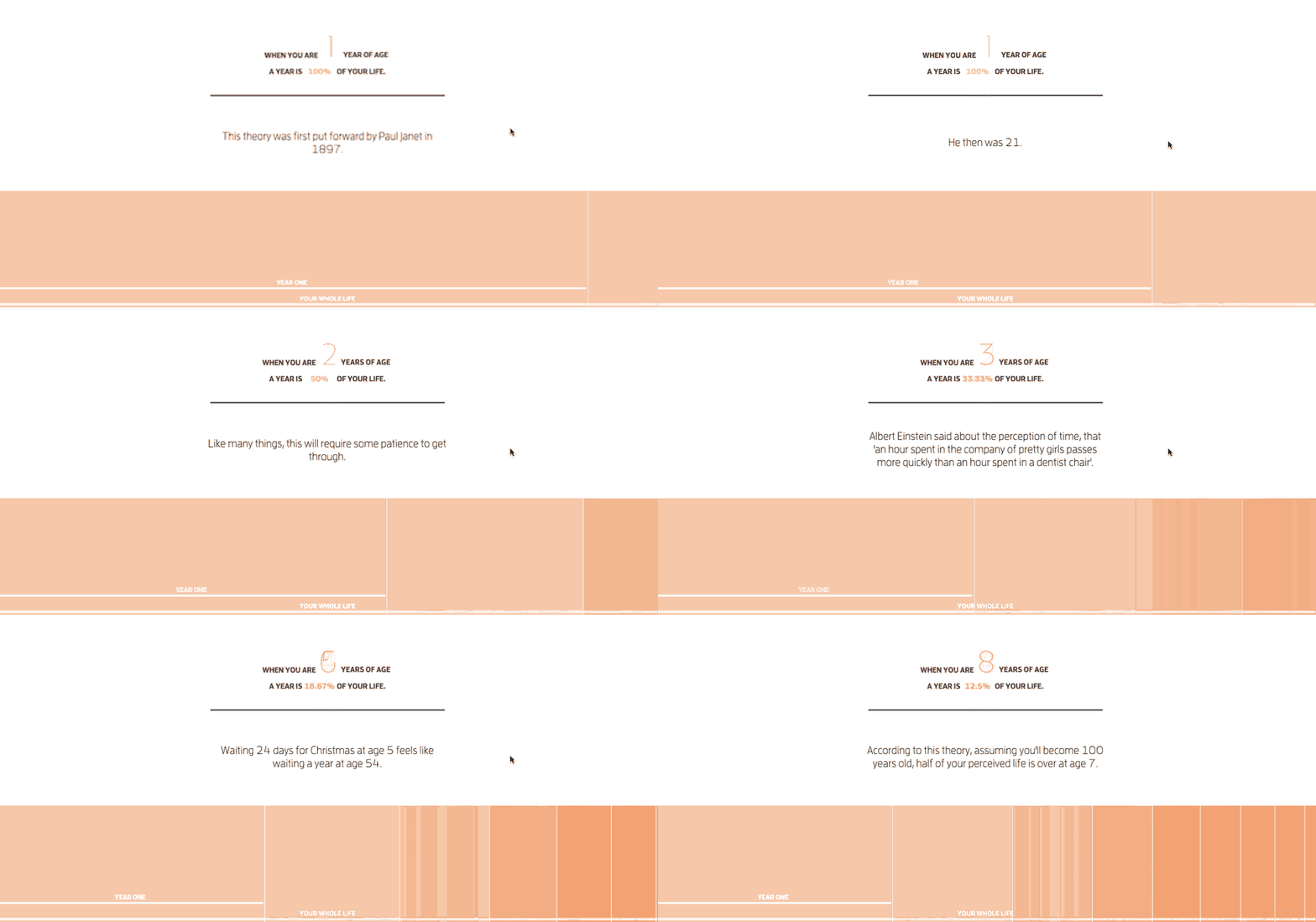
To visualize Janet’s ratio theory more intuitively, in 2015, Maximilian Kiener, an Austrian designer, created a website that allows you to scroll to experience the relativity of time in your mind.
As you can see here, Maximilian Kiener starts simulating the life of a 4-week-old child. At that time, a week lasts up to 25% of their life and feels nearly infinite. But by the time the child turns 1, a week only represents 2% of their life. The same number, you will find that 1 year at 50 feels like just a week for a 1-year-old.
Albert Einstein also spoke about our relative perception of time. “An hour in the company of beautiful girls passes faster than an hour sitting in a dentist’s chair“. Einstein passed away at 76. Kiener noted that a year at 76 is only equivalent to 24 days when you are 5, about the time from the beginning of December until you have your Tet holiday.

Suppose you live to be 100 years old; half of your relative time has actually passed by the time you are 7. But if you consider that all memories from the first 3 years of your life have faded, then half of the memories you have had and will have to remember in your life actually ended the day you turned 18.
It’s no surprise that many people say we start aging when we grow up and die at 25. Try to think back to when you were 18 and now; how quickly do you feel those 10 years have passed?
With Janet’s ratio, when you look back on your entire life at 76, it will feel just like a summer vacation in college when you just entered your freshman year.

On Kiener’s website, when you scroll past 25 years, you will see the numbers start to accelerate. It rushes through 30, 40, then 50. Decades will pass in the blink of an eye under your finger scrolling at a steady pace.
And even when you try to make it slow down, you will still feel your fingers burning from the friction of time screaming past it.
***
Now, you know that Janet’s “ratio theory” could be an explanation for the consistent speed-up of the flow of time in life. But what lies behind the numbers 10%, 5%, or 2%? Why does our brain perceive these absolute time periods relatively?
In the book “Making Time: Why time seems to pass at different speeds and how to control it“, Dr. Steve Taylor, a psychology professor at Leeds Beckett University in the UK, further explains this through a theory he calls “the cognitive theory of time“.
According to Taylor, the acceleration of absolute time that we experience is mainly related to our perception and experience of the world around us, and these perceptions and experiences gradually change as we grow older.
The speed of time seems to be largely determined by the amount of information our minds absorb and process – the more information, the slower time seems to pass. This relationship was confirmed by psychologist Robert Ornstein in the 1960s.
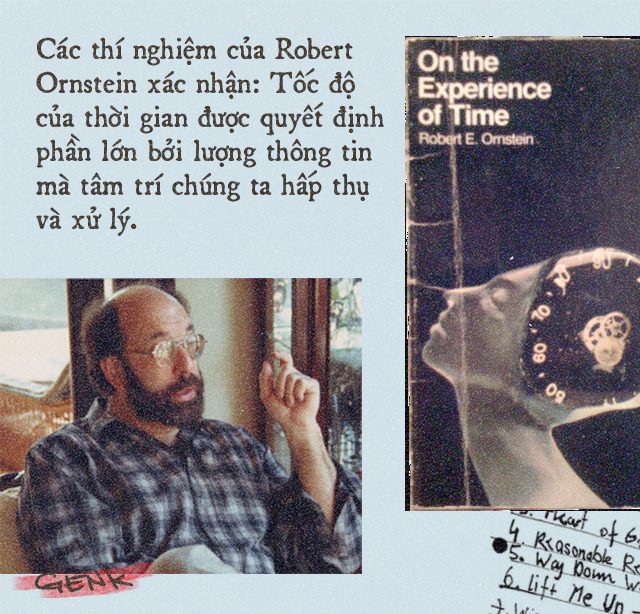
In a series of experiments, Ornstein had volunteers listen to recordings filled with various noises, such as clicks or household sounds. These tapes were of equal length, but the number of sounds within them varied.
At the end of each experiment, when the tape had finished, Ornstein asked the volunteers to estimate the time they spent listening. An interesting phenomenon emerged: those volunteers who heard tapes with more sounds, such as double the number of clicks, were the ones who estimated longer time spans.
And not just with sound, Ornstein found that his experiments could be extended to many more complex types of information. For example, when volunteers were taken into an art gallery with various paintings: The group that entered the room containing the most abstract paintings, with the most information, would estimate the time they spent in there to be the longest.
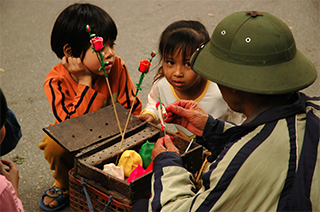
Children’s hearts beat faster than ours, their body temperature is higher, they breathe faster, and their blood flows quicker. The internal clock of children has a span of 24 hours longer than what we have each day.
Taylor’s information theory slowing down time can also explain why, when we are young, time seems to pass very slowly. This is because children continuously absorb a huge amount of information from the world around them.
Everything in that world is new to a child. During my first time standing at Hanoi train station at 6, I was overwhelmed by what was there. The straight columns, the bright windows, and countless noisy passengers made it a vast maze.
I always had to follow my older brother’s footsteps to avoid getting lost at every turn by the staircase, passing through each waiting area. That childhood train station was a more intense, vibrant, and overwhelming world than it was when I was 25. Now, I can step off the train, looking at my phone without needing to pay attention to it.
And this is also one of the reasons why we often remember our childhood as the happiest time. Do you see the past Tet holidays filled with beautiful and interesting things more than now? That’s because all our experiences in the past, when we were young, were very intense.
Observe children playing or doing anything. Even when they sit still, they are not actually sitting still; their minds are still active, continuously gathering a mess of information from the outside world.

I remember as a child, I could sit beside the pot of banh chung without knowing boredom. My eyes would be glued to the dancing flames while my ears still heard the crackling firewood, under the music of Cheri Cheri Lady coming from the cassette player in the house.
And not just sight and sound; a child’s nose would also detect the very subtle flavor of the dong leaves being boiled. The warm hands held out to the fire suddenly felt cold when you pulled them away, while the drizzle outside was pouring, and the Tet of childhood always fell on those bone-chilling cold days.
A child’s perception always amplifies every experience they have compared to adults. Scientific research shows that children’s hearts beat faster than ours, their body temperature is higher, they breathe faster, and their blood flows quicker. The internal clock of children has a span of 24 hours longer than what we have each day when we become adults.
When you have gone through dozens of Tet holidays in the past, had many family New Year’s Eve dinners, returned to your hometown dozens of times, watched fireworks, and seen all 15 episodes of Tao Quan, you will find that everything is no longer exciting.
And there are theories suggesting that children live in longer moments, which is why they feel time passes more slowly. Think of a clock set to run 25% faster than normal time: After 12 actual hours, it has run through 15 hours, and after one day, it has run 30 hours.
On the other hand, older people have a slower metabolism, slower blood flow, and their internal clocks seem to run less than 24 hours each day. The intensity of perception naturally declines because of this.
As we grow up and age, the world around us suddenly becomes a boring and familiar place – so boring and familiar that we stop paying attention to it. A child may pay attention to the buildings and streets around them, but why would you do so when you’ve seen them thousands of times in your life?
The Tet holidays are the same. When you have experienced dozens of Tet holidays in the past, had many family New Year’s Eve dinners, returned to your hometown dozens of times, watched fireworks, or seen all 15 episodes of Tao Quan, you will find that everything is no longer exciting. Tet now just feels… ordinary. Tet is bland!

And that’s also why time seems to accelerate as we grow up. When we have enough experiences, we begin to see the magical lights of childhood fade away, we trivialize everything around us. We become more indifferent and apathetic.
Gradually, the conscious attention we give to our surroundings disappears; as our experience records fill up, we no longer want to stuff in more. The older we get, the less information we will absorb, which means our time passes more quickly.
The timeline then is no longer stretched out, because the amount of information you pin on it is too little.

So as we mature, the world around us becomes increasingly familiar. We also get caught up in living in loops of days, months, and years, gradually reducing the amount of information we absorb (including perceptions, sensations, and thoughts) over time.
Therefore, we see time passing faster with each year. As American philosopher and psychologist William James once said: “With each passing year, a portion of your experiences will be turned into automatic habits“.
A Tet holiday when you were 10 will be completely different from a Tet at 25. Let’s look at how many things have disappeared from your reality, or even if they still exist, you will never notice them again:
Banh chung, banh tet, Tet markets, the last class before the holiday, homework, New Year’s Eve dinners, fireworks, Tet wishes from the president, text messages on button phones, chicken, candied fruits, red envelopes, new clothes, a trip back to the hometown, spring outings, going to temples, fortune-telling, Tet wishes from maternal and paternal sides…

And look at what you did during the last two Tet holidays: Did you still have the same New Year’s Eve parties? Did you get tired of having to park and jostle to watch fireworks? Did you scroll through your Facebook news feed continuously? Did you sleep in? Did you meet relatives, friends, and old acquaintances who still ask you the same old questions: “When will you get married, have children, get promoted, when… when…“?
Honestly, if you look back, a year has passed quickly for you, then a week of Tet will pass even faster. So if you want time to slow down and have a meaningful Tet, what should you do?
In the book “Making Time“, Dr. Steve Taylor suggested two rules for people to slow down their time. First, he says, “time seems to slow down when we are exposed to new environments and have new experiences“.
Being in a new environment, the strangeness awakens us, helping us absorb more information. This can be done in many ways, such as traveling to new places, setting new challenges for yourself, learning a new skill or hobby, meeting new people, reading a new book, watching a new genre of film…
If you are someone who usually sleeps in, try waking up early during Tet; if you never go to the market, try going to the market; if you haven’t exercised in a year, try jogging or swimming…
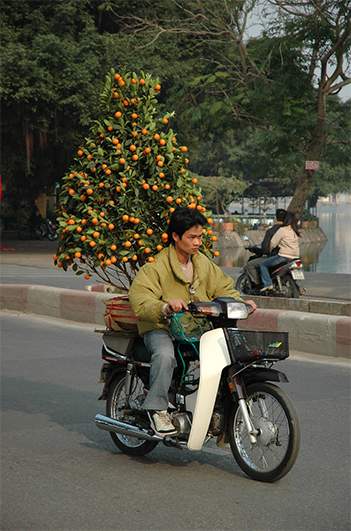
Fairly speaking, no matter how boring Tet is, it is still a good occasion for you to break your daily habits. Time during a week of Tet will pass slower than a week of work when you no longer have to carry your bag to the office in the morning and back home at night and sleep in on weekends.
Tet has many activities that can help stretch your time, just remember not to repeat the things you did during ordinary workdays. If you are someone who usually sleeps in, try waking up early during Tet; if you never go to the market, try going to the market; if you haven’t exercised in a year, try jogging or swimming…
One special thing to avoid if you want to stretch your time is activities that require focused attention. “Time will pass faster in a state of concentration“, Taylor says. This is because when our attention is narrowed to a small space and objects, we automatically block all information from the surrounding environment from reaching our senses.
Getting engrossed in video games is a good way to kill time, but you won’t want to do that during Tet because it will burn away the time you have. Similarly, don’t get caught up in gambling games from one round to the next. You might sit down in the early afternoon thinking you’ll just play for a bit of fun. But then you’ll be surprised to find that when you stand up, it’s already dark outside.
The fact that time passes faster in a state of concentration also explains why gamblers perceive less time than those who sit and watch around. Is it that when you play cards, everyone standing outside urges you to get up and go out because they are too impatient with the flow of their time?

The second rule that Steve Taylor points out in his book, which he also suggests people apply more, is that we can slow down time through conscious effort to have many new experiences even in old tasks.
Suppose you can’t skip a New Year’s Eve dinner with family during Tet. It may seem like a much more boring activity than taking a long trip with new friends abroad.
But by practicing mindfulness, Taylor explains as the act of giving our full attention and all our senses to an experience – to what we see, feel, taste, smell, or hear – rather than letting our thoughts drift unconsciously in our heads, you can also stretch your time and make it more meaningful.
For example, instead of letting your mind dwell and worry about the same old questions like “When will you get married?“, you can steer your mind towards newer and more meaningful thoughts. For instance, ask the person opposite about their business over the past year if you feel that story could offer you interesting lessons.
New stories will make for a fresher party. Never repeat old stories or ask the same old questions if you know the answer you receive will still be the same old answer. The good news is that we always have new stories to tell; you just need to know how to tap into them.
You will still have 24 hours in a day of Tet, but with more new and positive experiences, you will lie down in bed at night and feel that your day passed slower and more meaningfully.
Even your loved ones, a year before and a year after, have also become different people if you expand all your senses to feel about them. You will never meet a person as before if you look closely to see the wrinkles starting to appear on their faces and the hair of someone has silver strands.
Along with that are the subtle changes around the banquet table that you can notice when you expand your senses, a cat in the house, the way things are arranged, new bowls and chopsticks, a new speaker, new songs, a new scent of essential oil…
Even if you have to be the one to wash the dishes after the party, practicing mindfulness can give you a completely different experience from the unpleasant experiences you had in the past with that task. Pay attention to the flow of water, the smooth feel of the soap, the sound of your hand sliding on a clean bowl.
The key is to focus your senses to amplify interesting experiences and ignore feelings that make you uncomfortable, for example, don’t pay too much attention to the greasy mess, unless you love chemistry and start to wonder about the viscosity of grease, its density compared to water, how grease will denature under heat…

After all, both methods that Taylor suggested in his book increase the amount of information that will pin on your timeline. You will still have 24 hours in a Tet day, but with more new and positive experiences, you will lie down in bed at night and feel that your day passed slower and was more meaningful.
From this perspective, we will no longer see time as our enemy. Time is not an uncontrollable variable. To a certain extent, we can manage it.
Many of us try to exercise, eat healthily to ensure we can live as long as possible. We also often wish each other good health, and the elderly will live long during such Tet holidays.
Of course, those are all beautiful wishes. But as mentioned above, an entire life when you look back at 76 will feel just like a summer vacation in your freshman year of college. So remember, expanding experiences is also a way to have a more fulfilling and happier life.
According to Tri Thức Trẻ, Genk