


Throughout history, humans have attempted to create larger and better weapons in the hope that bigger size would bring more power. A few of those efforts have succeeded, but the vast majority produced weapons that look somewhat grotesque and operate ineffectively.
However, the type of gun we are discussing today is a Punt, which is a type of hunting gun but is very large (if it were smaller, it would commonly be referred to as a “cabbage gun” in Vietnam).
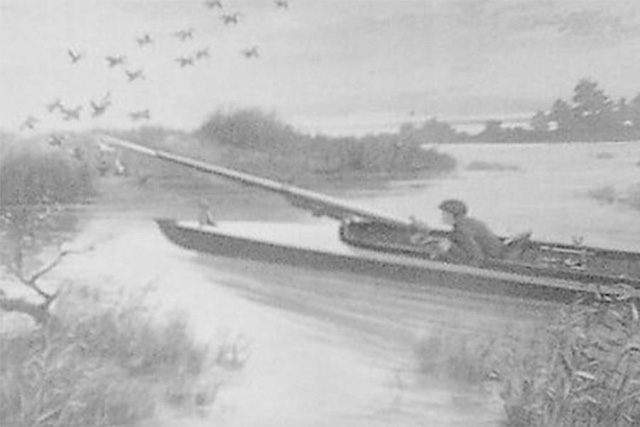
In the early 1800s, when duck hunting was invented, it was an incredibly popular activity. At the same time, during this period, the demand for meat as well as the demand for feathers for women’s hats increased significantly. Therefore, to make hunting easier, hunters began looking for ways to kill more ducks more easily. As a result, the Punt gun was created.
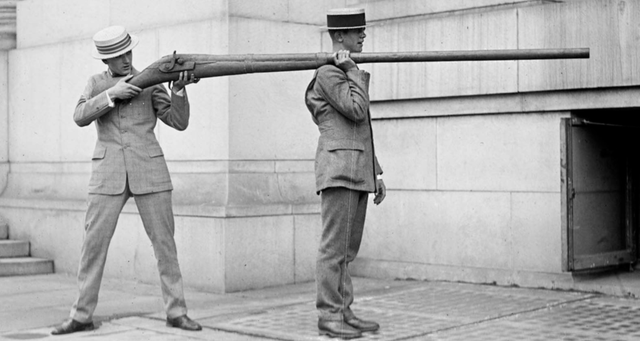
Custom-made and measuring over 8 feet (2.4 m) in length and 2 inches (5 cm) in diameter, some guns are especially long at up to 4 m and weigh about 50 kg. Such large guns can fire more than 0.5 kg of shot in one shot and can kill over 50 ducks and waterfowl at once.
These guns look like an enlarged version of regular cabbage guns, but they have a single barrel instead of a double barrel. However, double-barrel versions do exist, but they do not fire as powerful shots as single-barrel versions, so they are not commonly used.
Although these giant cabbage guns operate extremely effectively, they are too heavy for a hunter to handle them easily. Therefore, hunters developed boats that could accommodate the weight and size of the guns. These boats are quite long and slender, leaving just enough room for one gun and one hunter. Since the guns are fixed to the boat, when aiming, the entire boat must pivot to follow the target. These giant guns are so powerful that when fired, the boat is blown back several meters.
Soon, hunters developed a new hunting method to maximize their hunting profit.
They began working in groups of 8 to 10 boats, surrounding a flock of water birds. They coordinated their shots and fired simultaneously. In less than a minute, a few hunters could take down an entire flock of wild ducks, sometimes achieving an efficiency of up to 500 ducks at once.
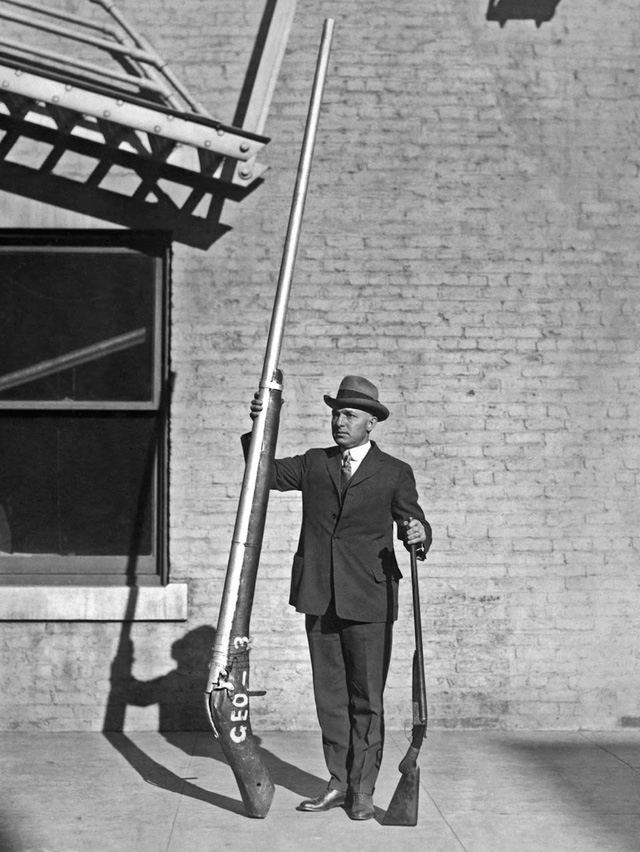
However, the fate of these giant guns did not last long. The weapon industry did not support their oversized and cumbersome design, not to mention the devastation they caused – shortly after the Punt guns were invented, populations of ducks and waterfowl in the United States began to decline drastically.
Their numbers dropped so significantly due to the effectiveness of these giant cabbage guns that the U.S. government worked to pass legislation banning both the hunting market and the transportation of these guns across state lines. From 1900 to 1918, a series of federal laws were enacted to prohibit the buying, selling, and use of Punt guns as well as boats that could effectively use Punt guns.
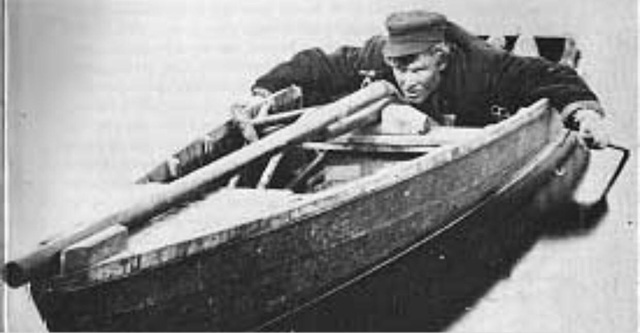
Today, Punt guns are considered a very rare item, with fewer than 100 guns in use worldwide. In the United States, they mainly exist as special items for some collectors or are displayed in historical museums.
However, in the United Kingdom, they are still used, but in extremely limited quantities, with fewer than 50 guns still in use in England. In this country, there are laws to restrict their usage frequency as well as to reduce the barrel size and use fewer shots compared to standard Punt guns; when they are used, it is often ceremonial, primarily used in royal welcome ceremonies rather than hunting.
In 1897, during her Diamond Jubilee, Queen Victoria requested a salute with a Punt gun. Since then, at every coronation and major royal event in the United Kingdom, Punt guns have been used. During Queen Elizabeth II’s Diamond Jubilee in 2012, a 21-shot Punt gun salute was fired to commemorate the occasion.