


Most people are familiar with the four states of matter – solid, liquid, gas, and plasma. Recently, however, scientists at Radboud University and Uppsala University have identified a new state of matter called “self-induced spin glass.” Not only does this discovery unveil a new form of matter, but it also holds tremendous potential for building new foundations for artificial intelligence.
Typically, to create North-South poles in the magnetic field of a standard magnet, the atomic magnets in a material will align in one direction. However, in the case of spin glass, the atomic magnets of alloy materials rotate randomly in all different directions.
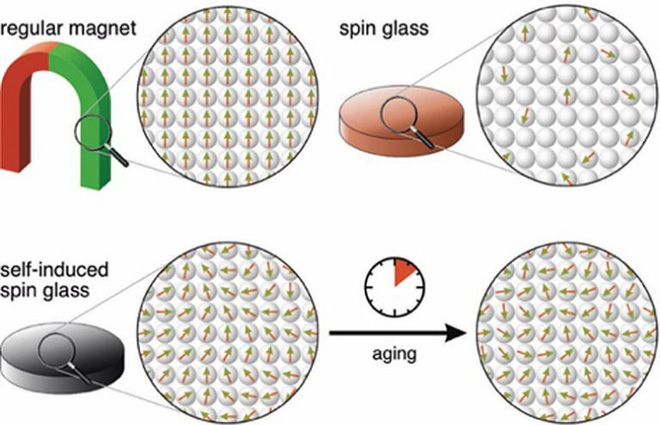
The name “spin glass” comes from the amorphous evolutionary structure of atoms in a glass piece. This phenomenon sometimes occurs in alloys, which are combinations of metals with one or more other elements in an amorphous structure, but has never been observed in a pure element from the periodic table.
However, it was surprising for researchers at Radboud to discover that the spinning atoms of the rare earth element Neodymium arranged in perfect order would spiral like a helix, but continuously change the pattern of that helical chain. This is the manifestation of a new form of matter – referred to as “self-induced spin glass.”
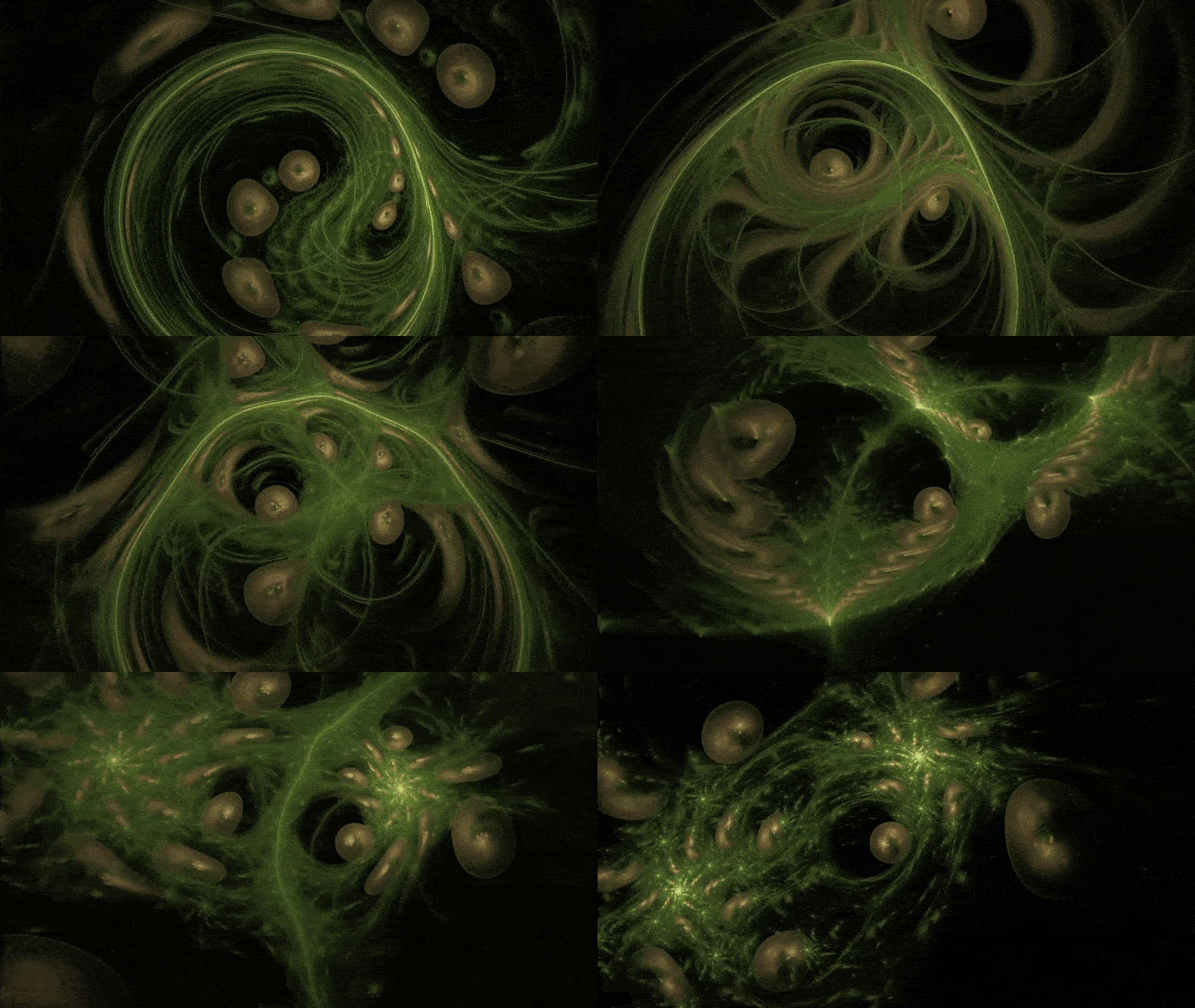
This discovery opens up the possibility that complex magnetic behaviors and glass formation may also be observable in countless other types of materials, including elements from the periodic table.
Professor Alexander Khajetoorians, a microscopy expert and one of the authors of this study, stated: “This discovery will refine the textbook knowledge regarding the fundamental properties of matter. Furthermore, it also provides a solid foundation to develop new theories that could connect physics with other fields, for example, theories in neuroscience.”
“The complex evolution of Neodymium could be the basis for simulating fundamental behaviors used in artificial intelligence.” Khajetoorians added. “All the complex patterns stored in this material could be linked to image recognition capabilities.”
With advancements in AI and its enormous energy consumption, there is an increasing demand for creating a new type of material that can perform tasks like a brain right on the hardware. “You can never build a computer that simulates a brain with simple magnets, but materials with these complex behaviors could be a potential candidate.”
Source: ScienceDaily