


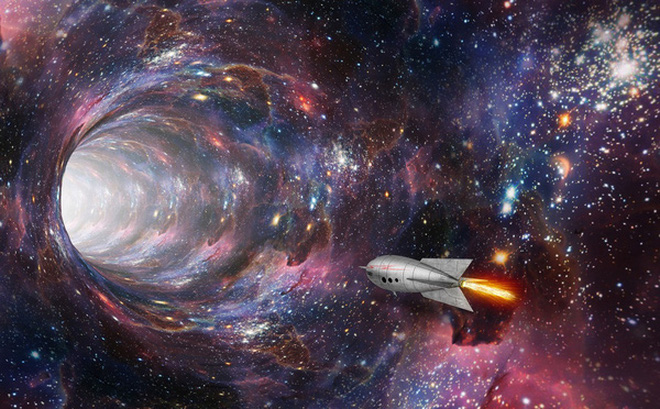
In his General Theory of Relativity, Albert Einstein predicted the existence of wormholes, which connect two points in space or time. However, to date, we have not found any evidence to prove the existence of these wormholes.
Recently, experts from the Central Astronomical Observatory in Russia believe that the ‘black holes’ at the centers of some very bright galaxies (known as active galactic nuclei or AGN) could be entrances to these wormholes. This research was just published in the Monthly Notices of the Royal Society.
An active galactic nucleus, or AGN, is the dense core region of a galaxy, caused by the accretion of matter onto a supermassive black hole at the core.
Essentially, wormholes and black holes are very similar. They are both extremely dense and possess immense gravitational pull. However, they do have several notable differences. For instance, nothing can escape from a black hole once it crosses its ‘event horizon’, while any object entering the mouth of a wormhole theoretically would re-emerge from its ‘other mouth’ in a different part of the universe.
Researchers reason that matter entering one mouth of a wormhole could potentially collide with matter entering the other mouth of the wormhole simultaneously. This collision would create plasma balls with temperatures around 18 trillion degrees Fahrenheit, emanating from both mouths of the wormhole at the speed of light.
At such temperatures, the plasma would also produce gamma rays with an energy of 68 million electronvolts, allowing some of NASA’s observatories—such as the Fermi Space Telescope—to detect the explosion. Researchers also suggest that if they find something resembling an AGN emitting high-energy spherical gamma rays, it may not be an AGN but an entrance to a wormhole.
“We currently know very little about the internal structure of wormholes. We don’t even know for sure if they exist,” study author Mikhail Piotrovich told Motherboard.
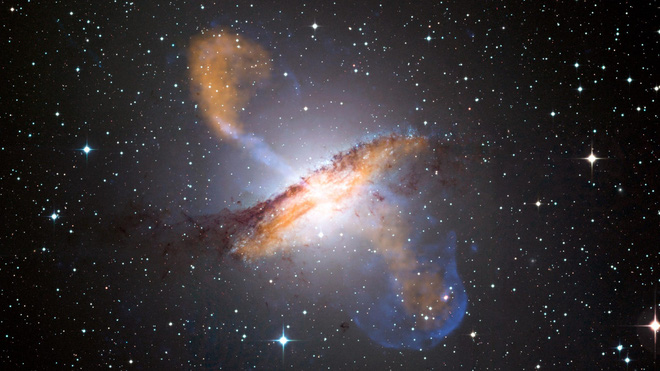
AGN are the strongest sources of radiation in the universe, with brightness equivalent to the radiation of billions of stars emitted from a region no larger than the Solar System.
If humanity could travel to the cores of these distant galaxies, we might find a potentially viable means of moving through the universe or even a way to travel through time. However, it should be noted that the nearest AGN is about 13 million light-years away from us. Therefore, the likelihood of humans being able to reach this AGN (let alone using a “wormhole” for space travel) is considered impossible with current technological capabilities.
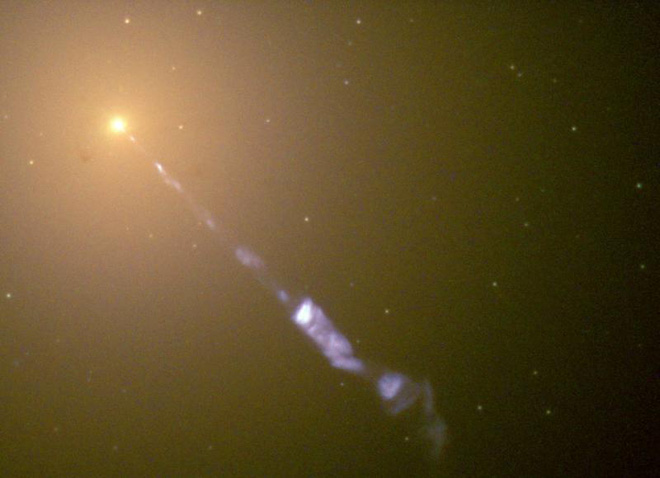
Moreover, although these wormholes are theoretically ‘traversable’ (spacecraft could pass through them), they are surrounded by extremely high-intensity radiation. This means that humans would struggle to survive the journey through a wormhole, even if we applied the strictest protective measures.
Source: Daily Mail