


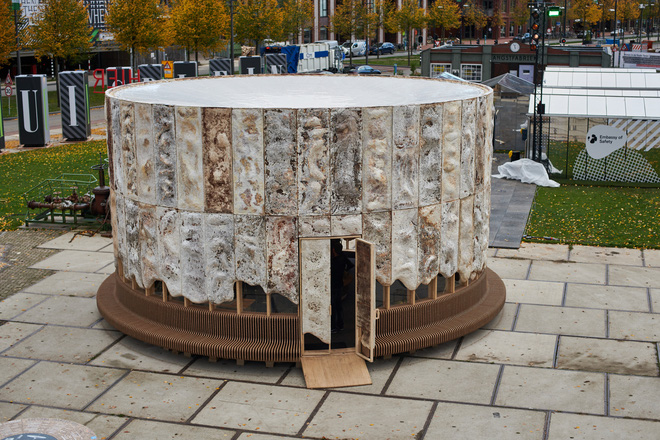
This cylindrical architectural structure looks like an oversized birthday cake covered in cobwebs, resembling something from the Spider’s Cave or an incomprehensible contemporary art piece, but it is not: the Growing Pavilion is an environmentally beneficial house made entirely from materials grown from Mother Earth.
The frame of this architectural piece is made of wood, the floor is composed of compressed cat tail grass, and it is wrapped around with self-nourishing mushrooms. The Growing Pavilion is one of the highlights of Dutch Design Week taking place in Eindhoven. Two of the many studios behind this work are Company New Heroes and Krown-design; notably, Krown-design is famous for designing and constructing architectural structures made from mushrooms.
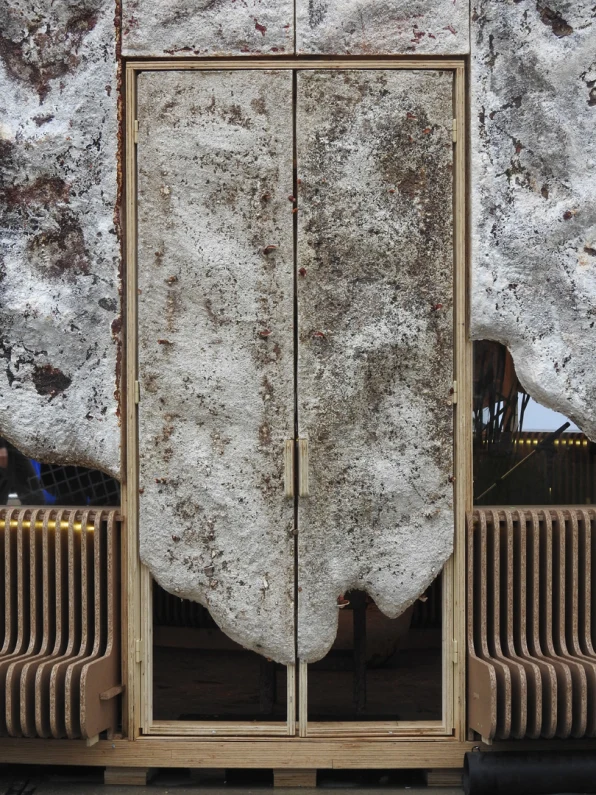
Jan Berbee, co-founder of Krown-design, explains that the EPS plastic panels covering most urban architecture emit three times their own weight in CO2. However, by replacing EPS with mycelium, the emissions from a building would significantly decrease, as mushrooms can absorb twice their weight in CO2.
Growing mushrooms is also not difficult. Just need a shaped frame, fill it with soil, and the mushrooms will grow on their own. The frame is quite large, standing 1.8 meters tall and nearly 1 meter wide, yet in less than a week, mushrooms have filled the wooden frame. To protect the mushrooms from environmental impacts, the designers sprayed the architectural structure with a protective layer made of biodegradable materials.
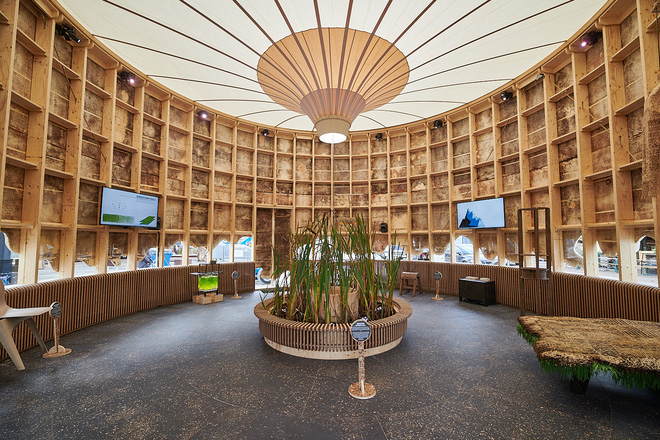
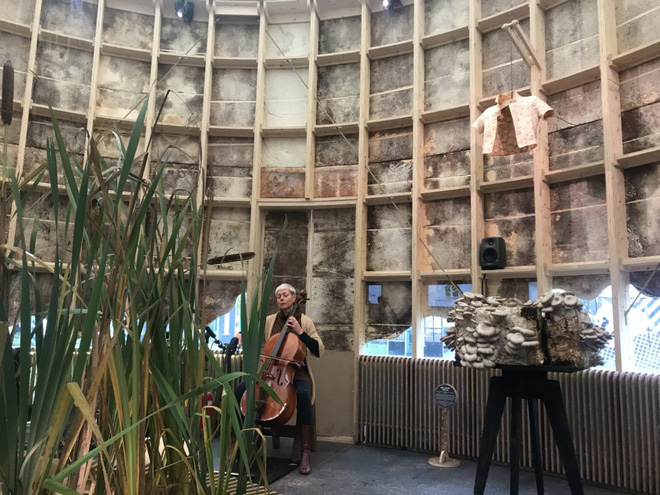
Berbee points out that mycelium is similar to a forest; the more it grows, the stronger it becomes. Mushroom walls also have the ability to insulate between the outside and inside environments, making it one of the candidates for walls in future human bases on Mars.
But what does it feel like to live in a mushroom-covered house?
“Mycelium products have a very light smell,” Jan Berbee says. “It’s hard to say what it smells like. Does a champignon mushroom have a scent? Or does an oyster mushroom have a scent?” There is a way to describe the scent each person perceives, but it is certainly more pleasant than the concrete and plastic that currently cover most of our homes.
Source: FastCo