


In a dismal year for the global automotive industry, with a significant drop in demand for new cars and travel, Tesla has emerged as a bright spot, becoming the world’s most valuable car manufacturer, surpassing giants like Toyota, GM, and Volkswagen. The skyrocketing price of Tesla’s stock has even seen CEO Elon Musk briefly become the richest person in the world just days ago.
But it’s not just the market capitalization; Tesla’s stock also astonishes with another important metric: the Price-to-Earnings (P/E) ratio. This metric indicates how long investors will take to break even when buying the company’s stock (usually measured in years) if profits remain unchanged – in other words, it also represents the number of years the company needs to generate income equal to its market value.
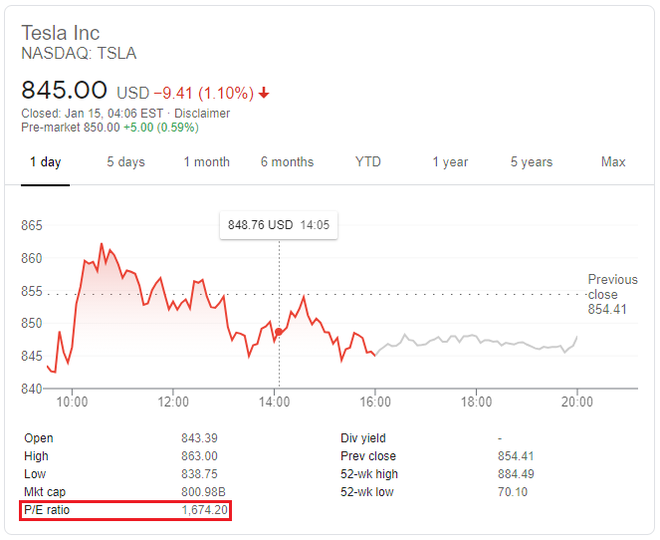
In Tesla’s case, according to analysts’ estimates, the company’s P/E ratio is at 1,674.2 – meaning if the company’s annual profits do not change, Tesla would need to operate for over 1,600 years to reach its current market capitalization.
In other words, currently, if any investor buys Tesla stock hoping to benefit from their investment, they will have to wait over 1,600 years just to break even at Tesla’s current profit level.
It’s not surprising when looking at Tesla’s current business results. In the last quarter (from June to September 2020), Tesla’s revenue reached $8.8 billion, up 39% compared to the same period last year. Although net profit more than doubled compared to last year, the company only achieved $331 million, about 3% of total revenue for the quarter. This profit level is not very attractive, but it still marks Tesla’s best business performance in many years.
This is also the reason analysts estimate it could take thousands of years to recoup investments in Tesla stock.
But what makes Tesla’s stock price so high despite low revenue and profits? In fact, stock value does not entirely reflect the company’s current business results; it reflects buyers’ expectations of the company in the future.
Even though Tesla only produced nearly 500,000 cars in 2020 – far behind traditional automakers – the company’s growth rate, both in revenue and profits in 2020, is at double digits, something traditional car manufacturers cannot achieve. With Tesla leading the global electric vehicle market, investors have even higher expectations for this stock.
Furthermore, according to an analysis on Newstatesman, another factor driving the insane price surge of Tesla’s stock is the emergence of online trading applications. During the pandemic, these applications allowed users to easily open accounts and trade even without leaving their homes.

And one of the most chosen stocks is Tesla. The popularity of Musk, the preference of young users for a tech-driven car brand, and the ease of trading on the app… all these factors have caused Tesla’s stock price to soar at a rocket-like speed since the pandemic started.
However, for many, investing in Tesla stocks feels like a gamble, and even CEO Elon Musk isn’t sure what its actual price is. In the middle of the year, Musk himself tweeted that Tesla’s stock was too high. This immediately wiped out $14 billion in the company’s market value, but shortly after, it quickly returned to that high price and even went higher.
Source: Jalopnik