


When the GPU craze hit, the first “culprits” that gamers thought of were definitely the cryptocurrency miners: the skyrocketing price of Bitcoin suddenly reignited the mining frenzy. However, in a better scenario, NVIDIA and AMD should have increased production to provide enough cards for both gamers and miners.
Moreover, globally, the supply of Xbox Series S/X and PlayStation 5 is also critically low. Even automotive manufacturers like Tesla, Ford, and GM have complained about decreased revenue due to chip shortages. So, what is happening? Why has the world suddenly fallen into a chip shortage disaster like this?
The “Joy” Named Covid-19
Certainly, the first answer you would think of is “Covid.” However, what you may not realize is that after factories were allowed to resume operations, Covid-19 became… a joy for high-tech manufacturers.

The reason is that when many countries had to implement social distancing, the demand for communication, entertainment, and working from home increased. This demand surged to the point that the PC industry, after years of decline, suddenly returned to record growth of 4.8%, the highest in a decade (Gartner data). Another hardware segment that also saw a turnaround after years of decline is tablets. Once considered a “thing of the past,” tablets experienced a growth rate of 13.6% last year (IDC data), a figure no one dared to imagine in the pre-Covid era.
Even smartphones, the segment most heavily affected by Covid, only saw a decline of 6% (IDC). When most consumers were “trapped” at home leading to reduced mobile demand, a 6% drop is not bad considering that smartphones had been saturated for years: the decline in 2019 was 1%.
In summary, the demand for electronic devices has surged significantly over the past year due to Covid. And, the surprising fact is, whether you bought a smartphone or a tablet, you may have contributed to the current GPU crisis.
An Industry Divided into Two Halves

Due to the high capital requirement and inherent risks in the chip product manufacturing process, most of the silicon industry has been divided into two halves. One half focuses on design and semi-finished products, including familiar names like AMD, NVIDIA, Qualcomm, and Apple (which designs its own A chips for iPhone, iPad, and M chips for Mac). The other half owns the chip factories, including TSMC, Samsung, UMC, SMIC, and Global Foundries (which was spun off as AMD’s manufacturing unit in 2009).
This “division” results in electronic devices becoming reluctant competitors for essential supply. For instance, Apple hires TSMC to produce the A13 chip for the iPhone 11 using a 7nm process. However, TSMC’s 7nm process is also used to manufacture various Ryzen CPUs, Radeon GPUs, chips for PlayStation 5 and Xbox Series X/S (which are designed by AMD on the Zen 2 architecture), as well as many other mobile chips. If TSMC prioritizes Apple (the iPhone 11 was the best-selling smartphone of 2020), the production capacity for CPUs, GPUs, or APUs from this Taiwanese company will clearly decline.
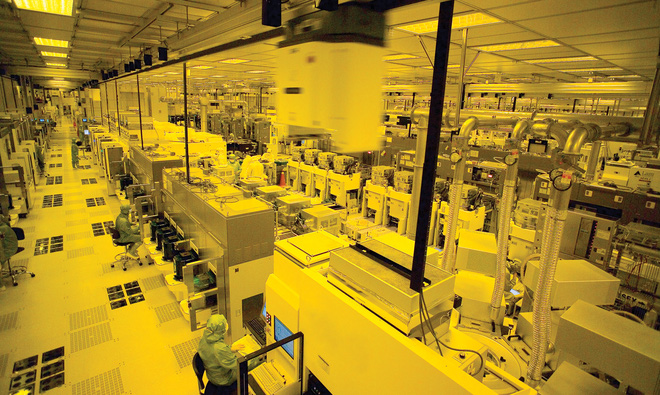
Across the entire market, Intel and Samsung are among the very few names that both design and manufacture. However, Intel is also considering outsourcing, and Samsung only utilizes a very small portion of its capacity for its self-designed chips. The unavoidable trend of the entire chip industry is to share a few certain manufacturers, and the higher the demand for chips – regardless of the type – the more it can contribute to a crisis like the current one?
Why No Growth?
The question arises, why haven’t chip manufacturing companies increased production to meet the explosive demand during the recent pandemic? The answer: they want to, but can’t. Only TSMC and Samsung have the capital, workforce, and enough experience to navigate the final chapters of Moore’s Law: in 2018, both GlobalFoundries and UMC announced they would not develop 7nm processes. The Chinese giant SMIC is currently just starting trial production on the 7nm process, a journey that will likely end in failure after the company was placed on the U.S. trade blacklist.
As a result, the current chip manufacturing market is firmly in the hands of TSMC and Samsung. According to data released by TrendForce last year, the Taiwanese giant holds up to 50% market share while the Korean company accounts for 17.4%, far ahead of all other competitors. In a hypothetical scenario where other companies can catch up to TSMC and Samsung, they would still have to spend billions of USD and would take a long time to reach 7nm, a milestone that TSMC achieved three years ago.
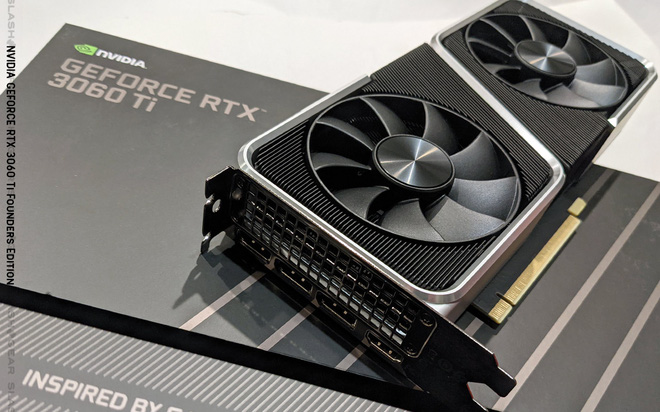
The result is that manufacturers are forced to rely on TSMC and Samsung, and when the consumption surge due to Covid erupted, both they and consumers became victims. The clearest example is the ironic situation of NVIDIA: initially, NVIDIA designed the RTX 30 models on Samsung’s slightly outdated 8nm process to avoid competing for TSMC’s 7nm supply with other companies. However, reports in December indicated that Samsung’s 8nm output also faced issues… As a result, despite not having to compete with Apple or Microsoft for factory space, NVIDIA still ended up with a GPU shortage to sell.
Increasing Scarcity
The chip supply battle is increasingly not just a concern for high-tech manufacturers anymore. In the 4.0 revolution, items that previously didn’t use chips now require them inside. For example, the computing system in Tesla vehicles has advanced to the point where it can even run Cyberpunk 2077!
Other competitors are clearly not falling behind. The chips are so crucial that GM and Ford have had to cut production, reporting a loss of $4.5 billion in the current crisis. Cars have become a massive consumer of chips.
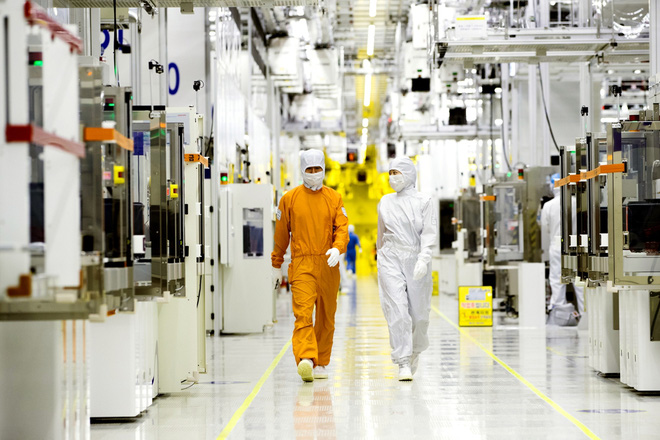
Refrigerators, washing machines, rice cookers, doorbells, TVs… are the same. The demand for chips will only continue to increase, but the supply is severely limited. Each new factory will require billions of USD in initial capital, not to mention that building a chip factory takes years… Graphics cards, smartphones, cars, doorbells… will have to continuously compete for a limited supply, and sooner or later, the world will witness many severe chip crises like the current one.