


Recently, some discoveries seem to indicate the possibility that ancient civilizations called planet Earth their “home” much earlier than previously thought. Why mainstream researchers choose to “overlook” details and clues pointing to the existence of civilizations far older than previously thought remains a puzzle for many.
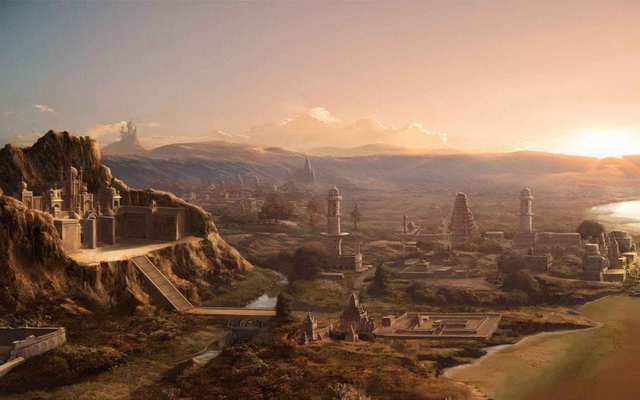
Evidence of civilizations inhabiting our planet before recorded history can be found everywhere in the world. In ancient Egypt, Mesoamerica, and Sumer, we find written texts about great civilizations in the distant past, great rulers, and a “golden age” lasting thousands of years.
One of the most typical examples of these “100,000-year-old civilizations” can be found in Africa. This astonishing discovery actually took place at a site in South Africa, about 150 km west of the port of Maputo. There, archaeologists uncovered the remnants of an ancient metropolis, which, according to data from surveys, spans an area of approximately 1,500 square kilometers (almost equivalent to the area of Haiphong).
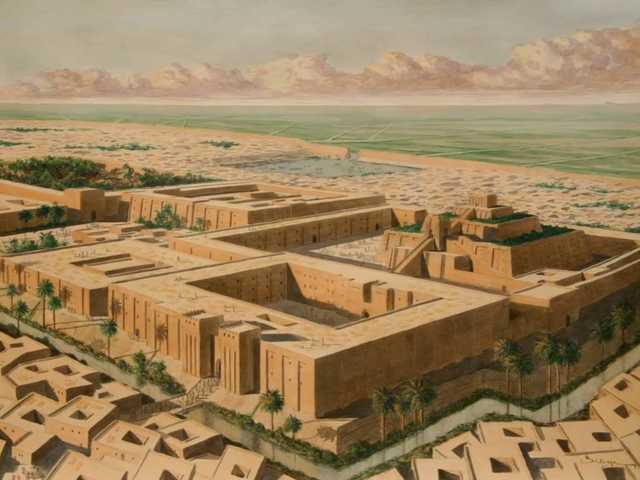
According to researchers, this ancient city is just part of an even larger mysterious community, with a scale of about 10,000 square kilometers, believed to have been built between 160,000 to 200,000 years ago. The geology of the surrounding area is also quite unusual due to the presence of many gold mines nearby.
Researchers have proposed that these ruins may belong to the ancient Anunnaki civilization, which vanished in the distant past, who lived and settled in this area to mine gold.
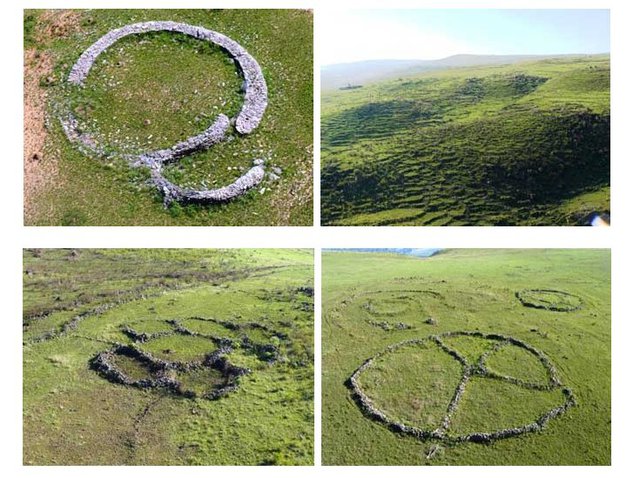
In the Amazon region, other civilizations have been discovered that may predate even the Inca civilization and could possibly be their ancestors. No one could have imagined that somewhere in the remote parts of the Amazon, there existed a lost civilization.
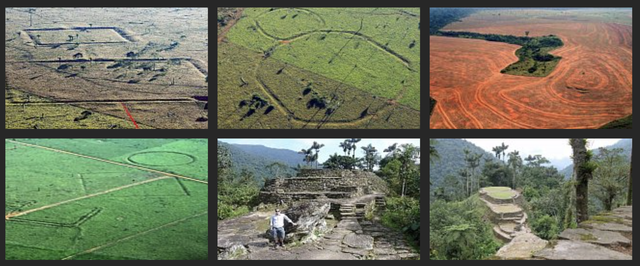
Approximately 450 geoglyphs, mainly in simple geometric shapes – squares, circles, or polygons – have been found so far over an area of 13,000 square kilometers.
Rapid deforestation combined with Google Earth has allowed the discovery of hundreds of geoglyphs (giant drawings on the ground) at 200 different locations, in a strip 250 km by 10 km in the Amazon. Like the Nazca lines, these mysterious geometric designs of the Amazon can only be truly seen and appreciated from the air.
Many remnants are clearly part of an unknown ancient civilization, until now hidden beneath the canopies of the Amazon rainforest. According to researchers’ conjectures, these strange shapes may have been ancient irrigation channels and livestock enclosures.
However, for some reason, no excavations have been conducted in the area to date, and all connections with Native American tribes regarding this archaeological site remain speculative. We still know nothing about the creators of these mysterious geoglyphs.
Additionally, a discovery made near the border between Bolivia and Brazil revealed mysterious pyramids in the Amazon: traces of a prehistoric civilization. Some researchers believe that these pyramids could be in the shape of a natural pyramid, but many other researchers are convinced that they are architectural structures built in the distant past by a civilization never seen before.
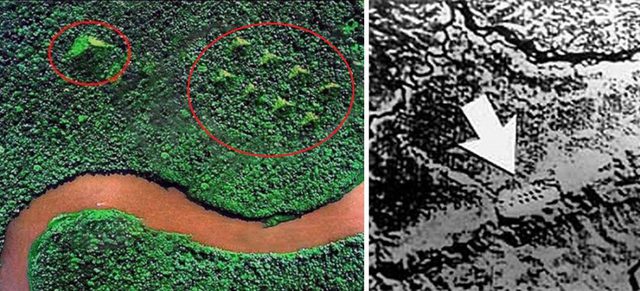
However, it is a fact that the mysterious pyramid structures were first identified through NASA’s digital satellite image C-S11-32W071-03, published in 1976: they prove that pyramid structures exist within pristine forests. The Machiguenga people named their sacred area Paratoari. Is this a product of nature or man? Is it merely a divine sacrificial area or the dead city of the Incas?
These images have prompted many investigators to venture into the Manu region, a dense tropical rainforest in southeastern Peru, hoping to determine whether these architectural works were indeed built by an ancient civilization lost in time.
While modern researchers still dismiss the hypothesis that these pyramids were built by humans, other researchers propose that the symmetrical spacing between the pyramids and their uniform shapes indicate that they are not naturally formed rock formations.
Just like with the Paratoari pyramids, the recent debate about the Visoko pyramids (Bosnia) has two schools of thought: one side argues they were built by humans, while the other claims these structures formed naturally.
But regardless, the truth remains that within the dense and tangled jungles of the Amazon, countless mysteries exist that could help you understand how ancient civilizations lived in the distant past.