


However, particularly in life, there exists a concept called “paradox” – situations that require more thought than that. And the results can be significantly better.
Here are some classic paradoxes; let’s see if you can understand them.
1. The “Black Raven” Paradox

Also known as “Hempel’s Paradox,” named after the philosopher Carl Hempel who proved it.
Hempel’s idea is that when coincidental events occur too many times, the reliability of the theory increases. To illustrate, he proposed a statement: “All ravens in the world are black.”
Ignoring the fact that there are white ravens, but because their number is very rare, you can check millions of ravens and still find them black, and then you will believe this statement is true. Then, when looking at an apple, because it is not black, it is also not a raven, and thus the statement “black raven” is further strengthened.
2. Epimenides Paradox
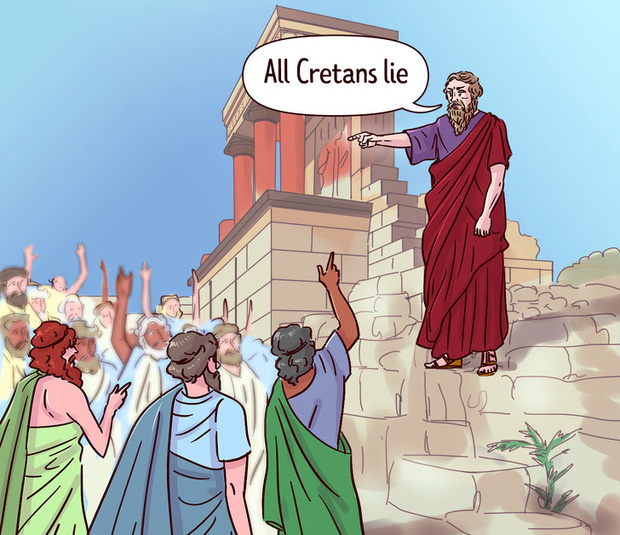
On the island of Crete in ancient Greece, there was a man named Epimenides from Knossos. He made the statement: “All Cretans are liars.”
It’s just a simple statement, but it contains a paradox. If that statement is true, then Epimenides himself cannot be telling the truth because he is also a Cretan. On the other hand, if all Cretans are telling the truth, then Epimenides must be lying, but as a Cretan, he cannot be lying. So, in conclusion, is he telling the truth or lying? That’s where the paradox lies.
3. Abilene Paradox: When We Are Forced to Do Things We Don’t Want
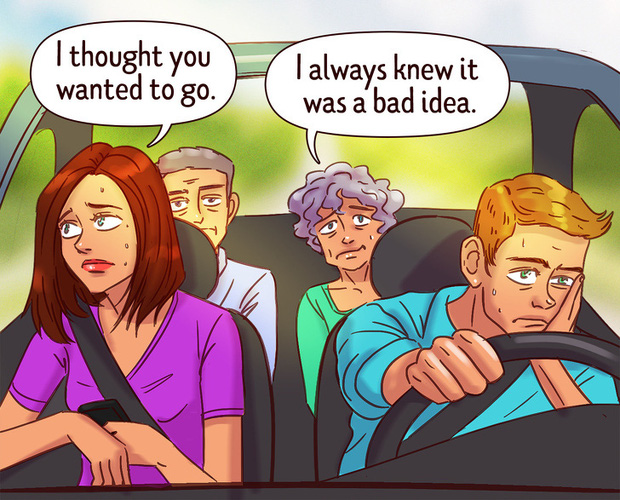
This is a social type paradox introduced by Professor Jerry B. Harvey, exemplified by a family consisting of a husband and wife, along with the wife’s parents preparing for a picnic.
The father-in-law suggests a trip to Abilene – a town about 80 kilometers from their home. The wife (his daughter) is not too interested because she thinks it’s a hot day, but she doesn’t say anything, only showing some agreement. However, she secretly thinks that no one is enthusiastic about staying home. The husband (the son-in-law) assumes that his mother-in-law wants to go. And so they decide to hit the road.
Just as the wife predicted, the trip is a disaster. The journey is too long, the weather is too hot, and the food at the café where they stop is terrible, so they decide to return after a few hours.
On the way back, the wife sarcastically comments that the idea of going to Abilene doesn’t seem great. The husband responds that he only agreed because he thought his mother-in-law wanted to go, while she hadn’t said anything. As for the father-in-law, he said he only suggested it because he saw everyone looking bored.
So, in conclusion, no one in this family actually wanted to go; why did they decide to set off? This is a true paradox as explained by Harvey. This paradox can lead us to do things contrary to our own desires.
4. Grandfather Paradox
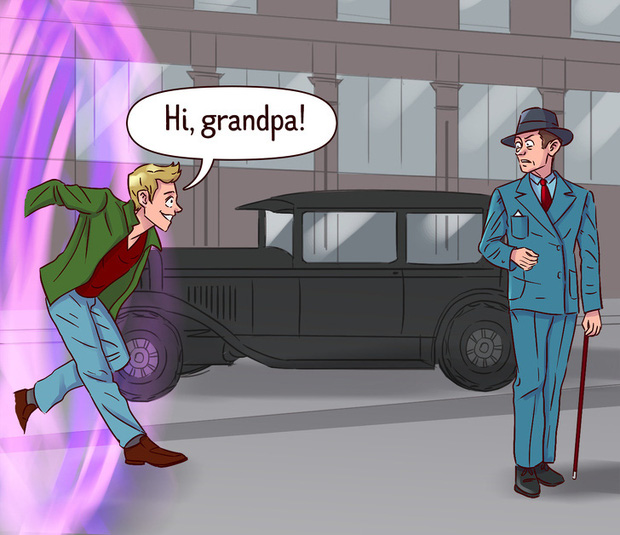
Fans of the topic of “time travel” are likely familiar with this paradox. It was introduced in 1944 by René Barjavel, a science fiction writer. The idea here is that a man (let’s call him A) travels back in time and accidentally causes his grandfather’s death.
Since his grandfather has died, he cannot marry and have A’s father, and thus A cannot be born. But if A is not born, who will go back in time to cause the tragedy? This means A’s grandfather will not die, and the story continues in an endless loop.
This is one of the time travel-related paradoxes that scientists cannot explain. Therefore, later, the theory of parallel universes (the foundation of time travel in the Marvel cinematic universe) is considered more plausible, though it still remains just a theory.
5. Twin Paradox

This is one of the paradoxes introduced by genius Albert Einstein to explain his Theory of Relativity. Accordingly, time is not an invariant quantity, but depends on the perspective and motion of the observer.
The foundation of the paradox is the story of a pair of twins. One is an astronaut traveling through galaxies at extremely high speeds. The other stays on Earth for 20 years.
As a result, the one who stayed on Earth will age faster due to the time dilation effect. The twin in space will return much younger because traveling at a high speed causes time to pass more quickly for him. This means that time is merely a relative quantity.
6. Theseus’ Ship
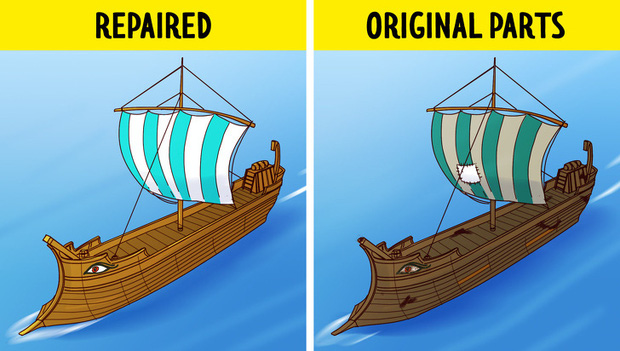
In Greek mythology, there is a tale about Theseus, who traveled from Crete to Athens on a ship with 30 oars and several young men. The ship was passed down through generations and remained in good condition because whenever it was damaged or worn, it was quickly repaired and parts were replaced.
However, this very fact raises the question among philosophers: If every part of the ship is replaced, is it truly the original? And if all the broken parts of the original ship are reassembled, which one is truly Theseus’ ship: the repaired ship or the ship reconstructed from the original pieces?
Source: BS, VT.co