


Although Windows is currently the most popular operating system among casual users, one thing is clear: the vast majority of professional systems – such as internet servers, supercomputers, and space exploration spacecraft – are all powered by Linux. Not to mention the billions of smartphones and millions of electric vehicles around the globe that also operate on this platform.
This success is not only due to the open-source nature of Linux but also because, compared to Windows, this operating system has a unique advantage that makes it suitable for professional systems: stability.
While Windows is notorious for the occasional blue screen of death that appears whenever the system encounters an unusual issue, as well as frequently needing to restart after a period of use, after an update, or even just after installing a piece of software, Linux can run continuously for days, months, or even years without needing a reboot.

What Contributes to Linux’s Unmatched Stability?
According to Melvin Menezes, a computer scientist specializing in distributed operating systems, the capability lies in the fundamental principles of Linux’s design philosophy, inherited from the UNIX operating system.
In reality, every line of code has the potential to cause errors, and there is almost no way to avoid this in the present. In other words, every operating system is susceptible to bugs. The best way to minimize this risk is to reduce the size of the operating system itself. Regardless of the programming techniques used, increasing the size of the operating system will exponentially increase the likelihood of errors occurring.
Linux – like other UNIX-based operating systems – addresses this issue by identifying the core features essential for an operating system – primarily resource management and allocation – and limiting the operating system to just those resources. This is considered the kernel of the operating system and is ensured to be as small and tight as possible.
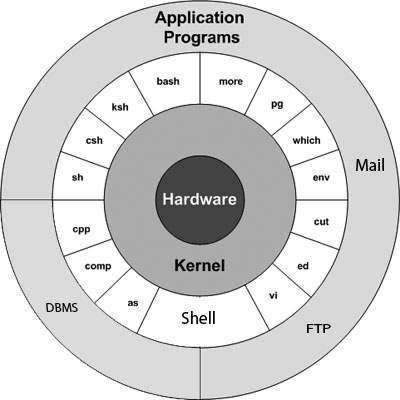
The Linux Kernel is isolated from external applications to ensure the system’s security and stability.
It has most of the essential features necessary to ensure the stability and security of the operating system. Its small size and well-defined and controlled entry points make it more stable, and breaches of these kernel-based operating systems become more difficult.
All user-related factors are kept outside the Linux kernel to some extent. Such programs send resource request calls to the Linux kernel as needed through APIs. However, the Linux kernel acts as the final arbiter for these resource allocation requests.
Windows’ Approach
In contrast, the approach to Windows has gone in a different direction. From its early days (Windows 3), there was no concept of an operating system kernel. Any user program could request resources directly down to the lowest level of the system and device APIs.
This seems to have begun changing with Windows NT under the direction of Dave Cutler, an effort towards an operating system kernel approach was introduced. However, its impact was very limited as it conflicted with Microsoft’s market approach.
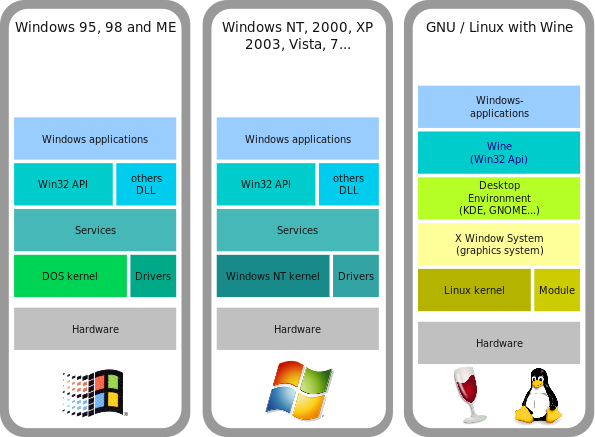
At that time, Microsoft’s goal was not only to control the operating system market but also to have as many user programs as possible.
With the kernel-based approach of the operating system, whether third-party user applications or bundled applications with the operating system, they all have equal rights to access system resources. If you don’t like the cc compiler from Unix, you can buy one or write your own. If you don’t like the basic shell of Linux, you can also use Korn Shell or Bourne Shell or anything you want. Any program you purchase or write has equal rights to access resources as the software bundled with the operating system.
Meanwhile, Microsoft wants its own programs to have an advantage over competitors, and they do this by slowly integrating user programs into the operating system kernel. This grants their proprietary programs unprecedented access to system resources – but it also brings legal troubles regarding antitrust for Microsoft.
The clearest example is the Internet Explorer browser in Windows. If it were not bundled with this operating system, it would not be able to compete with Netscape. At that time, the internet was slow and costly if you wanted to install any third-party software. Nevertheless, it was still more convenient than running to a computer store to buy installation disks. With Internet Explorer pre-installed in Windows, Netscape quickly failed in the market share battle with Microsoft. Moreover, being prioritized for system resource access also helped IE to start faster than its competitors.
However, when accused of exploiting its monopoly position to increase market share for its user programs, Microsoft could argue that it does not sell the browser to users, as Internet Explorer is “part of the operating system.” This makes Windows look like an operating system with a kernel similar to Linux.
Trading Security for Convenience
Unfortunately, this business advantage does not translate to a technical advantage. In Linux, even if you breach the browser on the machine, you still cannot penetrate the operating system kernel. But with Windows, it’s a different story.

Too many user programs are incorporated into the Windows kernel, and therefore, if any program is breached, a hacker can open a pathway directly into the heart of this operating system. An abnormal program running in Linux can still be stopped by the kernel without affecting the stability of the system. In contrast, an unstable user program in Windows will impact the entire operating system’s stability.
But to be fair, security or stability often has to trade off with usability. The same can be true when talking about Linux or Windows. Microsoft’s operating system tends to be easier to use compared to Linux. For example, with Linux, you cannot just download and run an exe executable file. On Linux, these files cannot execute without user permission, but with Windows, they can.
This is also why Linux is more suitable for professional users who know exactly what they need to do with their systems.
In other words, the lightweight kernel approach of Linux makes systems based on it more stable, particularly suited for applications for critical systems such as the internet, data centers, or even spacecraft. Its stability is further enhanced when it is built and operated by professional users who understand what they need for their systems.
Source: Quora