


Our Sun looks like a giant ball of gas that is constantly burning, but that won’t last forever; everything has its limits, and the Sun is no exception to that rule.
If the Sun’s life cycle were to end, it would surely be catastrophic for life on Earth; everything would either evolve to adapt to the darkness or face eternal extinction.
According to a study published in the journal Nature, after the end of its life cycle, the Sun will no longer shine as it does now; instead, it will transform into a massive quartz block, but this type of quartz will be entirely different from what we see every day.
Before discussing the quartz crystals at this supergiant star, we need to understand how stars like the Sun go through their life cycles.
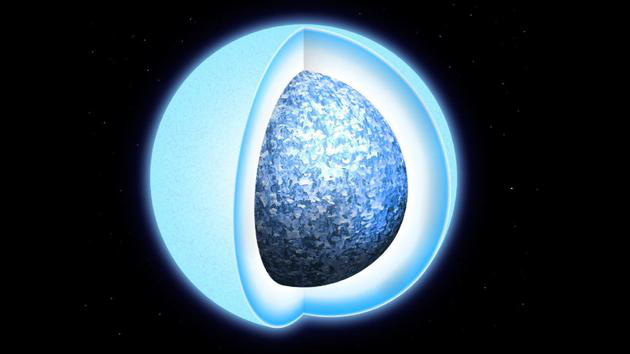
The Sun generates energy through the fusion of atoms, while its immense gravitational force compresses hydrogen atoms together, condensing them into helium atoms and releasing a vast amount of energy along with a significant amount of light and heat.
As long as there is enough hydrogen fuel to support this process, the size and temperature of the Sun’s core will remain stable (around 15 million Kelvin). The energy produced from nuclear fusion radiates throughout the solar system and ultimately has led to the evolution of life on our planet.
In the life cycle that the Sun goes through, the hydrogen-burning phase lasts about 90% of its time, and stars in this life stage are called “main-sequence stars.” Currently, this phase of the Sun has lasted for 4.5 billion years – about half of its life.
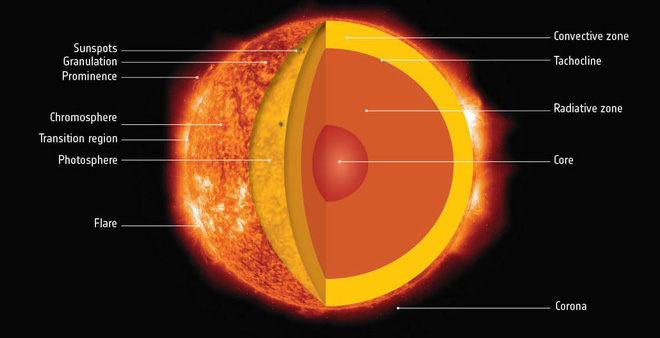
If there is no external pressure from the energy produced by hydrogen fusion, the Sun’s gravity will bear down on its core, causing the core to shrink and its temperature to increase tenfold. Heavier helium nuclei will begin to fuse, once again creating external pressure to maintain the Sun’s balance. It is predicted that this will begin to happen in about 5 billion years, marked by a sudden energy explosion known as “Helium flash.” During the helium fusion process, carbon and oxygen will form, and the core’s temperature will return to initial levels.
Soon, heavier elements will begin to fuse again, causing the Sun to change its appearance. It will start to swell, fierce solar winds will sweep through the interstellar space, and the surface layers of this planet will begin to peel away. However, the Sun’s mass is not enough for it to explode into a supernova – an astronomical event that occurs in the final stages of stellar evolution in massive stars marking their destruction. Instead, the Sun may expand beyond Earth’s orbit and engulf our planet in flames.
After that, the remaining gas in the outer layer of the star will be blown into space by the solar wind and ionized into solar plasma, forming a stunning planetary nebula. This nebula will be rich in newly formed heavier elements and will continue to be used to create the next generations of stars and planets. Once the outer layer separates, the remaining core will remain hot for 5 to 10 thousand years and is referred to as a white dwarf. This is a small star with a high density and significant mass, but it will gradually cool down and extinguish.
The white dwarf will extinguish and dim over billions of years, but this is not the end of the story. Researchers at the University of Warwick, UK, have accidentally discovered a secret hidden behind that.
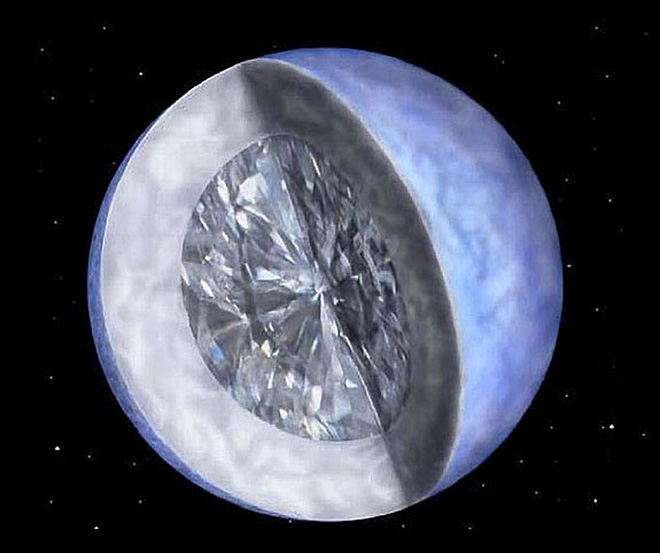
Immediately after formation, white dwarfs become very hot, radiating powerful energy from the core of the former main-sequence star. Over billions of years after formation, white dwarfs will slowly cool down, and at some point, the oxygen and carbon inside will undergo a transformation – similar to the freezing of water.
“All white dwarfs will crystallize at some point in their evolutionary process, and larger white dwarfs will undergo this process faster,” said Pierre Emmanuel, head of research and the physics department at the University of Warwick.
His team analyzed observations and measured the brightness and color of 15,000 white dwarfs located within 300 light-years of Earth, showing that there are many stars that exhibit a specific color and brightness. They realized that this group of white dwarfs represents a similar stage in stellar evolutionary processes.
The researchers also found that some of these stars have lived for over 2 billion years.
“This is the first direct evidence of crystallized white dwarfs, or the transformation from liquid to solid,” Pierre Emmanuel added.
A crystallized white dwarf is not just a star. As the material of the white dwarf crystallizes, it will be arranged at the quantum level and atomic nuclei will organize into a three-dimensional lattice, forming a metallic oxygen core and an outer layer rich in carbon.
So, after the death of stars like the Sun, their story is far from over. All white dwarfs will undergo this crystallization phase, leaving behind a lot of remnants akin to stars in the galaxy.