


One of the more interesting aspects of the rockets that SpaceX has launched into space in recent years is the deployment of a large number of Starlink satellites into orbit. These satellite constellations will provide continuous Internet coverage across the United States and potentially worldwide in the future. The Starlink satellites are responsible for connecting the Internet to users via receiving devices; namely, satellite dishes on the ground, placed at people’s homes and various other locations.
However, with the summer season and rising environmental temperatures in many areas, a significant issue has recently emerged regarding the Starlink satellite dishes. On Reddit, a user named SocietyTomorrow recently posted a screenshot of a warning message, indicating that the satellite dish had overheated and the system automatically shut down. And when it shut down, the Internet connection was lost.
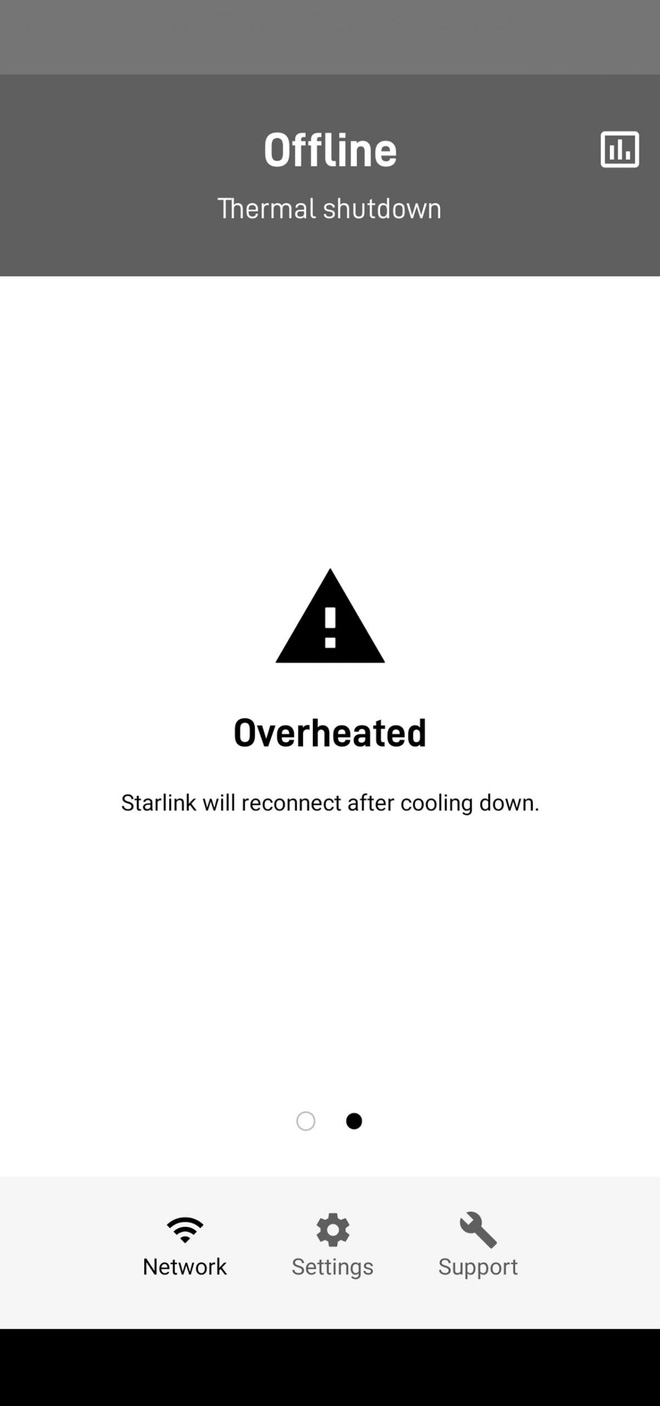
“The disconnection only started happening about a week ago, initially for a few minutes in the afternoon, but now it occurs most days, albeit for a short period of time”, this user shared. “However, the duration of the disconnection keeps increasing, in the last few days it has stopped working from around 11 AM to 7 PM. My guess is that the outdoor temperature is a major contributing factor”
This user noted that they live in Arizona, where the temperature was reported to be 112 degrees F (about 44 degrees C) at the time. SocietyTomorrow works for a small business that provides repair services for printers and electronic devices. They signed up for Starlink because it was the only service in the area with the advertised highest Internet speed of 10 Mbps. There are other wireless Internet service providers offering speeds ranging from 25-50 Mbps, but at higher prices, around 150 USD per month.
“Starlink is the clear choice, at least for the next few years”, they shared.
Another user who is also trying out the Starlink service reported experiencing similar issues with the satellite dish. This person lives in a remote area near the Grand Canyon and loses Internet connection whenever the temperature gets too high.
Interestingly, based on the system’s notification, user SocietyTomorrow mentioned they found an easy solution to handle this issue. That is to direct a water spray straight onto the satellite dish. As the water flows over it, the system cools down, and the Internet connection continues. However, it is clear that this is only a temporary fix. With many areas in the U.S. and elsewhere on Earth experiencing very high baseline temperatures throughout the summer, the system shutting down when the satellite dish overheats could be a significant problem.

So far, there has been no announcement from SpaceX regarding a fix for this issue. It is also unclear whether there could be a defect in the satellite dishes affected by heat, as some other users in high-temperature areas reported not experiencing this issue. Currently, the water cooling method is considered one of several feasible solutions.
Last November, engineer Ken Keiter posted a 55-minute video about the Starlink satellite dish on his personal YouTube channel. This technical expert told viewers that “it’s rare to see something so complex in a consumer product.” Keiter also suggested that more improvements regarding heat dissipation in the product’s design are needed before it is released to the public, as he could foresee many potential issues, from materials to design.
Starlink is currently providing 10,000 participants in the beta version with Internet speeds ranging from 50Mbps to 150Mbps. Users will have to pay 100 USD per month (plus 500 USD for hardware costs) for this next-generation broadband service, which Elon Musk claimed would be more widely commercialized before the end of 2021.
Source: Slashgear