


To make the best impression on gamers, developers often try to add as many exciting elements to the game as possible. Or sometimes, developers chase trends to “cash in” on popularity. However, this can backfire, causing the games to suffer unexpected failures.
Last time, you learned about the first 5 games that had a bit of a “bad luck”. Let’s continue to explore the top 10 games that tried too hard and ended up… “too much”!
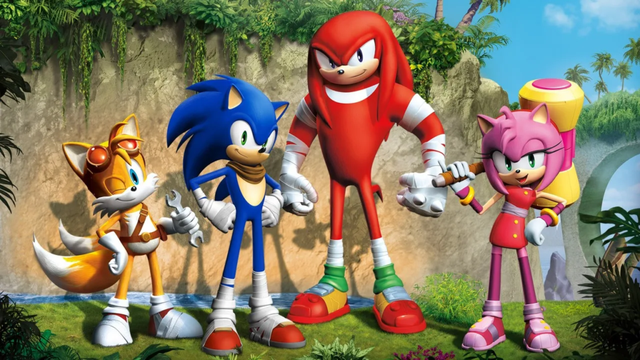
Sonic Boom – Transitioning from 2D to 3D when no gamer wanted it
Sonic Boom is a game that attempts to “forge its own path” in the legendary blue hedgehog series, instead of focusing on its inherent strengths. For some reason, Sega keeps wanting to change this game in new directions. The early 2D versions were beloved by gamers, but occasionally Sega decides to make Sonic games in new styles that no one asked for. Most Sonic games in 3D have failed, primarily because they face competition from big names like Mario, Spyro, and Crash.
Sonic Boom aimed to compete with games like Super Mario Galaxy and New Super Mario Bros on the Wii platform. But instead of focusing on fast-paced gameplay, Sonic Boom added some “offbeat” mechanics and a weapon combat system. Sonic games hardly ever needed those elements, yet Sega insists otherwise.
Star Citizen – Too greedy and trying to cram too much into the game
Star Citizen has been in development for nearly 10 years without an official release, despite having received hundreds of millions of USD in investment. There are many reasons for this, but largely due to over-promising. Star Citizen continually promises loyal gamers and newcomers that the game will have a vast amount of content to explore. From epic space battles to visiting planets and customizing your spaceship. These are just a few of the many features that Star Citizen is continuously developing to showcase to gamers.
Due to attempting to cram too many features, the game’s development time has significantly increased. Initially, the developers intended to create a stunning space ship game with gameplay spanning several years. But gradually, it turned into a campaign mode detached from the multiplayer aspect. As of the time of writing, the game is still receiving investment and has yet to set a release date. The studio developing this game should know when enough is enough and stop at the right moment to allow the game to be released in a complete form.

Call Of Duty: Infinite Warfare – Stubbornly taking gamers to outer space
Every year, a new Call of Duty game is released. And Call of Duty: Infinite Warfare is perhaps the most criticized by gamers. The reason is that fans were tired of the future setting, shooting in space, and wanted to return to ground combat. However, Call of Duty: Infinite Warfare stubbornly went against gamers’ wishes, continuing to take players to unfamiliar places in the universe.
Thus, the trailer for Infinite Warfare received a wave of dislikes from gamers. It is even considered the most disliked Call of Duty trailer ever. Clearly, the developers wanted to cram in elements related to the future setting without realizing that gamers were eager to return to traditional Call of Duty gameplay. Infinite Warfare isn’t necessarily a bad game; it just strayed too far from what gamers wanted. Additionally, the “money-grabbing” elements and pay-to-win mechanics further alienated fans from this installment.

Mario Party 9 – Changing the core gameplay mechanics
Mario Party 9 made a serious design mistake by changing what gamers loved about this legendary series just for the sake of change. Fans loved Mario Party because it resembled a board game, had a friendship-fracturing factor, and featured fun mini-games. And most importantly, the characters from the Mario series all appeared in this game. While Part 9 retained some of these elements, the core gameplay mechanics were completely replaced.
Traditionally, Mario Party allows you to roll dice to move characters on the board and compete through mini-games while collecting coins and stars. But in Part 9, instead of having characters move individually, the developers decided to have them move together through a vehicle mechanism. This change blurred the strategic nature of the game, lacking emphasis. Additionally, coins and stars were also removed. While most mini-games remained engaging, they weren’t enough to save this game, which had undergone too many changes.

Metal Gear Survive – Intentionally mixing genres to “cash in” on gamers
Metal Gear Survive was developed after Hideo Kojima – the father of the famous Metal Gear series – left Konami. Unfortunately, this game was created by Konami to extract money from gamers as quickly as possible. They exploited the Metal Gear name and took this game in a direction no one was interested in, ultimately “tarnishing” the Metal Gear brand.
Konami thought that gamers would enjoy a mix of Metal Gear, zombies, shooting, and survival, so they crammed everything into Survive. But it ended up being a hodgepodge. All the hard work Hideo had put into building the franchise was disregarded by Konami in this one version.

Konami did not understand the essence of why gamers loved the Metal Gear series, and especially why Hideo created the things he did. Instead of seeking to understand, Konami just grabbed bits and pieces here and there and stitched them together to make Metal Gear Survive. Meanwhile, there are other games that have done it much better. In fact, Konami went even further by requiring gamers to spend real money to purchase… save game slots. Thus, it is not hard to see why Metal Gear Survive failed entirely.
Source: What Culture, translated by Gearvn