


Let’s start this article with a true story from America. It was the year 1844, 32 years before Alexander Graham Bell invented the telephone, and the whole world was still using letters sent by train and horse-drawn carriage to exchange news.
Samuel Morse, an inventor, created the first telegraph system for the United States. He set up a line running along the railway connecting Baltimore to Washington, DC, over 60 km long. Morse decided to test his invention right at the National Democratic Convention.
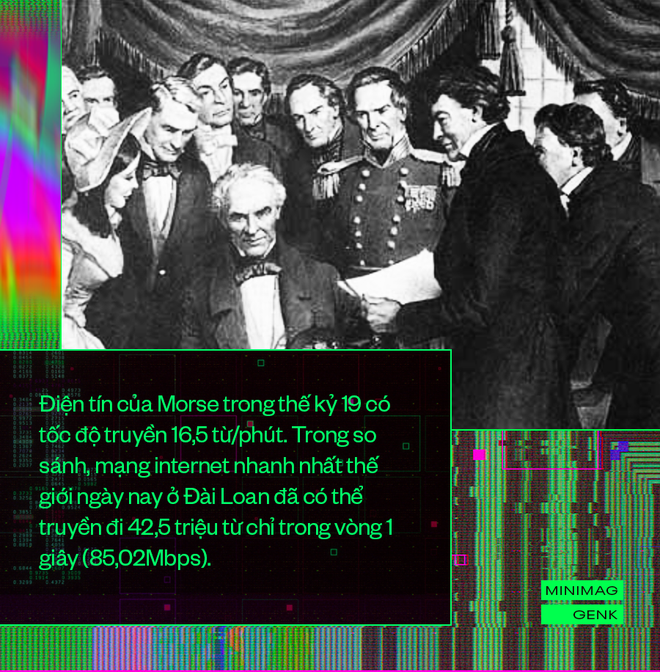
That year, the convention was held in Baltimore, and Morse himself was stationed at the Washington end of the line when he received an urgent telegram. It stated that the delegates had unanimously elected Senator Silas Wright as the candidate for Vice President. Now, they wanted to know if he was in Washington and if he agreed.
Wright asked Morse to tap out a signal on the line to decline, merely a single word: “No“. Because Morse code in the 19th century had reached a transmission speed of 16 and a half words per minute, and the electrical signals traveling along the line were at approximately 3/4 the speed of light, just a few seconds later the information reached the hall in Baltimore.
The incredible speed of the telegraph left the presiding officer of the meeting in disbelief. He decided to send a committee to the station to catch a train to Washington to confirm. A few hours later, they returned with the same answer.
From then on, the telegraph was used to exchange information directly between the two endpoints of Baltimore and Washington, DC. Soon after, it continued to change the way the world received news.
***

Nearly 80 years after Morse’s invention, the fastest internet system in the world in Taiwan can transmit 42.5 million words in just one second (85.02 Mbps), and you can ping from your home modem to the network server with a delay of only a few milliseconds.
But this also reveals a truth: No matter how fast the signal travels, once it is transmitted over a distance, latency will occur.
Even light, traveling at absolute speed from the Sun to Earth, takes over 8 minutes. The thoughts in your head right now aren’t exempt from this rule. They also have speed and latency!
Have you ever wondered how fast these numbers are? How quickly can humans think? And will we ever experience lag?

We have always thought that humans can react to the environment instantly, and thoughts will flash in the brain immediately without delay. But try this experiment: Touch your hand to a flame, and you will pull your hand back before you feel the burn.
What happened here? Shouldn’t we feel pain before pulling our hand back? In reality, the reflex to pull your hand back and the sensation of pain follow two different lengths of neural pathways. The difference in length between them creates the delay. And this is the best evidence that thoughts are transmitted at a limited speed.
Let’s talk about reflexes first. A reflex is an automatic (unintentional) and quick response to stimuli, aimed at minimizing damage to the organism in the face of potential dangers. It is an embedded code of evolution in the body that helps you maintain your existence.
Imagine the fate of an antelope if it did not immediately run when it spotted a lion. Your hand would be burned if you did not pull it away from the fire, and if you do not have the ability to quickly react to avoid a car speeding onto the sidewalk, you could even lose your life.
Now, the most interesting thing scientists have discovered is that the neural pathways of reflexes might not need to go through your brain. It starts from the sensory nerve endings, goes through the relay neurons in the spinal cord, and then turns to the motor neurons in the muscles.
For example, with the phenomenon of a fire burn described below:
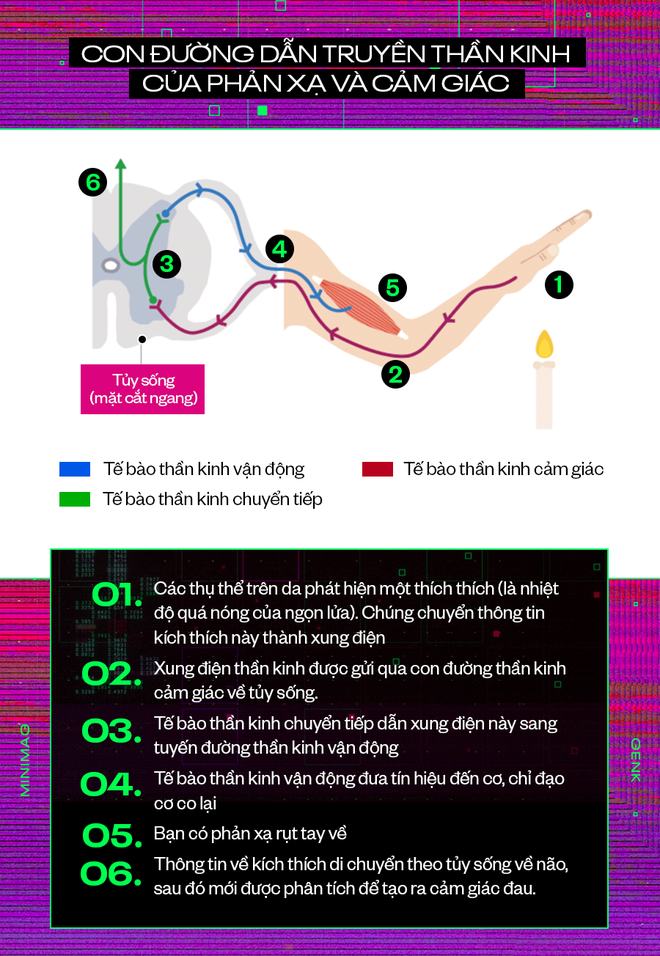
So why does the sensation of pain come after you pull your hand back? Because it is transmitted through a longer neural pathway from the arm to the brain, along with the delay that the brain takes to analyze those signals, which we will discuss later.
But essentially, the speed of the nerve impulses transmitted in both pathways is equivalent, as they are all electrical impulses transmitted from one neuron to another. The nerve cells in the body connect with one another through axons and dendrites. Together they form a neural pathway similar to the telegraph line that Samuel Morse established.
Therefore, the speed of nerve transmission can be calculated using the same simple formula: v=d/t or speed equals distance divided by time. We have a distance from the fingertip to the spinal cord and back to the arm muscles of about 1 meter. The reaction time with the flame is about 15-30 milliseconds.
Therefore, the speed of the nerve signal v can be calculated at approximately 33-66 m/s, which translates to 120-240 km/h.
Sophisticated experiments with neurons in the laboratory have also confirmed that the average speed of nerve impulse transmission from one neuron to another is 180km/h. Thus, we can consider that as the average speed of a thought.
But average speed means that some people think more slowly, such as when we age with a deteriorating telegraph system in the body. Conversely, some people think faster, with a wider bandwidth.
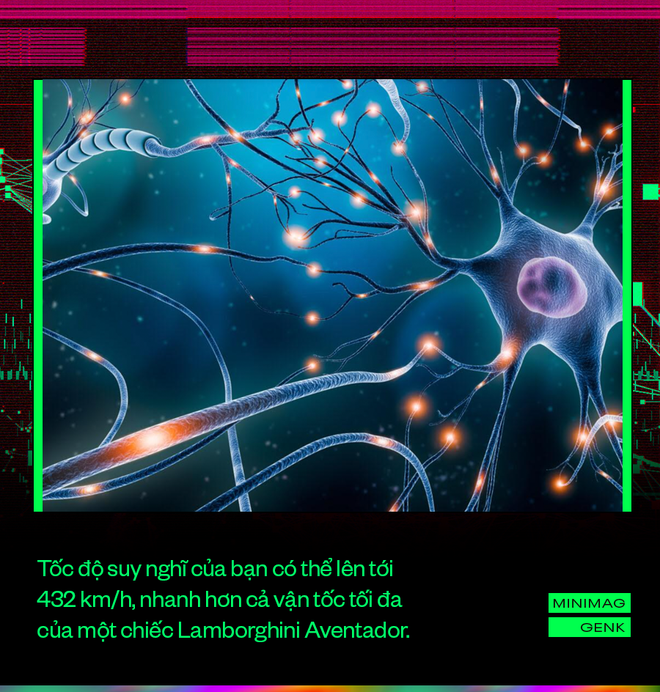
In fact, researchers point out that those with neurons that have larger axons can transmit signals faster since resistance decreases as the cross-sectional area of the conductor increases.
And those with thicker myelin sheaths—the fat surrounding the nerve axon—can also reduce the loss during nerve impulse transmission, allowing them to have even faster reflexes and thoughts.
The nerve impulse speed of these individuals can reach up to 432 km/h. Think of Bruce Lee’s punch or athletes on the starting line ready to hear the gunshot.

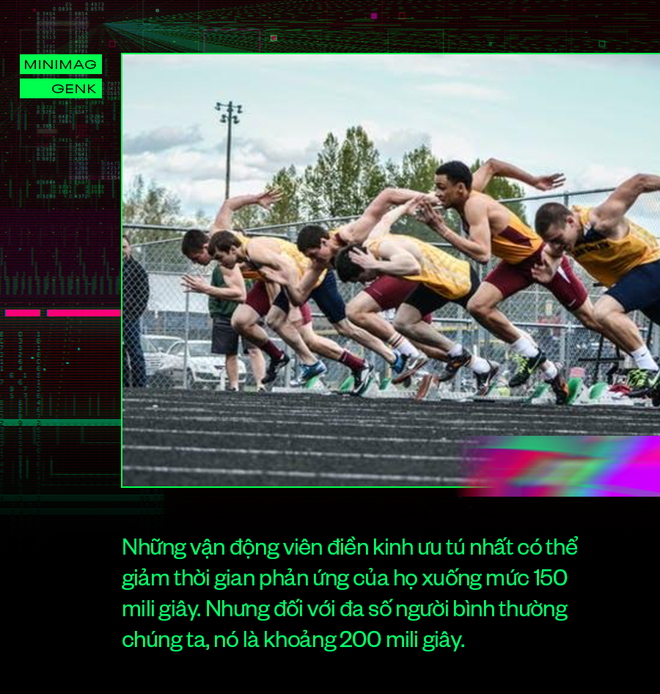
Now, you know that the thoughts in you can sometimes run faster than a Lamborghini Aventador, but the truth is that doesn’t free us from lag. The fastest reflex athlete still takes 150 milliseconds to start after hearing the gunshot, and most of us take longer, about 200 milliseconds.
Although you might think you have started immediately after the gunshot, 200 milliseconds may seem insignificant to you. But it is actually enough time for the nerve signals to make over 10 laps from your ear, through your brain, to the muscles in your thigh. You should have started at around 20 milliseconds, but ultimately the signals got bogged down somewhere.
Science calls this delay “reaction time“. It is calculated by the delay from the moment the stimulus signal appears until you take action in response to that signal. To understand reaction time, nothing is more interesting than going back to the classic trick of dropping a coin:

The rule is that I will place this coin between your fingers. When I drop it, if you catch it, the coin will belong to you. If you don’t catch it, you lose nothing. Sounds easy, right? But trust me, you won’t win this game.
Try it with someone before we go back to the numbers and calculations.
Unlike pulling your hand back from fire, which is an unconditional reflex, your visual reflex to the coin in this game, or the auditory reflex of athletes to the starting gun, are all conditioned responses.
We set the rules of the game and learned these conditioned reflexes. The neural pathways for these reflexes thus must loop back to the brain for processing and analysis instead of going directly through the relay nerves to the motor nerves.
For example, in the case of vision, the light wave signal travels from the coin to the sensory nerve cells in your retina. They convert the light wave into electrical nerve signals and send them to the processing area in the visual cortex.
The starting gun causes air molecule vibrations, which impact the eardrum, and the frequency of the eardrum’s vibrations is also converted into electrical nerve signals in your inner ear. Then the signal is sent back to the auditory cortex for processing.
The process of signal processing in these cortical areas takes time and creates delay. But this delay is necessary to help you build an internal world, allowing your brain to understand what is happening outside that you are facing.
In many cases, this processing is very complex and takes a long time, such as when you are looking at a painting at an exhibition. Each person can understand and feel that painting in different ways, depending on their signal processing in the cortex.
But for simpler signals like the coin and the gunshot, we all understand what we need to do. Therefore, after processing, the signals will be transmitted down to the motor nerves in the fingers or legs. And then you will have the reflex to catch the coin or jump out of the starting line.
The issue, as mentioned, is that the processing time of the cortical signals is never less than 150 milliseconds for elite athletes and around 200 milliseconds on average for regular individuals. If you don’t believe it, you can check your reaction time on this website.
Now, back to the coin, during 200 milliseconds, with gravitational acceleration of 9.8 m/s2, it can fall a distance of about 19.6 cm and slip out of your hand. So unless you get a coin longer than 20 cm, you have no chance of winning this game. By the way, the length of a 500,000 VND bill is only 14 cm.

Look at the crumpled head of this old van, one of the most shared photos on social media last week. The female driver was learning to drive with her instructor, and both were fortunate to only suffer minor injuries after colliding with a sand truck.
But their comically tragic situation immediately became a meme online, leading to a series of topics: from women driving to the finicky nature and the fate of driving instructors.

There is a reality that needs to be mentioned: Research has shown that women have a slower reaction time to the car brake pedal compared to men.
The difference may be negligible, only about 30 milliseconds. But if travelling at 60 km/h and aware of a dangerous situation, a female driver who slams on the brakes will still have a stopping distance 0.5 meters longer than that of a male driver. Sometimes, this half a meter can put their lives in danger.
Countless studies have linked reaction time to the risk of traffic accidents. Accordingly, up to 57% of car accidents occur due to the driver’s own fault. When combined with other external factors, human error accounts for up to 90% of total accidents.
Theoretically, the ideal reaction time for a driver should be 0.2 seconds. However, real-world tests show that they are often much longer, ranging from 0.78 to 2.5 seconds.
Many studies have demonstrated that several factors can extend this reaction time: from fatigue, drowsiness, alcohol consumption to stress, and even an instructor who is lecturing you on how to drive.
Indeed, in reality, you can hardly create a reflex while thinking at the same time. In fact, thinking can distract and increase your reaction time, putting you at risk of traffic accidents.
Yogi Berra, a legendary American baseball player, once shouted at his coach directing him before a hit: “How the hell can you think and hit at the same time?”
In this context, the average speed of a baseball after a pitch is 120 km/h, and it can reach nearly 170 km/h.
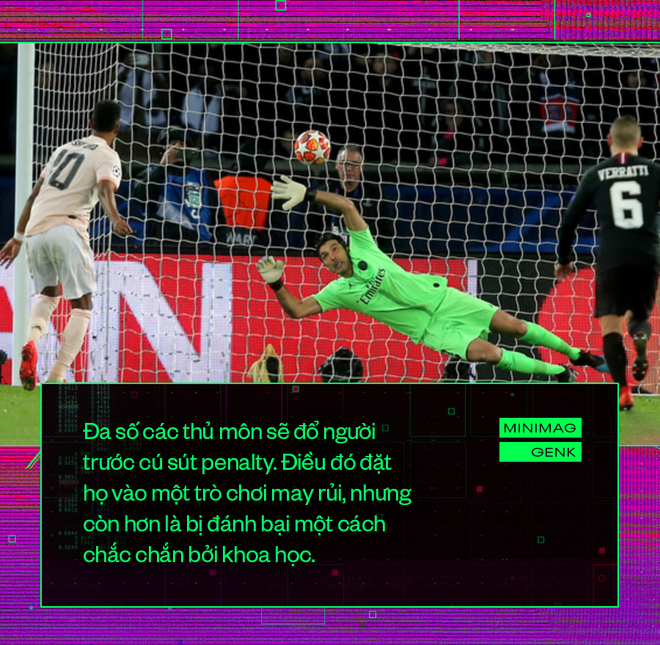
The speed of a penalty kick can also reach up to 128 km/h. Do some calculations and it will tell you why the 11-meter mark is always more of a game of chance than technique.
With an average speed of 112 km/h, a penalty kick can cross the goal line in about 350 milliseconds. The fastest goalkeeper also takes 150 milliseconds to recognize the direction of the ball, and by that time, the ball is just over 6 meters away from him.
The motion of diving takes an additional 350 – 550 milliseconds. So the ball would be in the net if the striker’s shot is accurate. Therefore, you will see that most goalkeepers have to dive before a penalty kick, which puts them in a game of chance, but it’s better than being defeated 100% by science.
Therefore, understanding reflexes, the speed of thought, and brain latency is not entirely irrelevant and meaningless knowledge for our lives. Let’s be thankful for the unconditional reflexes that protect your body, and be aware of brain latency to prepare for emergency situations.
Once again, you can try to measure your reaction time at this website: https://humanbenchmark.com/tests/reactiontime. Let’s see if you possess a quicker thought speed than average.