


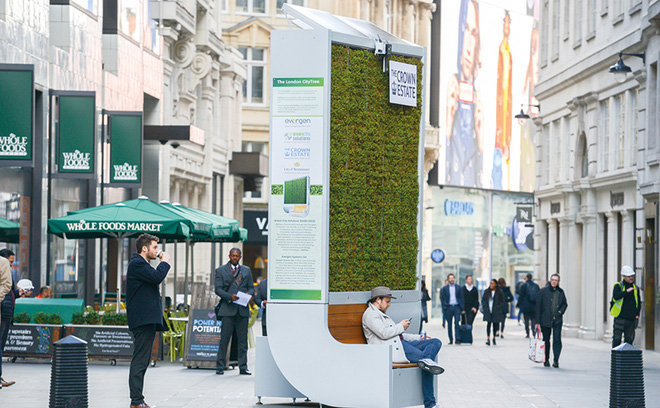
Imagine a long bench in the city that not only provides you a place to sit and rest but also helps you breathe a little easier? That’s the idea behind Green City Solution, a German urban green solutions company installing a series of bio-air purifying benches that stand over 4.2 meters tall in major cities across Asia and Europe.
These purifiers don’t require expensive industrial HEPA filters, yet they can still remove up to 82% of fine dust from the air. The secret of Green City Solution is moss, a natural dust filter that doesn’t use electricity and operates entirely on water, soil, and sunlight.
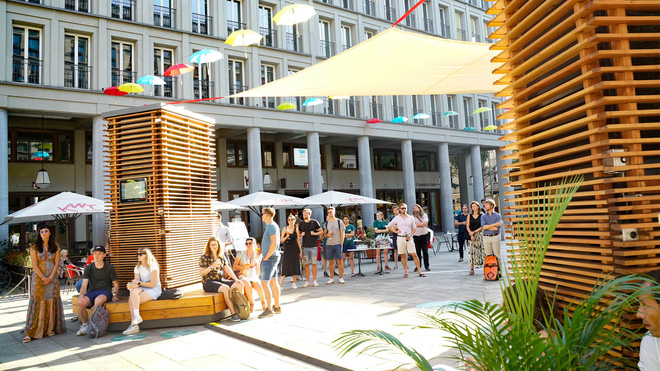
These massive air purifiers are named CityTree. It is an intellectual product of Peter Sänger, a 29-year-old gardener from Dresden, Federal Republic of Germany. After traveling across cities in Europe, he became captivated by the topic of addressing air pollution within urban areas.
“Cities are the living spaces of the future, and they will bring many benefits to humanity. Unfortunately, the air inside cities is not clean,” said Sänger.
According to the World Health Organization, air pollution kills about 7 million people worldwide each year. In places where air quality levels exceed WHO limits, fine dust particles can penetrate deep into the lungs and cardiovascular system, posing numerous risks from strokes to heart disease and lung cancer.
Today, 91% of the global population lives in such areas.
Bringing Nature into Cities
Coming from a gardening background and studying crop production and business management at the University of Dresden in Germany, Sänger spent many years researching agricultural products aimed at mitigating air pollution.
“I discovered that air pollution solutions can only arise if we combine them with nature,” said Sänger. Humans can create industrial HEPA filters from steel leaves, which can be ground down to a few hair strands, but the process is time-consuming, energy-intensive, meaning CO2 emissions and costly.
Nature, after all, is the best air filter, and moss has millions of years of experience purifying the air on Earth, Sänger said. And so, he wanted to develop a product using moss for polluted cities.
But everything took off after Sänger met Liang Wu, a student running a workshop on urban design and environmental issues. “We shared the desire to develop an economic and ecological solution to this problem,” he said.
In 2014, before graduating, the two friends gathered a team of experts in gardening, computer science, architecture, and mechanical engineering to establish Green City Solution.
The company currently has 35 employees working to tackle a simple yet challenging question: How can we effectively and aesthetically bring nature into cities, using nature to create positive impacts on the atmosphere on a large scale?
A Breathable Oasis
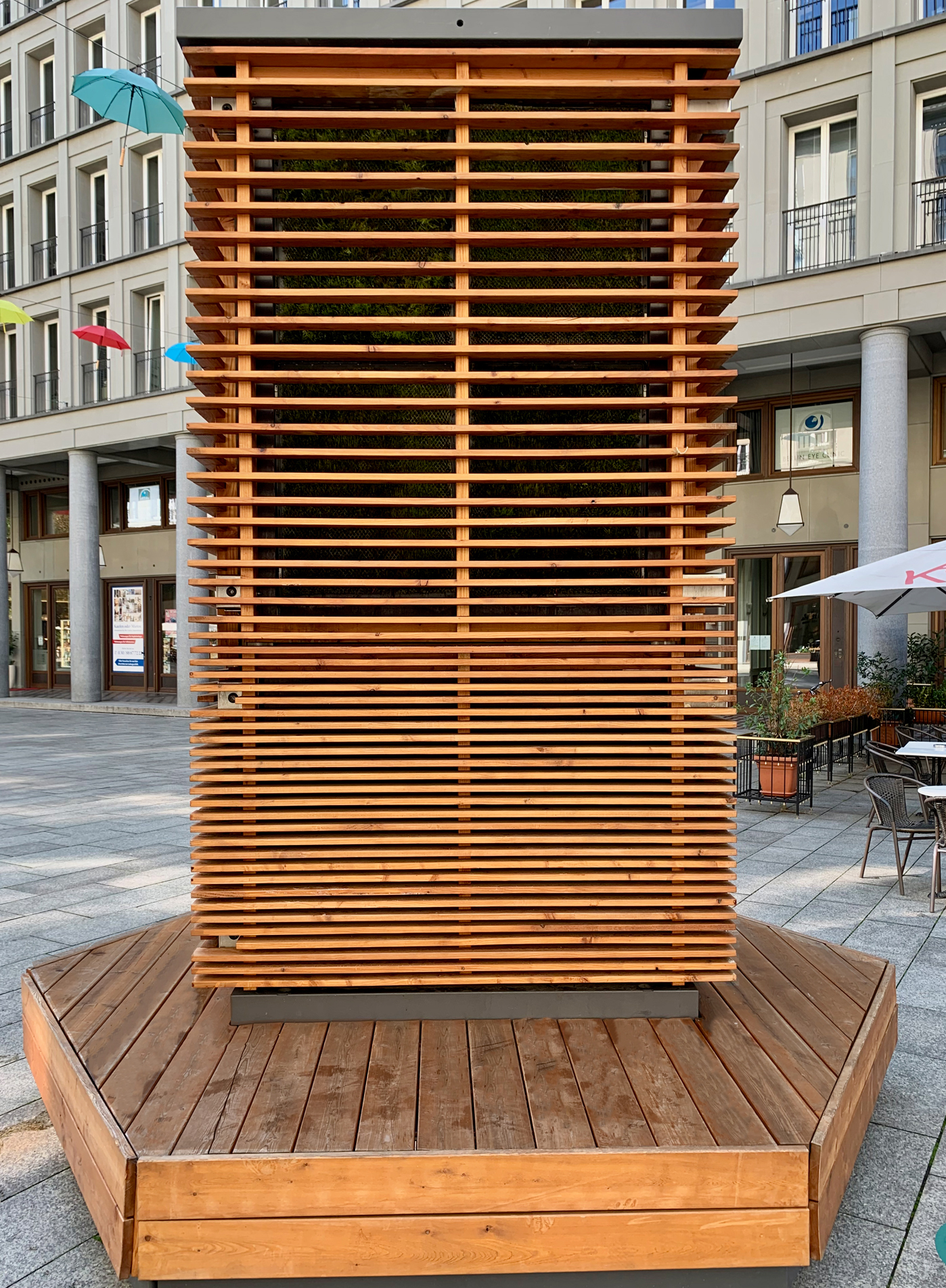
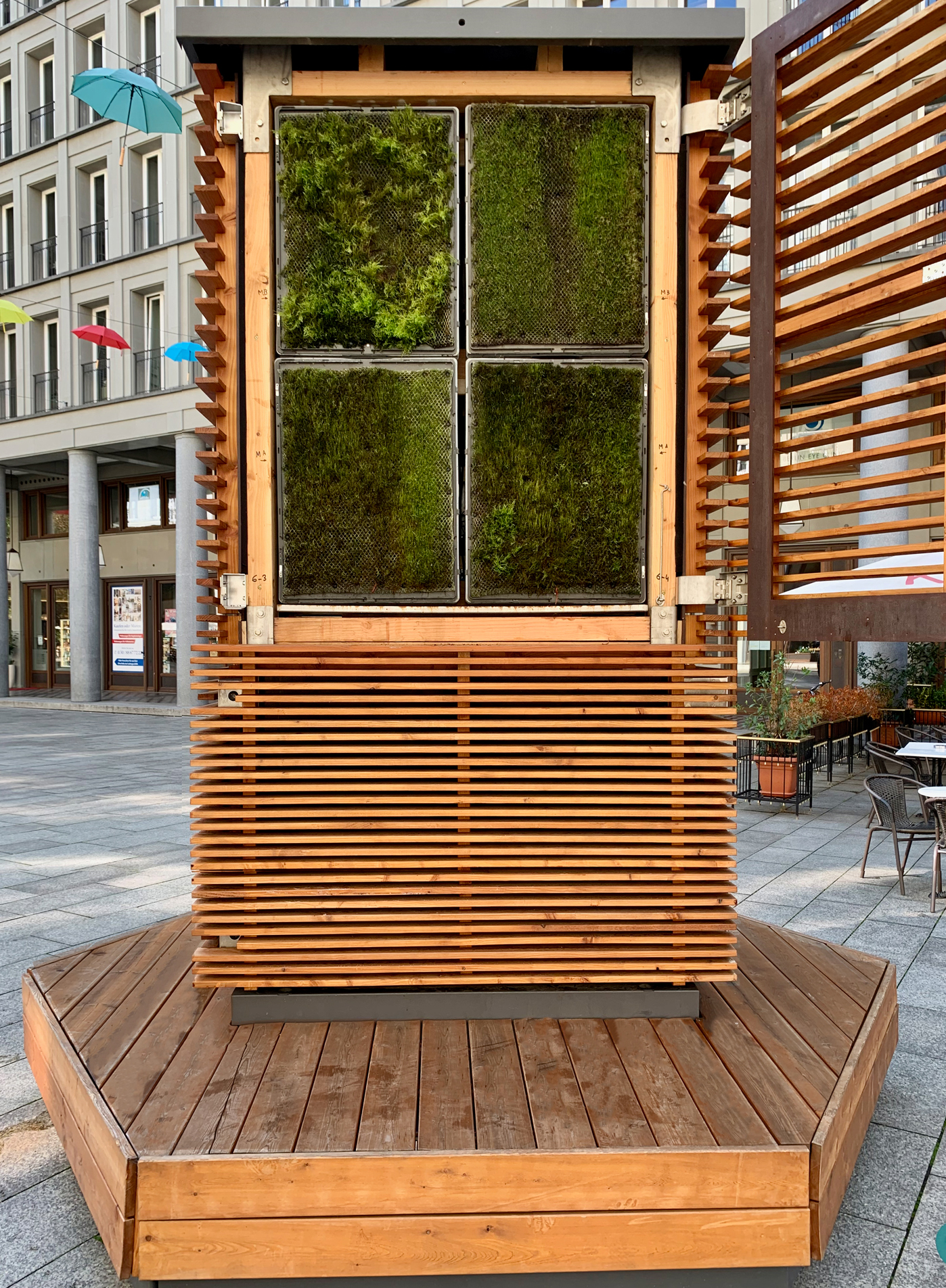
As you may have seen, the solution that Sänger and Liang Wu created is the CityTree systems, capable of filtering the air for 7,000 people per hour. It’s not just a bench, a tower covered in moss but also a decorative structure integrating modern IoT technology.
Inside these CityTree towers, there is also a fully automated irrigation system controlled by sensors that provides optimal moisture for the moss. The installed IoT software provides continuous feedback on performance and air conditions, as well as environmental data of the surrounding area.
According to Green City Solutions, CityTree can improve air quality by 53% within a 1-meter radius, making those sitting around it feel extremely comfortable. The amount of fine dust passing through the moss leaves can be retained up to 82%.
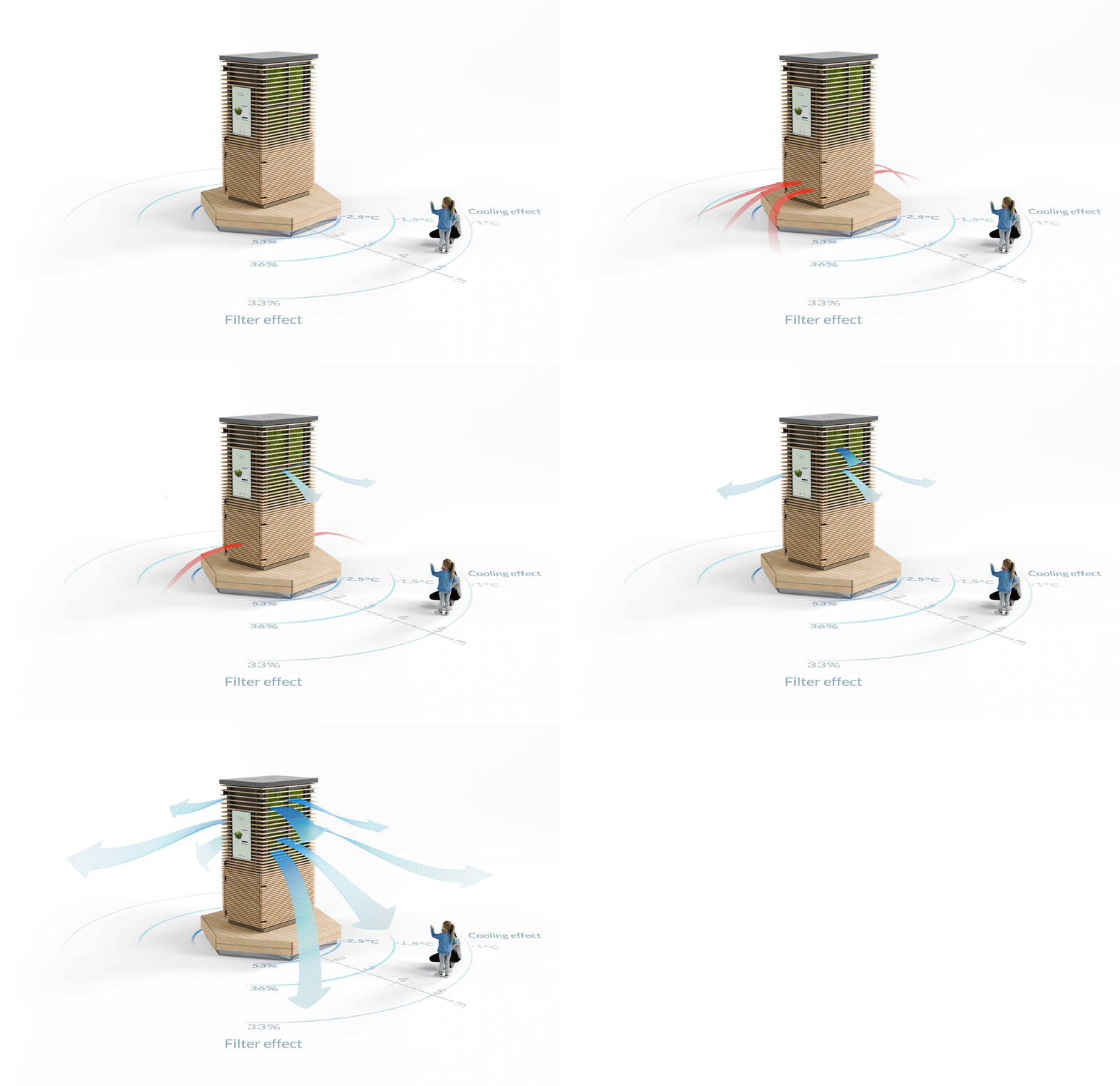
The moist moss leaves create a dust-absorbing surface through static electricity, the moss surface carries a negative charge that attracts positively charged dust particles, similar to the mechanism of HEPA filters. After the moss tower retains the dust, 50% will become food for its own growth, 25% will be decomposed by bacteria, and 25% will become sediment that exists with the moss and can be removed.
Additionally, the CityTree moss towers can cool the air down by 4 degrees Celsius due to the evaporation of water and the presence of vegetation inside it. Sänger admits that this device cannot replace greenery in cooling the entire city, but it can certainly provide an oasis that allows people sitting around to feel comfortable, breathe, relax, and linger.
“Think of a bus stop on a busy street, a street café, a square, an inner-city courtyard, even a company campus,” he said. Sänger has now deployed his product in many such locations within cities across Europe and Asia, including London, Paris, Amsterdam, Berlin, Hong Kong, and Cork, Ireland.
An Ambitious Plan

For Sänger and his team at Green City Solutions, the CityTree moss towers are just the beginning. The company is experimenting with WallBreeze, a modular moss wall that can be installed on the exterior walls of buildings. Using similar technology and filtering systems as CityTree, WallBreeze can provide higher air filtering efficiency over a wider radius where it is installed.
Additionally, the company also intends to improve CityTree into a slimmer version, to turn it into a digital advertising board in urban spaces.
Overall, Sänger says the goal of Green City Solution is to install up to 1,000,000 square meters of moss by 2030, integrating this natural air filter into every possible urban space. With this area, Green City Solution could help clean the air for 500 million people and eliminate up to 80,000 tons of CO2.
Source: Business Insider