


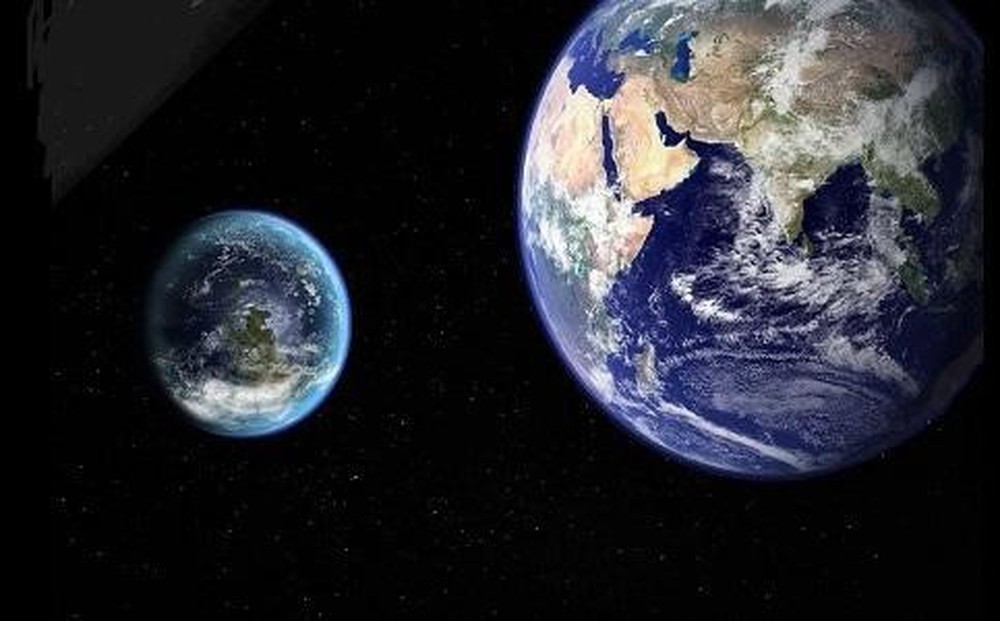
Searching for Another Earth
The Kepler space telescope has made incredibly exciting discoveries in astronomy. Launched in 2009, this telescope observed 13 million stars until it ceased operations in 2018.
During that time, Kepler discovered over 2,600 planets orbiting other stars. Among these, one was completely unlike anything in our Solar System, forcing astronomers to create two new classifications for planetary systems.
Kepler found one or two cases of planets located in the habitable zone of their parent stars, although this region is around red dwarf stars, unlike our Sun.
This is particularly interesting because this temperate climate zone, where water can exist in liquid form, has conditions believed to be crucial for the existence of life.
But despite all this, Kepler ultimately failed. Its mission was to find another Earth, or in other words, an Earth-like planet orbiting a Sun-like star. However, after nearly a decade of observations, Kepler did not find a single Earth 2.0.
This is partly because Sun-like stars turned out to be more variable than expected, requiring longer observation times. But also because in 2013, two of the four reaction wheels of the telescope malfunctioned, making long-term observations impossible. As a result, astronomers have yet to find another Earth out there.
Scanning the Skies
This could now change, thanks to a Chinese mission called Earth 2.0 set to launch in 2026. This mission will scan the skies for Earth-like planets around Sun-like stars, with instruments designed to deal with the stellar variability that Kepler inadvertently discovered.
The research team includes about 300 scientists and engineers from over 40 organizations, mostly in China. And this week, the team published detailed descriptions of the mission on arXiv.
One challenge for any space telescope is to cover the widest possible observation field while minimizing the cost and mass of the spacecraft. The Chinese research team addressed this issue by not using just one expensive and heavy telescope.
Instead, the spacecraft will carry six smaller telescopes, each 30cm in size, observing a similar area of the sky as Kepler (the mirror of Kepler has a diameter of 1.4m). These telescopes will observe special changes in the brightness of stars when a planet transits in front of them.
The spacecraft will also carry a seventh telescope designed to search for microlensing events, where the gravitational field of a star focuses light from a distant star behind it, causing it to temporarily brighten.
By monitoring the brightness variations, astronomers can determine whether that star has any planets orbiting it. This seventh device may also detect free-floating planets, shedding light on the strange, solitary objects.
Enormous Data Volume
The Chinese research team plans to send Earth 2.0 to the Lagrange Point L2, one of the regions of space that balances the gravitational forces of the Earth and the Moon, and is far from areas where Earth could cause interference.
L2 is a popular choice for telescopes and is home to several past and current instruments, such as the Herschel Space Telescope and the James Webb Space Telescope. The Earth 2.0 spacecraft will stay at L2 for four years, sending back about 169 GB of data each day.
This increases the potential for exciting discoveries. “Simulations suggest that this survey mission could discover about 20,000 new planets, including about 4,900 Earth-sized planets,” the research team stated. This means the mission could find between 10 to 20 Earth 2.0s by 2030.
The discovery of the first Earth 2.0 could mark a significant moment in the history of astronomy. It generates immense interest in the nature of these planets, the composition of their atmospheres, and the potential for liquid water.
Following this will be the search for biosignatures suggesting the existence of life, such as molecules like methane and oxygen, and the light absorption characteristics of the photosynthesis process. Further on, the search will be for technological structures that might indicate the presence of a civilization, such as industrial pollutants containing chlorofluorocarbons (CFCs) and even narrowband radio transmissions.
Of course, Earth 2.0 is not the only mission capable of discovering another Earth out there. Others, such as the ESA’s Plato mission, are also set to launch in 2026. But they will have to be luckier than Earth 2.0 to succeed.
This will create a race among nations to find another Earth and usher in a new era in the study of potentially habitable planets.