


A lake, dense forests, mist, and white snow in the Kola Peninsula make this hidden corner of Russia appear as picturesque as a painting. But amid this idyllic scenery, a deserted scientific research facility, dating back to the Soviet era, stands alone. Among the ruins is a rusted cap, tightly sealed to the cold concrete floor, and around the mouth of the cap are a series of rivets that have also turned brown with age.
Some people call this the road to hell.
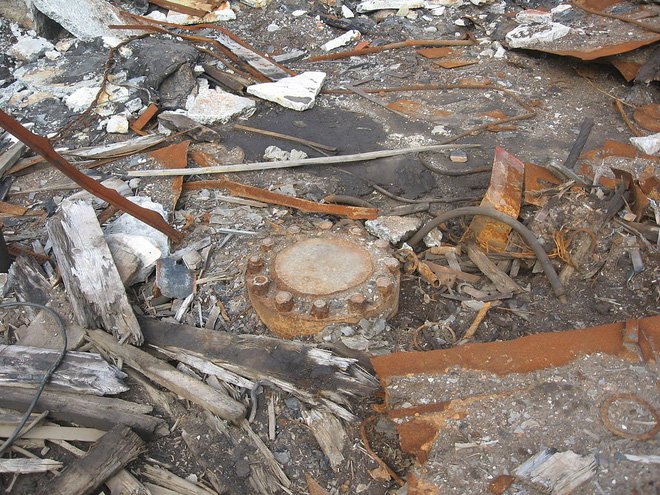
The cap of the 12km deep hole drilled by Russian engineers and scientists.
The words above describe the Kola Superdeep Borehole, the deepest artificial hole in the world. With a depth of up to 12.2 km, local people still whisper that the screams of tortured souls in fiery hell echo back through the pipes, resonating in the cold air. Soviet scientists took 20 years to drill that deep, but they only reached ⅓ of the Earth’s crust (and still need another 6,300 km to reach the core) before the project was indefinitely postponed.
The Soviet Union’s deep borehole is not the only “gateway to hell.” During the Cold War, superpowers raced to find the deepest route possible, trying to reach the mantle layer located 2,900 km below.
This ambition to go deeper has not stopped; the Japanese also want to drill deep to see exactly what lies beneath those depths.
“It was during the time of the Iron Curtain that drilling began. Obviously, there was competition among research groups. The unwillingness of Russian scientists to share all the information they gathered was one of the biggest motivations for us to carry out the project ourselves,” Uli Harms from the International Continental Scientific Drilling Program, who also worked on a German drilling project aimed at surpassing the Kola drilling project, recounted.
“When the Russians started behaving, they declared that they had found water – most contemporary scientists did not believe it. At that time, Western scientists still believed that the Earth’s crust at a depth of 5 km was dense enough that water could not permeate it.”
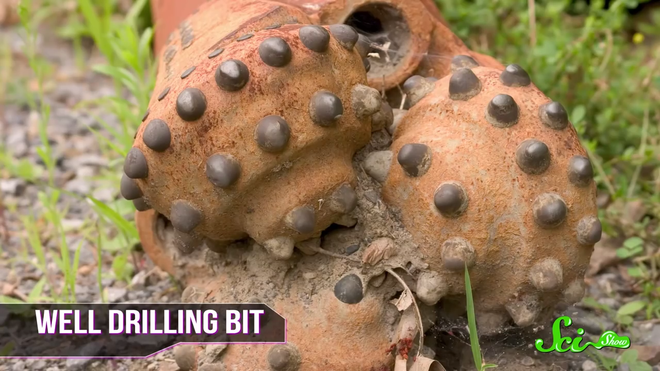
The drill bit used by the Russians.
Sean Toczko, project manager at the Japan Agency for Marine-Earth Science and Technology, talked about the new project: “Our ultimate goal is to obtain a sample of the mantle layer at the present time. In regions like Oman, for instance, you can see the mantle layer very close to the Earth’s surface, but those are mantle layers that date back millions of years. It can be compared to the differences between a living dinosaur and fossilized dinosaur bones.”
Just like the efforts to reach space, the race to the depths of the Earth, searching for the limits of an artificial borehole, is also a display of a nation’s technical prowess. Scientists hope to metaphorically set foot in uninhabited places; the rock samples taken from deep underground are as valuable as any extraterrestrial stone brought back by NASA.
But in this race, the U.S. is not the leading country. In fact, no country has won the ultimate victory.
America does not sit idly by while other countries surpass it. In the late 1950s, the American Mixed Community announced the idea of drilling down to the mantle layer. With some of the brightest scientific minds in the U.S. at the helm, the community initiated the Mohole project, named after the “Mohorovičić discontinuity” (Moho) – the boundary between the Earth’s crust and mantle, defined by Croatian geologist Andrija Mohorovičić.
They did not intend to drill a deep hole in a reasonable piece of land but decided to take a shortcut, seeking the ocean floor off the coast of Guadalupe Island, Mexico. Beneath the deep water, the Earth’s crust would be much thinner than on land; however, the deep water itself posed a significant obstacle: where was the point at which the Earth’s crust was thinnest? That would be the deepest point of the ocean.
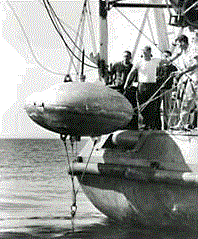
One of six dynamic positioning buoys that allow the ship to remain stable on the water’s surface during drilling operations.
The race into the depths has seen a series of powers involved. Since 1970, researchers from the Soviet Union have been drilling in the Arctic Circle. By 1990, Germany’s Continental Deep Drilling Program (KTB) was initiated in Bavaria, reaching a depth of 9 km. Just like the Moon missions, scientists had to find ways to invent new technologies to achieve the unthinkable.
In 1961, when the Mohole project began drilling the ocean floor, drilling tools for oil and gas offshore and deep-sea were still underdeveloped. At that time, no one had yet thought of essential technologies like dynamic positioning – allowing the ship to remain stationary over the well. Engineers had to improvise: they installed a system of thrusters along the sides of the ship to keep it afloat and balanced on the ocean surface.
One of the greatest challenges for German scientists was to drill the hole as straight as possible. The solution they came up with at that time became the standard technology for all oil and gas drilling rigs worldwide.
“Learning from the Russian experiments, it was clear that we had to drill as straight as possible; if the torque of the drill bit increased, there would be sections that constricted within the borehole,” researcher Uli Harms said. “The solution we devised was a vertical drilling system. Currently, it has become the industry standard, but when developed for the KTB system, they could only drill down to 7.5 km. At about 1.5 to 2 km towards the end, the borehole deviated from vertical by about 200 meters.”
“We tried to take advantage of Russian technology from the late 1980s and early 1990s, when they were willing to cooperate with the West. Unfortunately, we could not receive technology transfers from them in time,” Harms added.
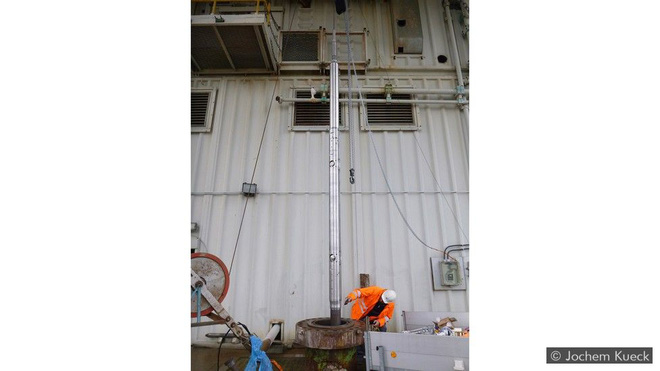
Germany’s drilling project.
Most of these drilling projects ended up in failure: some started and never finished, others encountered too many obstacles in execution, high temperatures in deep underground, and rising costs that made the dream of reaching the Earth’s depths remain just a dream. Two years before Neil Armstrong set foot on the Moon, the U.S. Congress canceled the Mohole project when maintenance costs hit the ceiling; drilling just a few more meters would cost up to 40 million USD (adjusted for current exchange rates).
The fate of the Kola Superdeep Borehole was not much better. Deep drilling had to stop in 1992, when the temperature at the drill bit reached 180 degrees Celsius, double what was anticipated, preventing researchers from drilling further. When the Soviet Union dissolved, funding for the project disappeared, and just three years later, the research area was closed indefinitely. Now, the remnants of this center have become a place for curious tourists to visit.
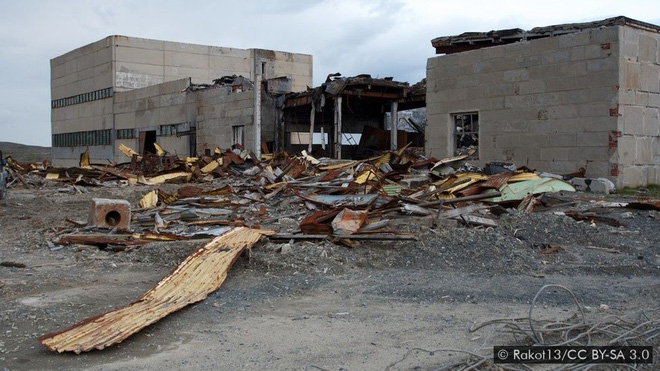
The German drilling hole had a slightly better fate. The colossal rig is still there, still attracting tourists. It has become an observatory for scientists looking into the Earth’s depths and an art gallery for visitors to enjoy.
When Dutch artist Lotte Geevan lowered a sound-recording microphone insulated in a casing into the deep hole, she heard inexplicable rumblings that science could not explain. The strange sounds made her feel “insignificant”; it was the first time in her life that she heard the colossal sphere, the home of humanity, emit sounds indicating that it was alive, and those sounds were haunting. Some attribute it to the echoes of hell, while others poetically call it the breathing of Mother Earth.
“The initial plan was to try to drill deeper than the Russian research, but we haven’t reached the allowed limit of 10 km within the time we have,” researcher Harms said. “Not to mention that the depth we reached was hotter than the Russian record. Clearly, the deeper we go, the harder drilling becomes.”
Although this project only involves drilling a hole as deep as possible, scientists still refer to it as an expedition. Considering the preparation process and the work to be done, along with reaching a place that has never been explored, it is certain that there will be things down there that will surprise scientists.
“These missions are also similar to exploring a planet. It is all purely scientific, and no one knows what the expedition will find,” said geochemist professor Damon Teagle, who works at the University of Southampton and is directly involved in the deep drilling project being undertaken by the Japanese.
“At Hole 1256, we were the first to witness the intact oceanic crust. It’s incredibly exciting. There are always surprises lurking beneath the surface.”
Today, the “M2M” project – short for “from Mohole to Mantle” is one of the most important projects conducted by the Integrated Ocean Drilling Program (IODP). Just like the old Mohole project, scientists aim to drill deep into the ocean floor, where the Earth’s crust is only 6 km thick. The goal of this 1 billion USD mission: for the first time in human history, obtain mantle rock samples for research.
This project is significant, and the drilling ship named Chikyū has been under assembly for 20 years. Chikyū utilizes modern GPS systems and 6 jet engines, controlled by computers, that can adjust the ship’s position accurately to within centimeters.
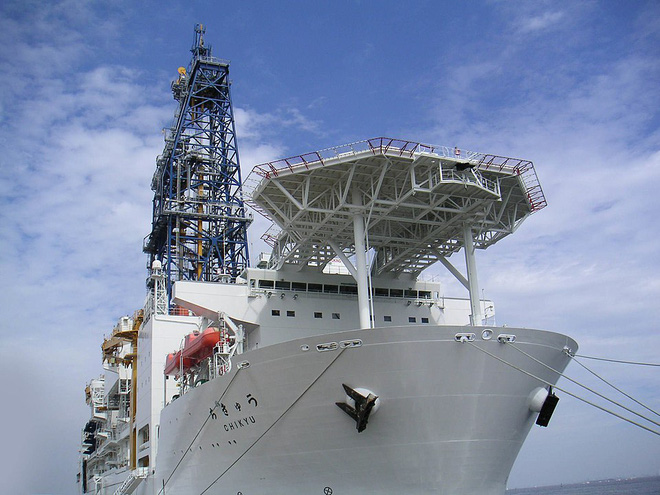
The Chikyū ship.
Sean Toczko, the project leader, said: “Our intention is for this ship to continue the work that the Mohole project initiated 50 years ago. The deep borehole gives us a lot of information about the continental crust. There are three potential locations: off the coast of Costa Rica, off Baja, and off Hawaii.”
Each of these research areas must confront the depth of the ocean, the distance from the drilling site to the shore, and a control center that has the potential to manage the operations of the billion-dollar project floating on the ocean surface. “Any infrastructure can be built; it just takes a lot of time and money,” Toczko stated.
“Ultimately, the main issue is still cost,” professor Harms said. “These expeditions are incredibly expensive – so it’s hard to conduct a second one. They can cost millions of USD, pushing the understanding of geology just a little further; the biggest breakthroughs lie at the limits of existing technology. We need the voices of politicians to elevate the value of these expeditions even higher.”
Source: BBC