


In the Qian Nan Buyi and Miao Autonomous Prefecture, located in the southwestern Guizhou Province of China, there is a very strange cliff known to the locals as Chan Da Ya. In Mandarin, the standard language of China, Chan Da Ya means “the egg-laying cliff.”
The reason for this name is due to a legend surrounding its bizarre ability to “lay eggs.” This cliff has puzzled geologists for decades. Despite numerous theories and scientific explanations, no one has provided a definitive and convincing answer.
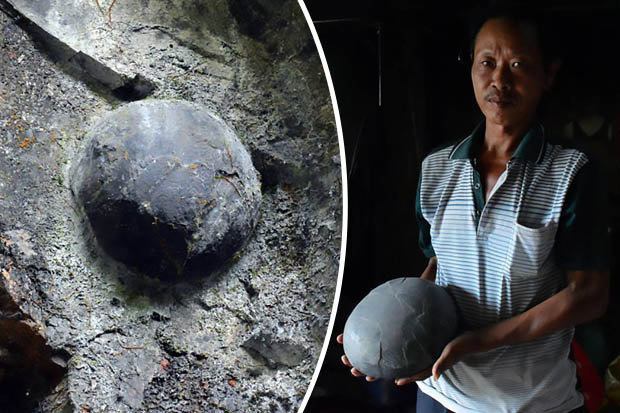
The cliff, which stands 2.4 meters high and stretches 19 meters long, resembles most other cliffs. The strange part is that protruding from the rugged surface of the cliff are smooth, round protrusions of various sizes. Over time, these “stone eggs” grow larger, gradually revealing themselves, and when they can no longer cling to the cliff, they fall to make room for new “eggs.”
According to the villagers of Gulu nearby, the Chan Da Ya cliff takes 30 years to produce its strange stone eggs.
Every 30 years, Chan Da Ya “lays” many “eggs” to the astonishment of the surrounding residents and the scientific community.
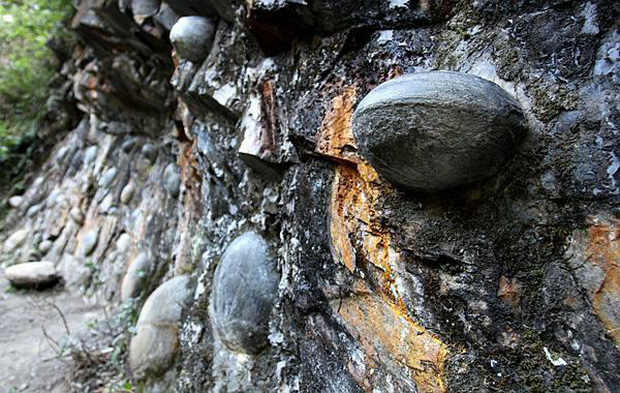
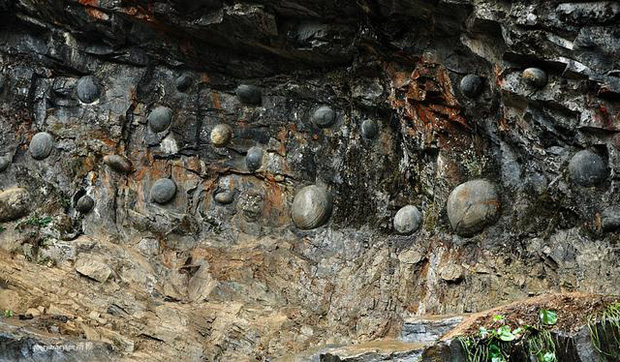
The egg-laying phenomenon of the Chan Da Ya cliff is considered unique in the world, drawing attention from many scientists, geologists, and even archaeologists. They come to study on-site to provide the most convincing answers possible.
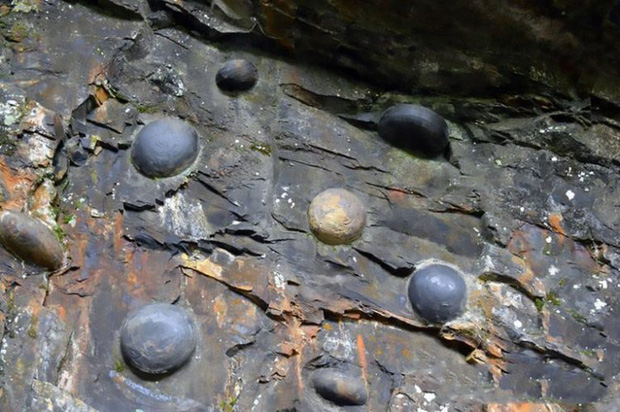
Scientific experiments show that most of the Gandeng mountain is made up of harder sediments, primarily limestone, which are easily eroded. Meanwhile, those smooth round stones are formed from a much harder type of rock. The differing erosion times may be the cause of this strange phenomenon.
However, scientists indicate that this explanation only unlocks part of the mystery; the reason why the stones have such perfect shapes and smooth surfaces remains unanswered.
Shrouded in mystery, the local people believe that anyone who obtains a stone that has fallen from the Chan Da Ya cliff will have good luck.
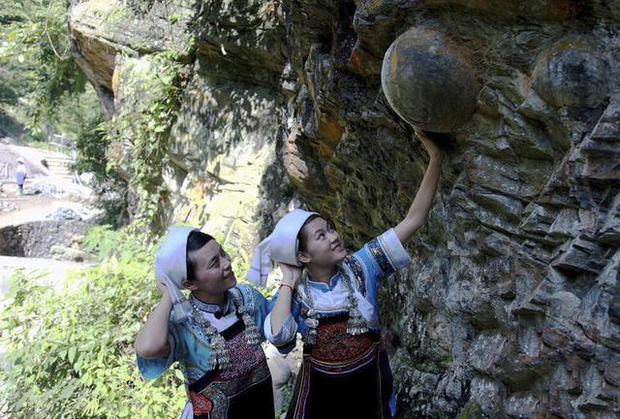
Generations of Gulu residents have been aware of the egg-laying cliff, so they frequently visit to touch the “divine eggs” for good luck. Data from 2005 showed that most of the 125 families in Gulu had at least one of these mysterious eggs in their homes as a good luck charm.
In recent years, Chan Da Ya has become famous as a tourist destination, and most of the stone eggs have been sold by greedy individuals for profit. Currently, only about 70 eggs remain, carefully protected by the local people. Any new egg that is about to fall from the cliff is often stolen by treasure hunters.