


If you’ve seen the classic film “Terminator 2: Judgment Day,” you surely cannot forget the T-1000, a villainous robot made from a polymorphic alloy, a type of liquid metal that allows it to melt, slip through doorways, and then reshape itself into anyone’s likeness.
At the time the film was released in 1991, the technology for liquid metal to create the T-1000 was still science fiction.
However, in a new study published in Additive Manufacturing, a trio of scientists from Binghamton University, New York, announced that they have created the “first liquid metal network in the world,” which, when you look at it, immediately brings to mind the T-1000 robot.
This prototype hand was created from Field’s alloy, a mixture of bismuth, indium, and tin, named after its inventor, Simon Quellen Field. Field’s alloy has a relatively low melting point, around 62 degrees Celsius, and is often used in nuclear applications as a coolant.
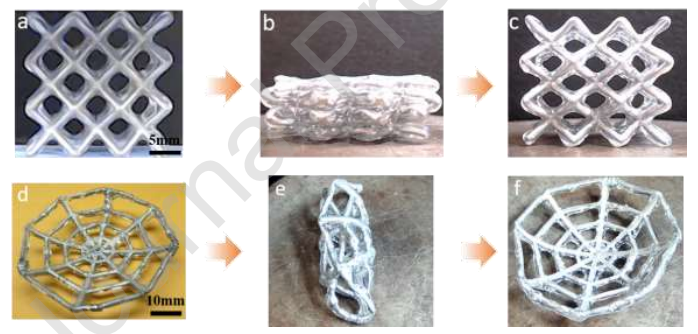
However, using that property for another application, Associate Professor Dr. Mechanical Engineering Pu Zhang, along with his two PhD students Fanghang Deng, a graduate from Beijing University of Science and Technology, and Nguyễn Quang Khả, a graduate from Ho Chi Minh City University of Technology, successfully created liquid metal networks that can melt and then recover their original solid form.
Speaking about his research, Dr. Zhang likes to compare it to the liquid metal technology that created the T-1000 in Terminator 2. But when someone mentioned that it might not be the best comparison, Zhang laughed and admitted: “Honestly, I have never seen that movie!”.

The job of a scientist like him is to turn impossible ideas into reality. Zhang has spent many years researching in the field of materials science, using computational models to design architectural networks and hybrid materials.
And when he saw the potential of Field’s alloy, Zhang came up with the idea to hybridize it with a rubber shell to create hybrid material with superior properties.
Until now, no scientist has been able to create liquid Field alloy crystal networks that can then recover their original shape, a fantastic property with countless applications that could turn sci-fi movies into reality.
The problem with this alloy is that “without a shell, it cannot recover its shape, as the liquid metal will flow away immediately,” Zhang said. Therefore, he had to spend nearly six months researching and creating a rubber shell for Field’s alloy.
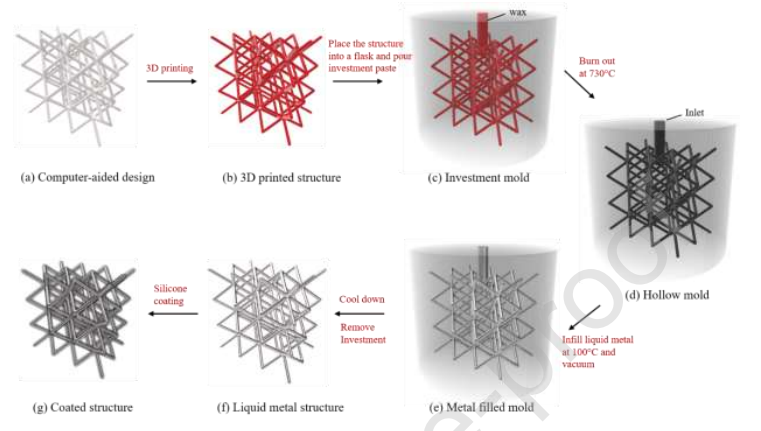
To ensure its applicability, this shell needs to integrate 3-D printing technology, vacuum casting, and appropriate coatings (used on electronic circuits to protect against moisture, dust, chemicals, and temperature).
“The shell framework controls the shape and overall integrity, so the liquid metal itself can flow around the channels [without leaking out]. We spent more than six months developing this production process because the new mesh material is very difficult to handle. You need to figure out the formula for the best material and the most suitable processing parameters.”
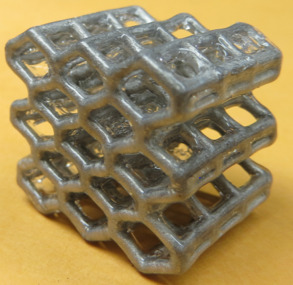
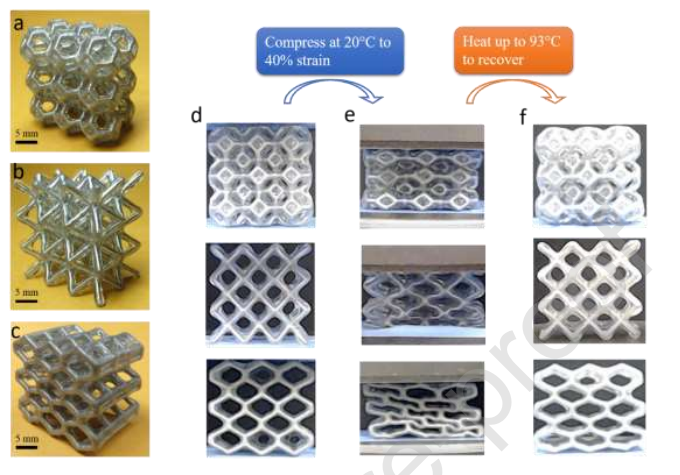
They used it to create balls, a spider-web-like antenna, cube-shaped networks like honeycombs, and especially a hand that can slowly open and close depending on the external temperature of its environment.
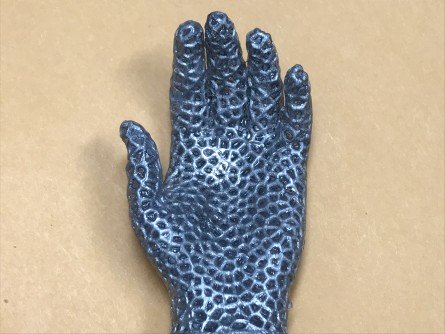
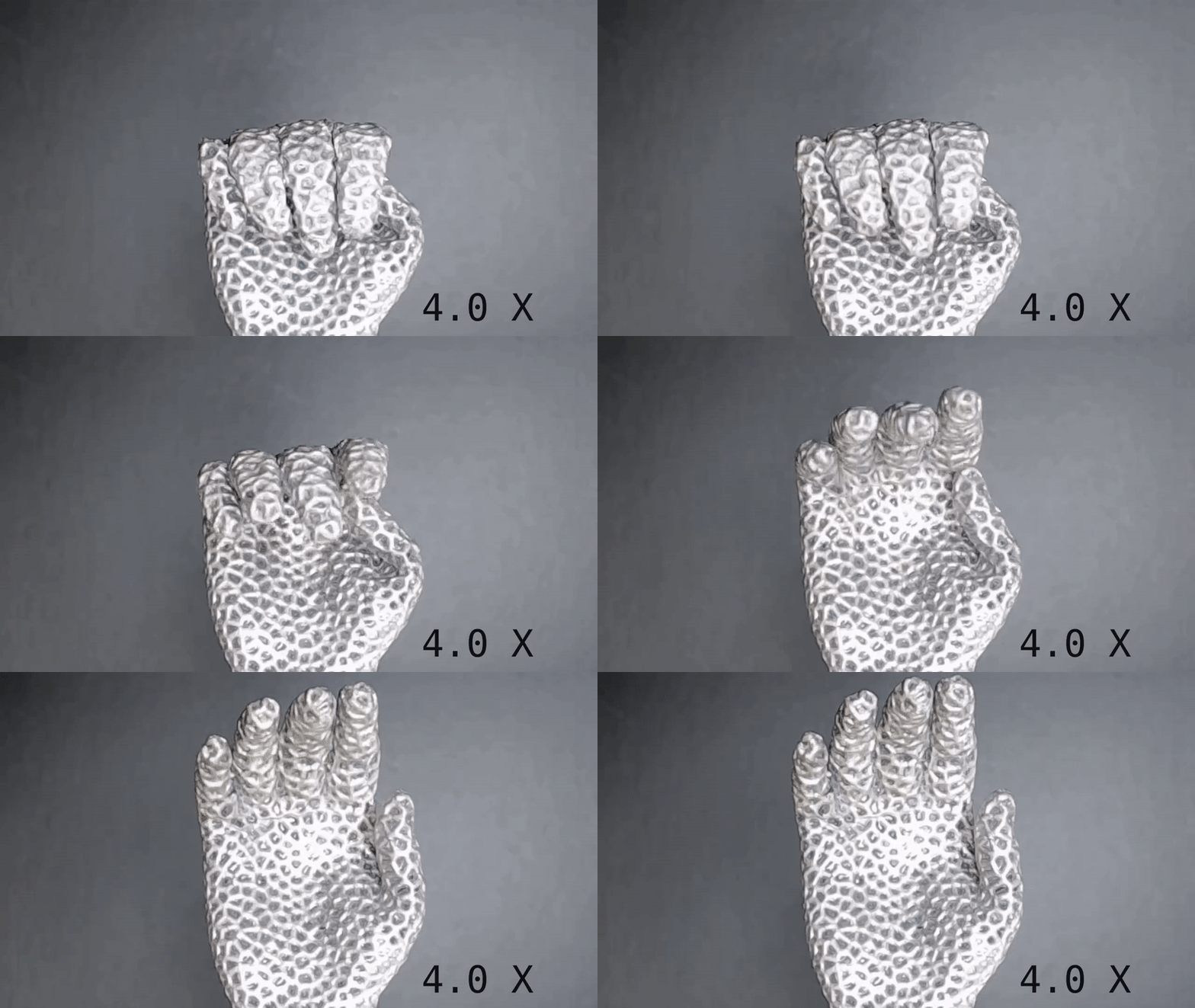
This hand might make you think that the day we create the T-1000 robot is not far off. However, Dr. Zhang stated that the applications he is aiming for in this research will be much “tamer” than the terminator.
When the liquid metal is in solid state, it is very safe and strong. It absorbs a lot of energy when melted, and then if warmed and cooled, the melted metal can return to its original shape for reuse.
Dr. Zhang noted that this property will attract the attention of NASA or other private space transportation companies. For instance, satellite designers could create “spider-web” antennas from this hybrid material, packing it into a small bundle to save space for rockets, then self-deploying once in orbit.
The same could apply to future settlement architectures on the Moon or Mars. You could melt down metal houses, making them more compact for transportation on rockets. These houses could then regenerate their shapes at the destination.
Dr. Zhang mentioned that liquid metal networks could even be used to construct interplanetary spacecraft.
“A spacecraft can encounter issues if it experiences shock when landing on the Moon or Mars. Typically, engineers use aluminum or steel to create shock-absorbing structures, but after you land on the Moon, the metal absorbs energy and deforms. The shock absorbers would have to be left there, as they can only be used once,” he said.
“But with this Field alloy, you can use it to land just like other metal shock absorbers. But instead of throwing them away after they are damaged, you can heat them up to restore their original shape. In other words, you can reuse them multiple times.”
Currently, research on this new material is still being carried out by Dr. Zhang’s team. He wants to equip it with improved coatings and create various shapes for the liquid metal network.
“Our dream is to create a robot from liquid metal mesh,” Dr. Zhang said. “Now we have a hand, so we just need to take one more step.”
Source: Phys, Additive Manufacturing