


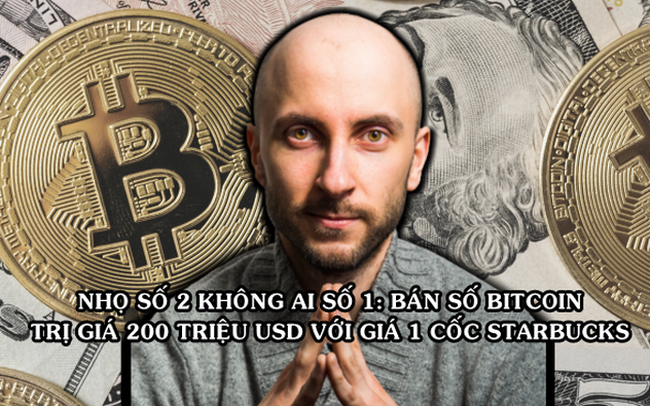
Martti Malmi is one of the first people to mine digital currency (Bitcoin) in the world. When it first emerged, miners often received attractive rewards like 50 Bitcoins for each request they completed. And Malmi managed to solve a “ton” of such requests.
From 2009 to 2010, Malmi easily mined over 55,000 Bitcoins. However, one very unfortunate thing is that this guy did not realize that Bitcoin would later become as valuable as it is today. On January 15, the price of Bitcoin briefly reached over $39,000 per coin.
However, back in 2009, it was almost free, and that was when Malmi sold 5,050 Bitcoins for just $5. If he had sold them today, he would have made $200 million, selling for the price of a Starbucks coffee! Unfortunately, that’s just a small part of what Malmi has missed out on.

Giving away tens of thousands of dollars almost for free
In 2010, he operated bitcoinexchange.com. Contrary to its name, it wasn’t a trading platform but a Bitcoin “faucet.” This was a reward system in the form of a website or app. Faucets would distribute rewards in the form of satoshis, a currency unit of Bitcoin, to visitors who completed tasks such as “watching a video,” “leaving a comment,” or “sharing a post on their personal page.”
In total, Malmi gave away about 30,000 Bitcoins through that platform without making any significant profits. A year later, things began to change.
From $0, the price of Bitcoin skyrocketed to around $15 to $30, inspiring Malmi to make a significant amount of money. He sold 10,000 Bitcoins and bought a luxury apartment near Helsinki.
This success motivated him to pursue bigger goals. In 2011, he bought a one-way plane ticket to Japan – the birthplace of Bitcoin. Besides learning Japanese, he visited Mt. Gox, the world’s leading Bitcoin exchange company at that time. After that, he planned to accumulate as much Bitcoin as possible.
Unfortunately, this was not enough to prevent Malmi’s misfortunes.
In 2012, Malmi ran out of cash and decided to go back to work. However, his job search took longer than expected. As a result, he had to sell most of his remaining Bitcoins at the then-rate of $5 per coin.
Thus, to date, Malmi has “lost” 55,000 Bitcoins worth over $2 billion! While he bought a beautiful apartment and still holds a small amount of Bitcoin in his digital wallet, it’s not enough for him to become a millionaire.

In a Twitter post, Malmi stated that he still feels happy with his modest achievements. He shared some lessons from mining and losing the massive amount of Bitcoin:
“More money is better than less money”
Malmi wrote: “No matter what you do, money gives you freedom. The more money you have, the freer you are. For me and perhaps many people around the world, more money is always better than less money.”
“More money is better than less money” makes sense to a “certain point.” Psychologists have tried to calculate that point and found that an annual income of $95,000 in the U.S. brings happiness and satisfaction. Clearly, these figures can vary from person to person.
You may want more, and you may want less. The more important issue is that you choose a level you deem appropriate for yourself and pursue it. However, don’t forget to enjoy life, even in the smallest things, because sometimes you don’t have to be in the top 1% of the richest people in the world to feel happy and satisfied with your life.
For Malmi, his significant loss has brought certain lessons. Perhaps at this moment, he doesn’t own as much money as he should have, but he is still satisfied with his life now. No one can predict how Malmi’s life would have turned upside down if he had hundreds of millions or even billions of USD in his hands.
“Never forget to save”

In 2012, the year Malmi ran out of cash before finding a job, he was “sitting on” 10,000 Bitcoins. That would be about $400 million at the present time. And they “evaporated” when he sold them at an unbelievably low price.
One of the most poignant lessons Malmi learned is to always save for emergencies like that. Investment legend Warren Buffett once advised: “Don’t save what is left after spending, but spend what is left after saving.”
Source: Compilation