


For the first time in medical history, doctors have enabled a paralyzed and deaf-mute man to communicate again by translating his brain waves into speech.
The 38-year-old man, living in the United States, has been nicknamed BRAVO-1 in a study conducted by the University of California. Fifteen years ago, he suffered a stroke that severed the nerves connecting his brain to his larynx.
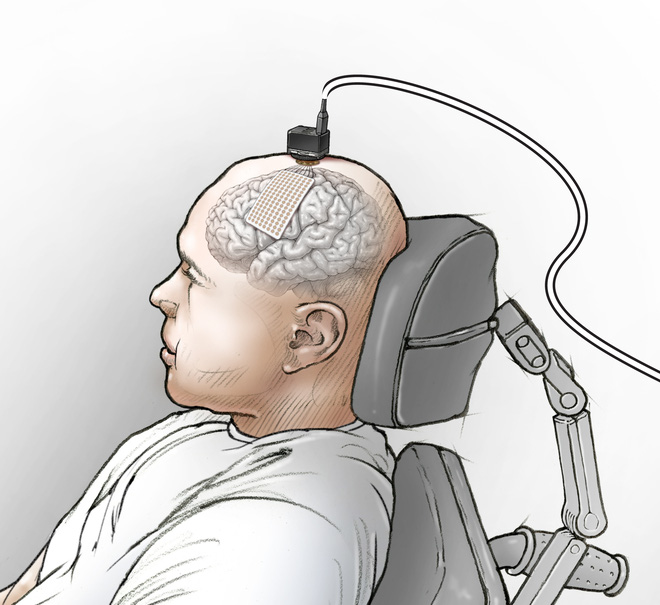
BRAVO-1 is also paralyzed from the neck down, allowing him only to use head movements to communicate. A team of engineers designed a special chair for him with a touchscreen connected to a computer in front of him.
Normally, BRAVO-1 wears a baseball cap with a long rod that allows him to touch the rod to the screen and select words to speak.
But now, with an electrode implanted directly inside his brain, BRAVO-1 can speak without using the cap anymore. His neural impulses have been transmitted directly to the computer for decoding, allowing him to speak at an average speed of 15 words per minute with 74% accuracy.
There are times when the speed can be pushed up to a maximum of 18 words per minute, with an accuracy of 93%. In comparison, a normal person speaks at a speed of 150 words per minute and achieves 100% accuracy.
This shows that the ability to decode BRAVO-1’s brain waves into speech is still not truly impressive. However, scientists say that the very first word BRAVO-1 uttered was “an important technological milestone for someone who cannot communicate naturally” like him.
“It demonstrates the potential of this method, which will help give a voice to those who are severely paralyzed and have lost the ability to communicate,” Dr. David Moss, the study’s author, an engineer from the University of California, told the Washington Post.
Helping the paralyzed mute regain the ability to communicate
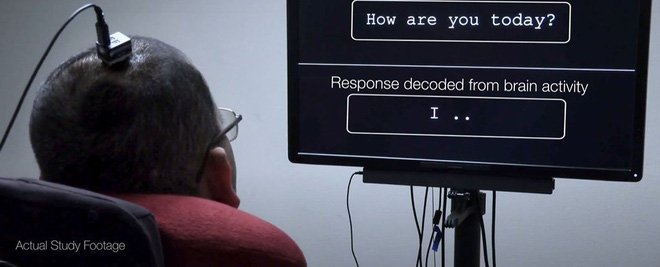
To help BRAVO-1 speak again, scientists at the University of California implanted a network of electrodes in the sensory cortex, which is also the part of the brain controlling his speech. The electrodes were then connected outside the skull through wires to a decoding computer.
The next step was to train a program that could recognize and distinguish the electrical impulses generated from BRAVO-1’s sensory cortex, helping him translate thoughts into speech. This was accomplished through 48 trial sessions lasting a total of 22 hours.
During this time, scientists attempted to record the brain signals that BRAVO-1 generated as he spoke 50 words flashing on the screen. They then used a deep learning algorithm to filter which signals corresponded to which words BRAVO-1 wanted to say.
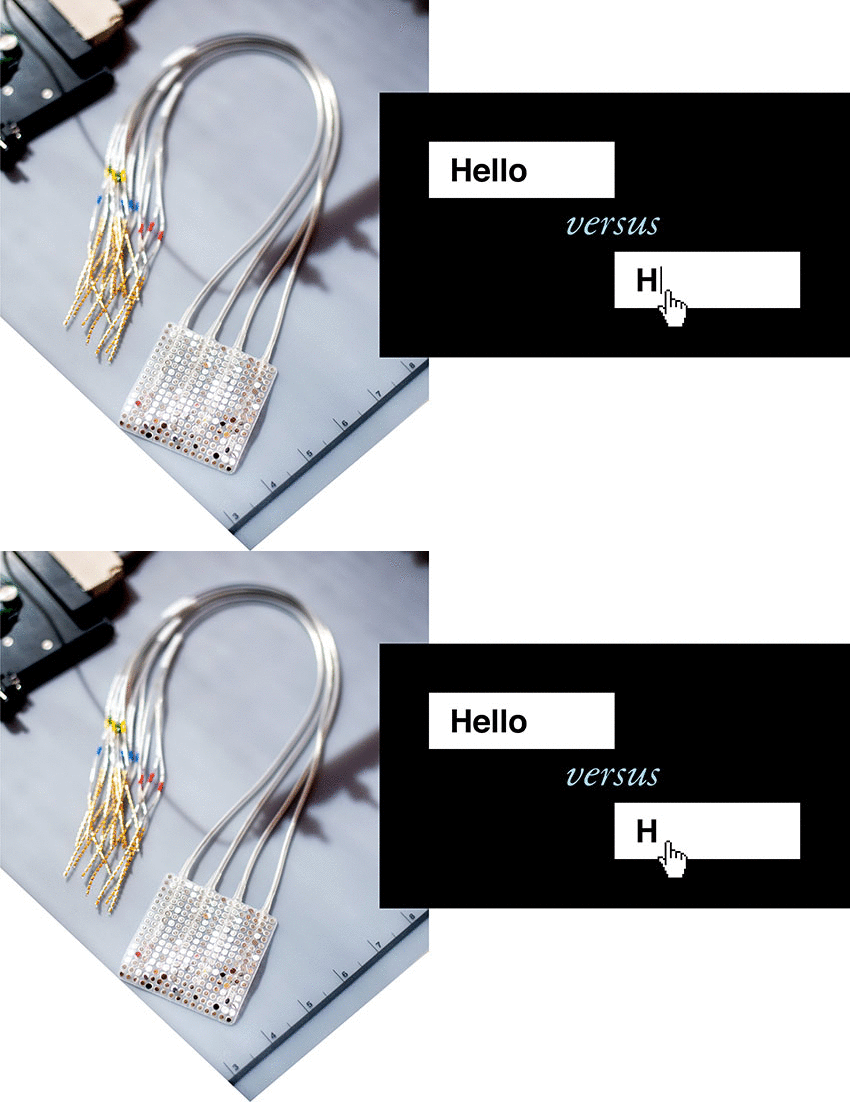
To speed up his communication, part of the algorithm allows the computer to guess the next word BRAVO-1 might utter. Essentially, this algorithm works similarly to the suggestion or spell-check function on your phone.
However, scientists say that the regular spell-check function has an accuracy of only about 2%. In this study, they were able to push that accuracy up to 93% with 50 words. That is a small vocabulary but includes all the necessary words for the daily life of a paralyzed person like BRAVO-1, such as “water“, “family“, and “good“.
In a demonstration to test whether the system worked, researchers asked him questions like “How are you today?” and “Would you like a drink of water?”
As a result, BRAVO-1 took a few seconds to think and displayed responses on the screen like “I am very well” and “No, I am not thirsty”.
“To our knowledge, this is the first evidence that directly decoding the brain activity of a paralyzed person who cannot speak into complete words can be successfully achieved,” brain anatomist Edward Chang, co-author of the study, said.
Five years ago, no one thought such a study would succeed
Chang is currently the chair of the Department of Neurosurgery at the University of California. He emphasized that five years ago, no one thought such a study would yield such good results.
Most similar studies at that time, with a computer connected to a person’s brain, were only conducted on patients with epilepsy. Such brain-computer interfaces were only used to diagnose the source of their seizures.
Going back another five years, although some researchers could decode sounds or syllables from the brain waves of patients, the accuracy of the algorithms at that time was too low to assemble them into complete words.
The success that Chan and his team achieved with BRAVO-1 today inherits a lot from the advancements in the field of artificial intelligence over the past decade. For example, speech recognition algorithms and spell-check features on computers and mobile phones have been developed with billions of hours of training on billions of data samples.
In the field of decoding neural signals, scientists have also made significant progress. For instance, just last May, a research team at Stanford University helped a paralyzed man write on a screen using brain wave decoding technology.
In this case, the man imagined how he moved his hand, controlling his fingers to write, rather than thinking about the letters that would be typed out or pointing at a touchscreen like BRAVO-1.
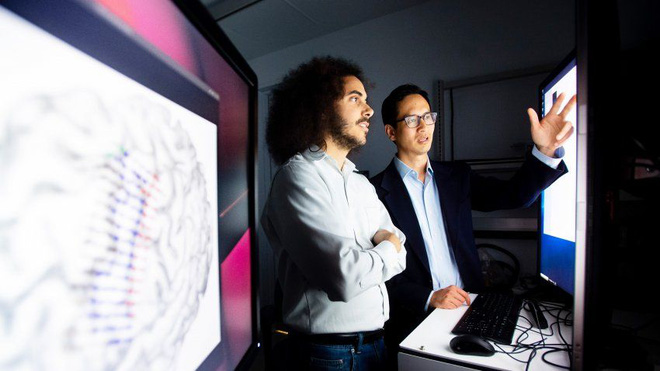
Commenting on the new study, Christian Herff, an associate professor of neuroengineering at Maastricht University in the Netherlands, said what Chang and his colleagues achieved is a “huge leap. “It has really addressed a major issue,” Herff said.
Previous studies have shown that decoding brain waves can help us read the thoughts of someone who can speak. “But this is the first study to do that in a non-speaking patient,” Herff emphasized.
In an interview, Chang stated that his new work is the result of a decade-long effort. Ten years ago, he met a deaf-mute patient and began to ponder the inconveniences this patient faced in life.
Thousands of people suffer the same fate each year due to neurological damage from strokes, cerebral palsy, trauma, and diseases like ALS, similar to scientist Stephen Hawking.
“Every day, I face those patients who have lost their ability to speak after a stroke or brain injury. Silence has devastatingly impacted their lives. After all, speech is part of what makes us human. Losing it is truly devastating,” Chang said.
But with the success of BRAVO-1 today, he aims to help his patients regain their ability to communicate. “And this is really just the beginning,” Chang said.
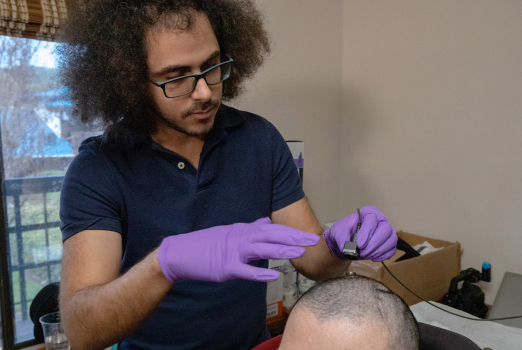
The next step, Chang and his colleagues will need to improve deep learning algorithms to enhance both the accuracy and speaking speed for BRAVO-1. He anticipates that he will also need to expand the vocabulary for his patient so that he can discuss a wider range of topics.
Meanwhile, Herff suggested that the research team could route BRAVO-1’s language into sound form. This means it would allow him to produce actual speech, similar to Stephen Hawking in the past but with added intonation and expression.
Additionally, they could develop wireless communication technologies between electrodes in the brain and computers. If successful, this could eliminate BRAVO-1’s dependence on the wires connected to the back of his skull.
The application of a wireless brain-computer communication system could also be much broader. It could be suitable for those who are deaf but not paralyzed, who would not need to sit next to their computer to speak.
“Although the study is considered a success, we do not dare to say that we have perfected anything with this technology. It is truly just the beginning,” Chang said.
The research has been published in the New England Journal of Medicine.
Reference UCFS