


In the eyes of Jason Padgett, math is everywhere. Even when he does something as ordinary as brushing his teeth – it is also governed by math. Padgett will turn on the tap and dip his toothbrush in the water 16 times.
“I don’t know why I like perfect squares,” he says. “And that number 16 isn’t just one, it’s two perfect squares, two times two equals four, then four times four equals sixteen. I simply like that perfection… everything I do automatically follows that preference.”
As a genius in the field of fractal mathematics, few know that 18 years ago, Padgett lived a very different life in Tacoma, Washington. Back then, he was just a lazy young man working at a mattress store.

“I used to live very shallow,” he laughs. “My life then revolved around girls, partying, and drinking. Those mornings waking up feeling nauseous, going out, chasing girls and then back to the bar again.”
Padgett had no concept of math in his head. “I used to say ‘Math is ridiculous, how can you apply it to the real world?’,” he said.
But one night in September 2002, on Friday the 13th, everything changed. While out with friends, Padgett was attacked by two robbers outside a karaoke bar. Unable to find anything valuable on Padgett, they eventually took his torn leather jacket.
“I just heard a ‘thud’ in my head as the first guy ran up from behind and hit me in the back. Then I saw a white light like someone was taking a picture. Then I collapsed, everything spun and I no longer knew where I was or why I was there,” Padgett recalled.
Stumbling to his feet, Padgett eventually made it to a hospital just across the street. Doctors said he had a mild concussion and a kidney bleed from a punch to the stomach. “They gave me a shot for pain and sent me home,” he said.
Strange things began to happen from that point on. Padgett experienced a syndrome called obsessive-compulsive disorder (OCD). It might have been the result of the head trauma he encountered. Those with OCD often exhibit unusual behaviors; in Padgett’s case, he became fearful of everything in the outside world and would only venture out to buy supplies.
“I remember taking towels and blankets to nail up to cover all the windows in the house,” he said. “For the front door, I would use spray foam to seal it shut.” And not just with what the naked eye could see, OCD also made Padgett extremely afraid of germs.
He had a daughter with his ex-wife, the child lived with her mother but would occasionally come to visit Padgett. “Every time she came over, I would obsessively wash my hands. The first thing I would do is take off her shoes, change her into clean clothes and take her to wash her hands,” he said.

Padgett clearly endured a lot of negative effects from the attack outside the karaoke bar, but one incredible positive thing happened in the way he viewed everything around him. Padgett’s ability to observe changed from then on.
“Every curve in my sight began to break down into pixels,” he explained. “The water flowing down the drain no longer just floated away. I saw it as little tangents.”
Then the clouds, sunlight streaming through the canopy onto a puddle, Padgett saw everything change. For him, the world now fundamentally resembled a four-button video game. “I was amazed… confused. That world was beautiful, but also very scary,” he said.
As the outside world suddenly changed through Padgett’s eyes, he began to ponder the big questions related to math and physics. Padgett went online, spending all his time at home reading. And from the internet, he started to access many concepts related to mathematics.
By chance, Padgett found a website about fractals and fell in love with the field.
Fractal geometry is a complex mathematical concept. Simply put, it refers to geometric objects that often have self-similar shapes at every scale of magnification, and can be broken down into parts: each part looks like the whole, just at a smaller scale.
The simplest example you can imagine is a snowflake. When you zoom in on a snowflake, you’ll see it’s made from smaller snowflakes connected together. Then when you magnify those smaller snowflakes, you see they are made up of even smaller snowflakes. This continues, with smaller and smaller snowflakes appearing indefinitely.
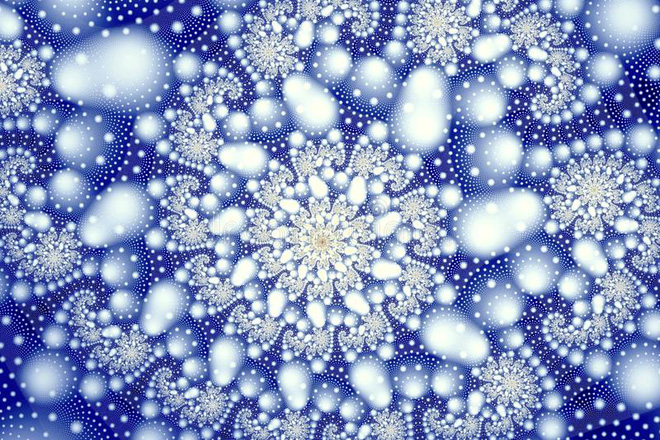
Although fascinated with fractal geometry, Padgett only began to delve deeper into it after one day when his daughter asked, “Dad, how does the TV work?”
“If you look at a TV screen and see a circle, it’s not actually a circle,” Padgett said. “The circle is actually made up of rectangles or squares. Once you look closely at the screen, you’ll see the edge of that circle is actually a zigzag.
Now, you can take those pixels and cut them in half, then half again. Every time a pixel gets smaller, your circle will look more perfect. But you will never reach a true circle.
You can keep making the pixels smaller, cutting them down in half, infinitely. The resolution of the screen will increase, but the circle when magnified will still be a zigzag; you will never achieve a perfect circle.”
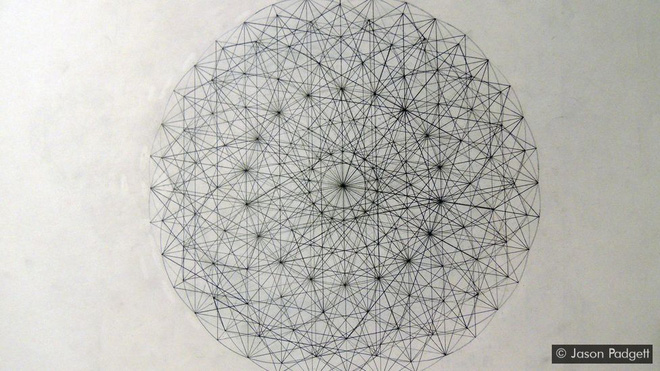
After realizing this, Padgett’s OCD seemed to catch a new interest. He felt compelled to embark on an exploration of the realm of fractal geometry. Padgett began to draw. And he kept drawing and drawing continuously.
“I really drew thousands of circles, rectangles, every shape I could draw. That was the only way I could live in a different world that I saw.” Padgett believed that his drawings held a key to unlocking a new universe. And he carried them with him everywhere.
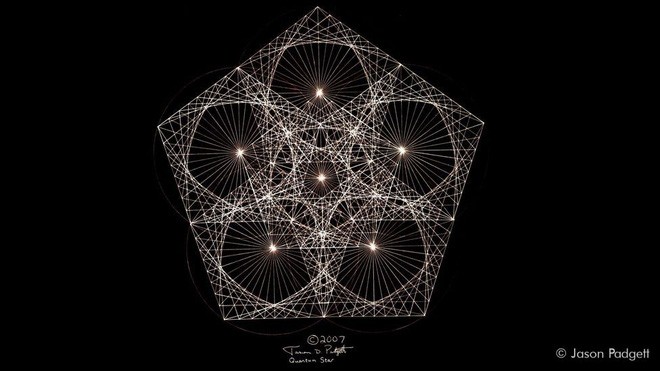
In a rare outing, a strange man noticed Padgett. He approached him and said that his drawings looked like math.
“I’m trying to describe the discrete structure of spacetime based on Planck length (a tiny unit of measurement developed by physicist Max Planck) and quantum black holes,” Padgett said.
The other man – who turned out to be a physicist – was startled. Realizing it was a talent, he urged Padgett to enroll in a math class at the community college. From there, Padgett began to learn the numbers, the mathematical language that could help him articulate and describe his obsession.
After three and a half years of living reclusively at home, with a computer, the internet, and an obsession with fractal geometry, Padgett now resembled a caterpillar emerging from a cocoon. He began to show talent in this field.
With the support of those around him, Padgett started to manage his OCD and his fear of the world. He even met a new woman, who would later become his second wife.
But what really happened? What on that fateful Friday the 13th transformed Padgett’s world, allowing him to see math, shapes, and graphs in everything around him?
Once again, the TV provided him a clue to seek answers. That day, Padgett was watching a math show, where another man suddenly transformed into another genius spoke about a world he saw filled with numbers.
“I’m someone who always says math is not just about numbers. And that was the first time I heard someone else, not me, talk about what numbers look like,” Padgett recalled.
He went online, scouring information about this man, but stumbled upon Berit Brogaard, a cognitive neuroscientist at the University of Miami. The couple spent hours talking on the phone. From these conversations, Brogaard proposed a hypothesis that Padgett had essentially developed synesthesia – a syndrome where cross-connections in the brain cause his senses to blend.
It is estimated that about 4% of the population among us may experience synesthesia. Suppose, when you see a number, you immediately associate that number with a color, or even it is combined with what it tastes or feels like when you touch it. The number one could be blue, the number two purple, and the number three red…
A world viewed through the lens of a person with synesthesia will be very different from a normal person. This is because within their brain, the neural pathways and decoding of their world are operating very vividly.
Some people with synesthesia are born with it. But there are also cases of synesthesia that occur after someone suffers a trauma, stroke, or allergy… any agent that could affect the brain.
After the conversation with Padgett, Brogaard believed that the brain injury he suffered 17 years ago activated his vision linked to a part of the brain responsible for analyzing and processing shapes or mathematical formulas.
This caused outlines and fractal geometry to begin appearing before Padgett’s eyes as if placed behind a lens or a super cognitive filter. “Most of us cannot excel in math because we don’t see math in real life,” Brogaard said.
But Padgett could, and synesthesia turned him into a genius in that way.
However, to test this idea definitively, Brogaard took Padgett to the Brain Research Unit at Aalto University in Helsinki, where his brain was placed under a scanner.
Brogaard projected a series of mathematical equations, including both real and fake equations on a screen while Padgett was inside the MRI. The researchers then wanted to see which parts of his brain lit up in response to actual math formulas.
“They found that I had access to certain areas of the brain – places that most other people do not have access to. Furthermore, my visual cortex was functioning concurrently with the brain regions involved in mathematics. Clearly, that was the case,” Padgett said.
Brogaard’s hypothesis was ultimately confirmed as true. Padgett was diagnosed with synesthesia, which had suddenly transformed him into a genius.

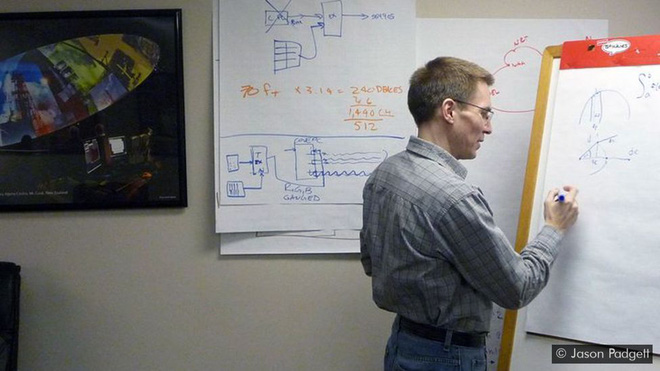
After everything became clear, Padgett began to write an autobiography, describing his experiences. He also traveled everywhere to talk about mathematics, encouraging education or simply describing interesting mathematical patterns to those who could not see them in life.
Many years after the fateful attack outside the karaoke bar, one of the two strangers from that night wrote a letter of apology to Padgett. It was a man named Brady Simmons, who was in recovery from drug addiction after a suicide attempt.
In a sense, two lives changed after that attack. “I am disgusted by the person I was in my past. I can’t imagine how I could have lived so lowly,” Simmons said. Still, he is now a different person, who knows remorse.
Padgett also feels he has turned into a different person than before. “I see everything in life as beautiful”, he said. Padgett can now be captivated by the simplest things in life that most people cannot see.
For example, a raindrop falling on a puddle in his eyes is now complex equations and wave graphs, overlapping into shapes like sparkling snowflakes. And Padgett is excited to describe that world to others. He wants others to feel that beauty too.
“Imagine being just around here and being amazed by the simple things that are just present and existing,” Padgett said. “I am awakening in math and seeing everything around us as miracles, or at least that’s the closest science we have to miracles.”
Source BBC