


At the site of an ancient, now extinct volcano located in Mexico, scientists are conducting research aimed at changing the foundations of science: they want to establish a new limit on the speed of light.
For a long time, physics has proposed plausible hypotheses based on the knowledge they have to explain the mysteries of the Universe, yet not all hypotheses are correct. For example, to test the limits that Albert Einstein’s theories set, they must expand the theories that the physics genius established.
Although experiments often yield incorrect results, this is the essence of science: to test until a correct answer is found. Scientists are facing what may be the greatest challenge they have ever encountered. “Overwhelming” is the word Pat Harding, an astronomer and one of the authors of the new research, used when referring to their new experiment.
Some physicists attempt to explain the mysteries of the Universe with new ideas (such as string theory), stemming from solid hypotheses that have been utilized in science for many years. These ideas only arise when a factor becomes complex to an extreme degree, prompting them to expand their existing knowledge to make the new theory meaningful, such as ultra-high-energy particles.
In their new experiment, scientists also aim to expand their understanding to see if the Universe rejects the Lorentz invariance applied to high-energy photons (light particles). Lorentz invariance posits that physical laws are the same for different observers, for instance, a person standing still on Earth or someone rotating at a certain angle or moving at a constant speed relative to a stationary observer.
The result of Lorentz invariance will be the constant value of light particles in a vacuum, which is 299,792,458 m/s.

If Lorentz invariance is violated, then a high-energy particle must move faster or slower than the speed of light mentioned above, and this will certainly cause specific effects. These particles will either decay or separate and not reach Earth, and will cause a decrease in the number of photons colliding with an object at sufficiently high energy levels.
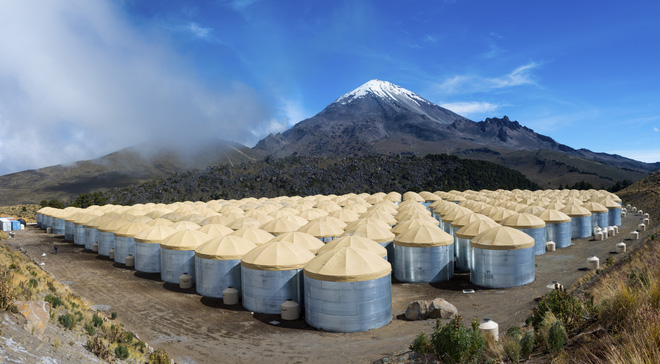
Based on these observations, scientists gathered at the High-Altitude Water Cherenkov (HAWC) observatory to search for clear signs.
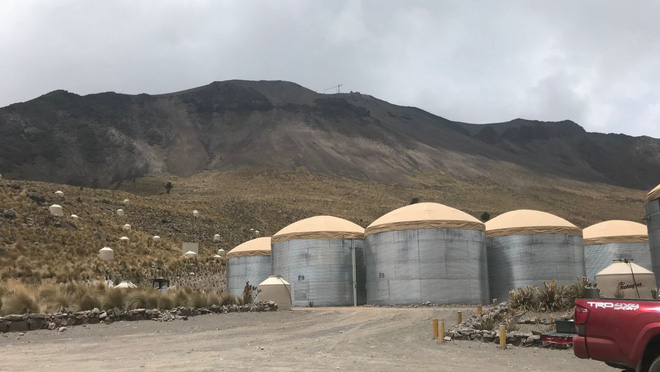
HAWC is an observation station with hundreds of large water tanks, located on the summit of the Sierra Negra volcano in Mexico. Here, scientists can observe how high-energy particles interact with the atmosphere, causing a rain of particles and creating a flash phenomenon when they come into contact with water in the tanks. Photomultiplier tubes convert these flashes into signals, allowing scientists to reconstruct the structure of the particles causing the flash effects.
Combined with more complete calculations of photon energy than before, the data revealed: no decrease in photon phenomena observed, the HAWC observatory continues to detect photons coming from extraterrestrial light sources. This proves that high-energy light particles cannot travel “faster-than-light,” a fictional term still used to describe devices that can exceed the speed of light.
According to physicist Humberto Martínez-Huerta, a professor at the University of São Paulo, through mathematics, the results of this research could increase the energy level at which hypotheses violating Lorentz invariance could exist by 100 times. Based on the new research results, a group of scientists wants to translate Professor Humberto Martínez-Huerta’s research into a unit of experimental measurement.
In general, the experiment demonstrates that even light particles with high energy still travel at the speed of light. The new observations also limit the new hypotheses that physicists propose to prove the unknown aspects.
Reference Gizmodo