


The Yiliang Museum in China houses many valuable artifacts. However, few would expect that among the vast collection displayed here, the intact embryo of a dinosaur lies hidden within a 70-million-year-old fossil.
Named Baby Yingliang, the dinosaur belongs to the carnivorous genus Oviraptor and could become the missing link in the connection between dinosaurs and birds. Dinosaur bones are incredibly fragile and prone to breakage, so they rarely exist long enough to become fossils. This fact makes the new discovery even more unique.
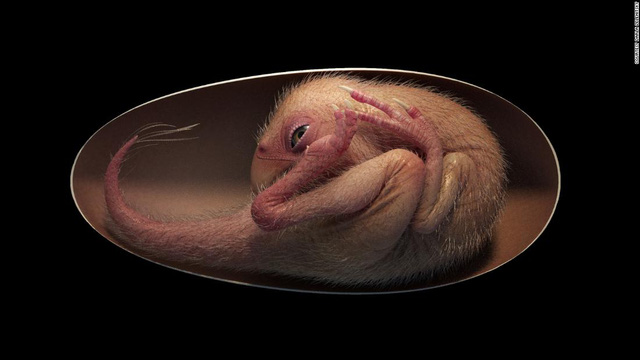
“This is an amazing specimen… I have worked with dinosaur eggs for 25 years, but I have never seen anything like this,” said Zelenitsky, co-author of the new study, to the press. “So far, we do not know much about what happens inside dinosaur eggs before they hatch, as there are very few dinosaur bones still in the embryonic stage, especially intact specimens that preserve the posture of life inside the egg.”
The dinosaur egg measures about 17 centimeters long, and scientists estimate that the dinosaur that hatches from it would be about 27 centimeters long (including the tail). They believe that if it lived to maturity, Baby Yingliang would measure between 2 to 3 meters long.
A team of scientists from China, the United Kingdom, and Canada carefully studied the posture of Baby Yingliang, comparing it to previously discovered dinosaur embryos and concluded: before hatching, dinosaurs also change positions, just like how birds twist and then break the shell of their eggs.
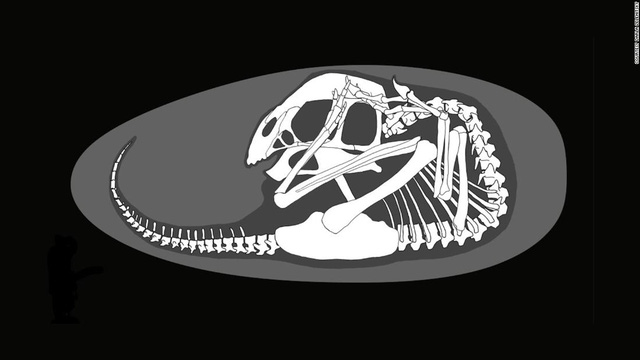
“Most non-flying dinosaur embryos are incomplete because most bones are disarticulated,” said Waisum Ma, the lead author of the study. “We were surprised to find this embryo perfectly preserved inside the egg, lying in a position very similar to that of a bird. This posture has never been found in any non-flying dinosaur embryo.”
Modern birds are direct descendants of a group of two-legged dinosaurs known as theropods, which include famous pop culture creatures like Tyrannosaurus rex and pack-hunting dinosaurs like velociraptors. According to researcher Zelenitsky, modern birds also inherit the behavior of sitting on eggs to incubate them, just like their ancestors did millions of years ago.
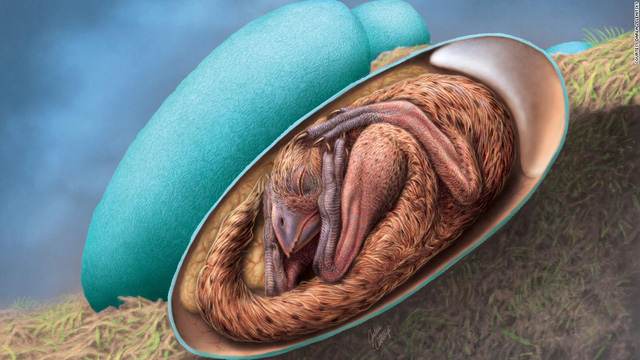
The historical fossil was found in Jiangxi Province and was purchased in 2000 by Liang Liu, the director of a stone manufacturing company called Yingliang Group. After resting in storage for 10 years, when the Yingliang Stone Natural History Museum was established, museum staff sorted through the stored items and discovered the precious egg.
Source: CNN