


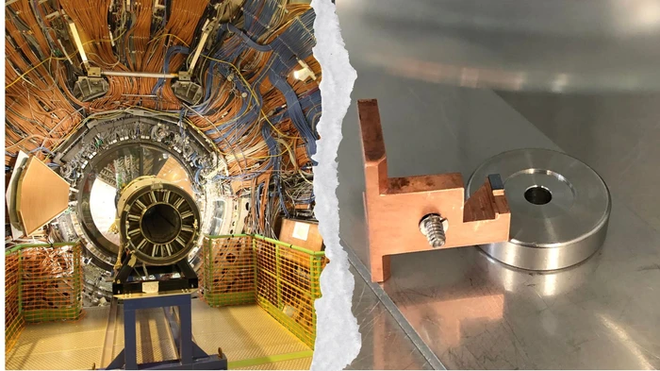
The Large Hadron Collider (LHC) is a massive underground facility with a circumference of 27 km, a marvel of modern science that cost billions of USD to build and operate. With the LHC, we delve deep into particle physics – seeking the structure and interactions within everything we know.
And scientists have just accomplished a project… in stark contrast to size: they have created a particle accelerator that measures only 30 micrometers, slightly thicker than a human hair.
This tiny structure is one of the latest achievements in developing the “accelerator-on-a-chip,” a super-small particle accelerator that could lead to breakthroughs in material science, chemistry, and medicine (specifically in drug development). The small machine, named the Dielectric Laser Accelerator (DLA), will pave the way for cheaper, more compact accelerators that operate at energy levels comparable to today’s massive particle accelerators. Potential applications include X-ray devices, radiation equipment used in cancer treatment, scanning devices for industrial use, and much more.
“The initial idea was to reduce the size of the particle accelerator,” Neil Sapra, the lead author of the new study published in Science, said in a phone interview with Vice.
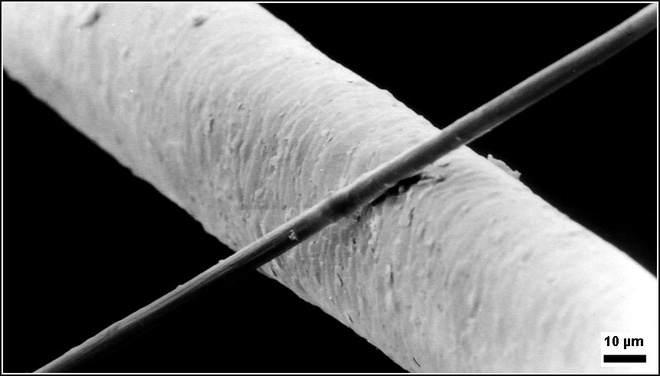
Previous experiments have shown that a light source can accelerate particles at a microscopic scale. The new device is developed based on that theoretical framework and then improved in many ways with a new design, capable of shooting particles at speeds of 94% the speed of light.
“The important thing about this research is that our device is the first example of a chip that contains a dielectric laser accelerator,” researcher Sapra said. “This is the path to larger systems, with even greater capabilities.”
The team of scientists achieved this breakthrough with a “reverse photon design,” meaning they obtained a design for the accelerator using a computer that employed optimization algorithms while observing the behavior of photons at the nanoscale.
The design of the accelerator used a chip with a flat surface and numerous grooves to guide electrons. When an infrared laser beam hits the chip’s surface, electrons accelerate and gain approximately 1 kiloelectronvolt – 1 KeV of energy.
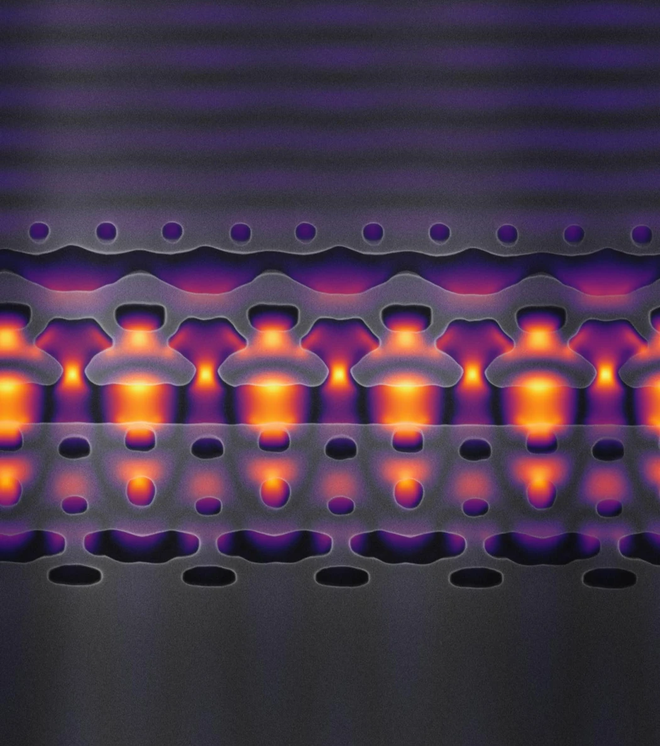
“Just look at this chip design, no ordinary engineer could come up with it“, Sapra said. “I don’t think I could have done it without applying the reverse photon technique, as finding this design is extremely difficult if we just used the old methods“.
Currently, the DLA design is still weak, and the scale of the machine needs to be a thousand times larger for this accelerator to reach megaelectronvolt – the operational level of particle accelerators. The research team believes it will take about 5 to 10 years to create the first prototype of this small particle accelerator, which will reduce costs and increase accuracy in many research fields, especially in medicine.
“These photon circuits are also based on principles from the electronics industry, so this is not just an effort to create a smaller machine; it’s an attempt to reduce the cost of the equipment,” Sapra said.
Reference: Vice