


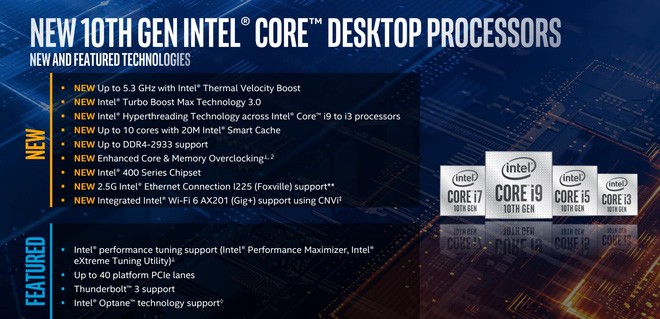
The most successful mainstream CPU in Intel’s history, the Core i has just launched its 10th generation with the codename Comet Lake-S. One of the most valuable improvements for users compared to the previous generation is likely the Hyperthreading technology, which was disabled on the Coffee Lake refresh line due to security vulnerabilities. Not only that, users can now enable or disable Hyperthreading on each CPU core. Thanks to this, the i9-10900K now boasts a boost clock speed of up to 5.3 GHz for single-core. Aside from the mentioned points, the new generation of Intel CPUs is not particularly remarkable compared to the previous generation, especially since they are still produced on the 14nm process. Nevertheless, Comet Lake-S in general, and the i9-10900K in particular, are still considered the best gaming CPUs on the market, at least according to Intel’s claims.
This is also the first time Intel has launched as many as 32 CPU models for the desktop personal computer market. Notably, there is a plethora of CPUs with the suffix F (lacking integrated graphics) and T (CPUs with a power consumption of only 35W, optimized for small-form-factor designs, which have been trending in PC builds for the past two years).
With a tradition of changing sockets every two CPU generations, in the 10th generation, Comet Lake S will use the LGA 1200 socket to meet the power requirements of 125W and above for K-suffix CPUs (unlocked for overclocking). This is also the weak point of Intel CPUs at the moment when compared to competitors from AMD. One thing is certain, no mainstream Intel CPU has been able to beat the Ryzen 9 3950X with its 16 cores and 32 threads in computational performance. Therefore, in its media publications, Intel mainly emphasizes single-core performance as well as gaming capabilities and running Adobe applications, which is a strength that AMD’s superior core/thread count has yet to reach.
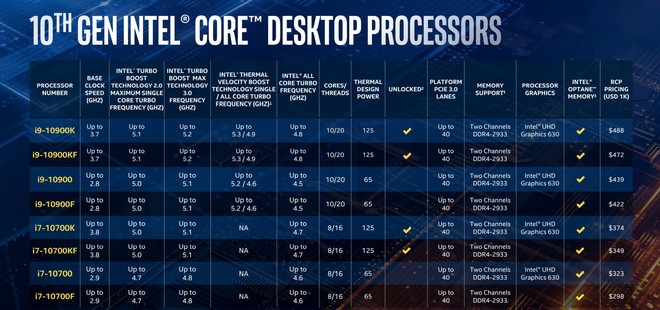
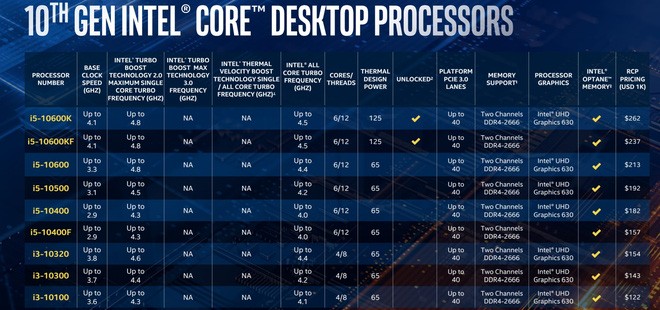
According to Brandt Guttridge, Senior Marketing Director for Intel’s desktop and workstation segment, the current goal of Intel is to improve clock speeds, overclocking capabilities, and real-world performance. We can see that the competition in the mainstream CPU market is heating up day by day. Leading the Comet Lake-S lineup is the Core i9-10900K, priced the same as the i9-9900K at $488. However, in terms of the best price/performance (p/p), the Core i5-10600K with 6 cores and 12 threads is expected to dominate the market. The issue is that the power of Comet Lake-S comes with a hefty price tag. The power consumption and thermal output (TDP) of the 10th generation Core i has reached 125W, an increase of about 25% compared to the 95W of the 9th generation. Meanwhile, the TDP of AMD’s Ryzen 9 3950X (16 cores/32 threads) and 3900X (12 cores/24 threads) is only 105W.
The turbo-boost self-overclocking capability of Comet Lake-S is also a new feature. Although Turbo Boost Max Technology 3.0 has been available on the Broadwell-E line since 2016, this is the first time this technology has been applied to mainstream CPUs. In this case, the self-overclocking technology will select one core deemed the strongest for overclocking. The improvement after four years is that the Comet Lake CPUs will choose up to two cores to overclock without needing to increase the input voltage.
Additionally, the i9 CPUs are equipped with Thermal Velocity Boost technology, which can read information from the CPU’s temperature sensors to add 200 MHz to the clock speed if the system is equipped with adequate cooling. Not only the processing cores but also the UHD 630 graphics cores will be overclocked from 350 MHz to 1.2 GHz if necessary.
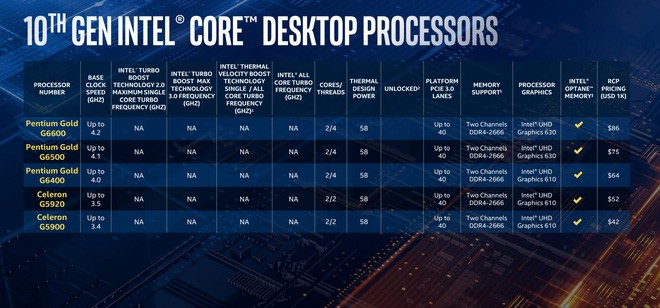
In this market “carpet bombing,” Intel has also introduced eight budget CPU models priced under $100 with a TDP of only 58W. This is also the segment where Intel will continue to maintain its dominance with five Pentium Gold CPUs equipped with Hyperthreading technology. Only three Celeron CPU lines lack the hyper-threading technology.
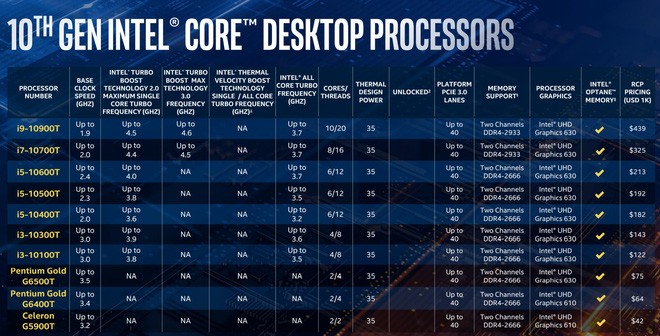
Lastly, we cannot forget the T-suffix CPUs, which are power-efficient CPUs designed for the next generation of Intel NUC and small form factor (SFF) devices. Despite having a TDP of only 35W, the T series of Comet Lake-S includes powerful models such as the i9-10900T and i7-10700T.
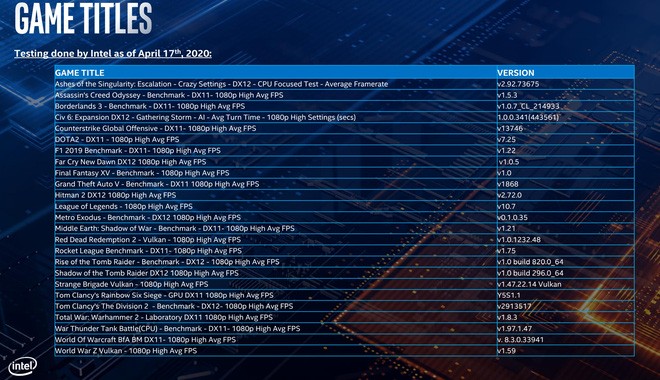
In terms of performance, although Intel lags in technology by sticking with the 14nm transistor size (which has been improved five times), the overall performance of the Intel Comet Lake-S CPUs is still very impressive, on par with AMD’s 3rd generation Ryzen CPUs that use 7nm transistors at a similar price point. Nevertheless, Intel’s transistor density still surpasses its competitors, for instance, Intel’s 14nm process has a density significantly higher than TSMC’s 10nm (the chip manufacturer for AMD). Looking ahead, when Intel unveils its 10nm CPUs, their performance will surely surpass to once again secure Intel’s leading position. Back to the present, the Core i9-10900K will help Intel strengthen its gaming crown by outperforming even the Ryzen 9 3950X in 25 games.

Intel maintains its stance that real-world performance is what matters, not just benchmark numbers. In fact, Intel even brought the i9-9900K and i7-7700K for comparison. When paired with the Nvidia RTX 2080 Ti, the flagship CPU of Comet Lake-S shows performance improvements of up to 81%.
Intel’s reasoning (or excuse) for overclocking certain CPU cores higher is based on their studies: 95% of systems with Steam installed utilize no more than 6 CPU cores. Therefore, clock speeds over 6 CPU cores will be a crucial factor in improving performance. Alongside this is the ability to disable Hyperthreading on unused CPU cores to optimize temperatures. This technology may soon be adopted by AMD to address thermal issues in their high-end CPUs.
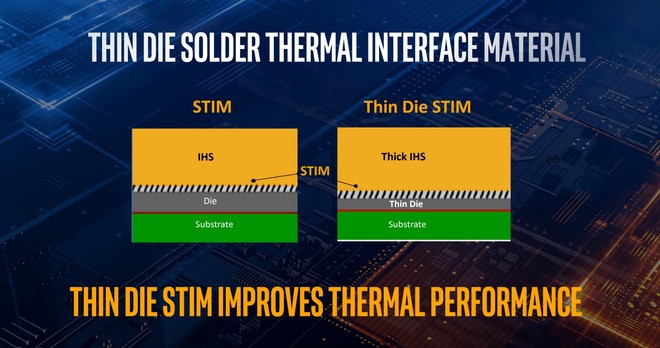
Due to the effort to cram in more CPU cores, temperature has become one of the biggest headaches for Intel with this new CPU generation. To address this issue, the blue team has had to improve the chip design and the thermal spreader. Now, the silicon base of the CPU will be thinner while the IHS will be thicker to dissipate more heat.
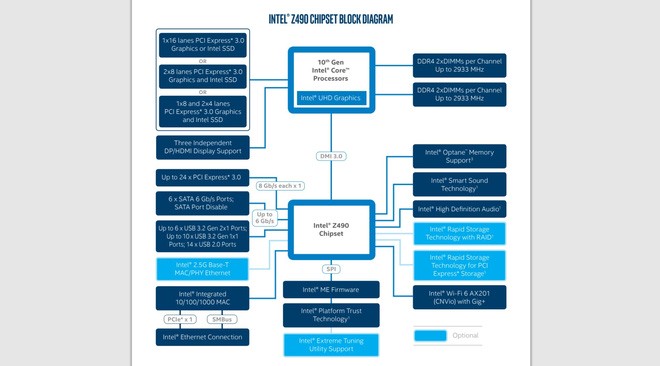
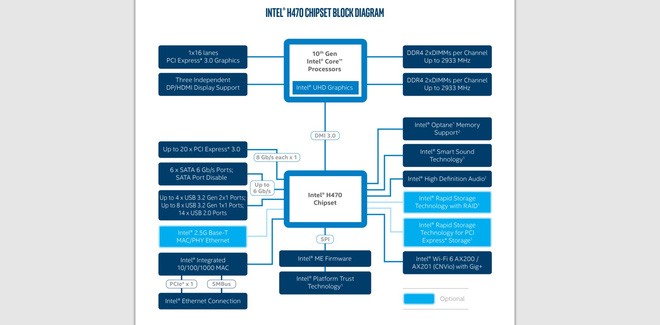
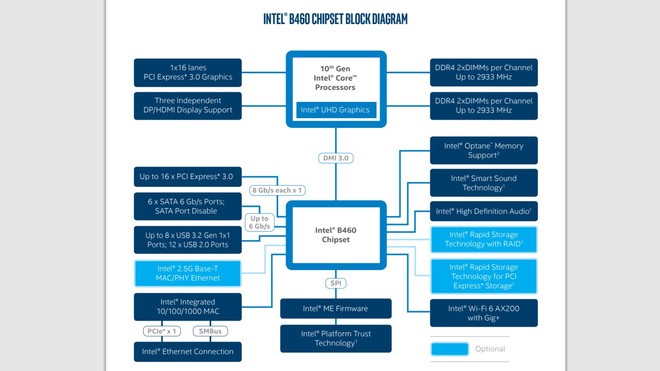
Alongside the 10th generation Core i, Intel has also introduced four new 400 series chipsets, still based on the old naming convention: Z490, H470, B460, and H410. The most disappointing aspect of this chipset generation is perhaps the continued support for the PCI Express 3.0 protocol while motherboards across the aisle have been equipped with PCI Express 4.0 since late last year. Otherwise, the four new chipsets have very little difference compared to their predecessors, except for additional support for Wi-Fi 6.
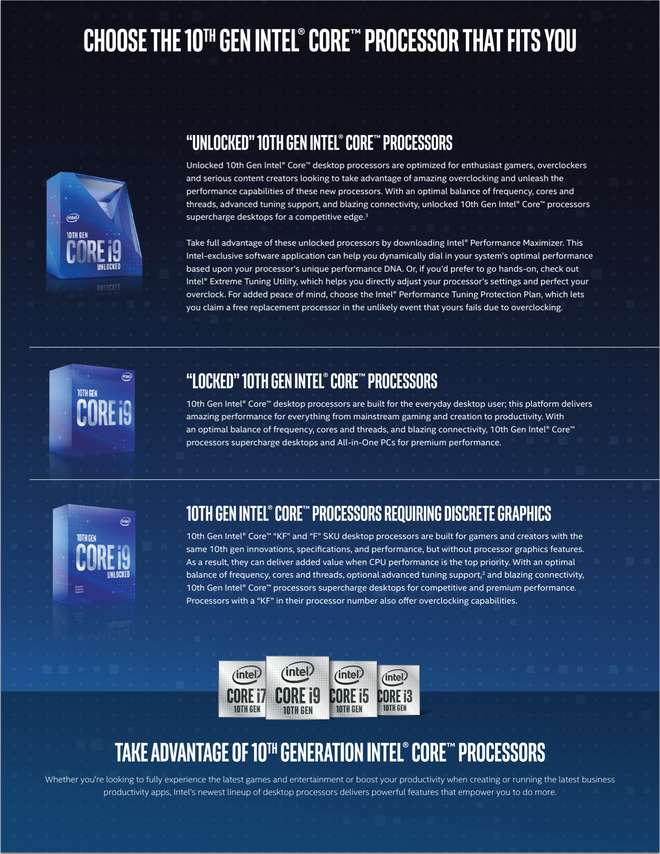
In summary, the 10th generation Intel Core i can still be seen as a roughly 25% improvement over the previous generation, following the company’s long-standing tradition. Not to mention this time, Intel has also launched completely new product packaging, distinct from previous generations.
However, Comet Lake-S is not truly a worthwhile upgrade, especially if you already own a desktop equipped with Coffee Lake. It should also be noted that AMD’s contribution is significant as now users can own an i7-10700K with 8 cores and 16 threads for just $300, double the number compared to three years ago with the i7-7700K at the same price point. The real-world performance of this CPU line will soon be evaluated by us in the near future.