


Discovered for the first time in the 1990s, Zealandia was officially recognized as the eighth and also the smallest continent on Earth in 2017. Often likened to the mythical lost kingdom of Atlantis, the continent of Zealandia is located east of Australia, covering an area of about 4.9 million km2.
Zealandia is believed to have existed alongside the seven continents (Asia, Europe, Africa, North America, South America, Australia, Antarctica) for many years in Earth’s history before it gradually sank beneath the sea about 30-50 million years ago.
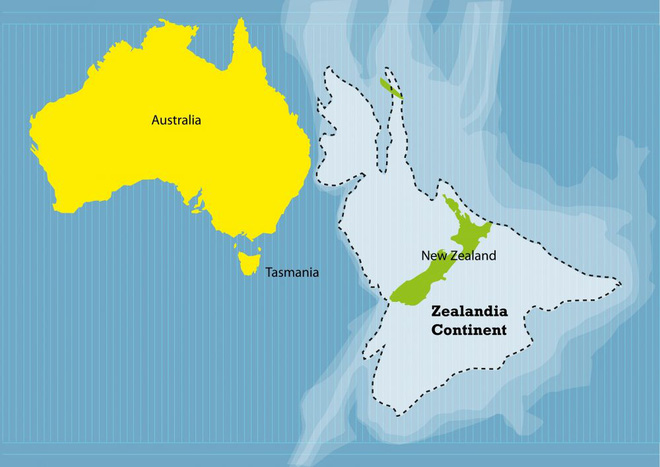
After three years of continuous research, scientists at GNS Science in New Zealand have recently created the most detailed map to date of the continent Zealandia, according to Business Insider. The maps describe the shape of the seabed and the tectonic characteristics of Zealandia, revealing the origin of this continent while helping to explain the formation of volcanoes, sediment basins, and many other geological features of New Zealand.
“We created these maps to provide the most accurate, complete, and up-to-date picture of the geology of the New Zealand area and the southwest Pacific – better than what we had before,” said expert Nick Mortimer, the head of the project.
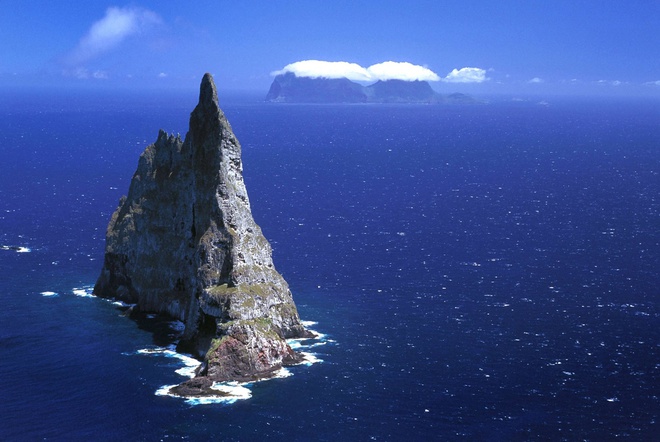
Balls Pyramid, the remnants of a volcano formed 6.4 million years ago, is a point above sea level of Zealandia
Submerged Thousands of Meters Beneath the Pacific Ocean
According to research from scientists, around 200 million years ago, the supercontinent Pangaea split into two parts: the supercontinent Laurasia and Gondwana. These two supercontinents continued to break apart into smaller continents. Laurasia in the north later split into Europe, Asia, and North America, while the supercontinent Gondwana split to form Africa, Antarctica, South America, and present-day Australia. Specifically for Zealandia, this continent separated from Australia and Antarctica as part of the Gondwana supercontinent about 80 million years ago.
Geological surveys show that the size of this continent is about 5 million km2, roughly half the size of Australia and comparable to the size of the Indian subcontinent. However, most of the area of Zealandia is submerged beneath sea level, at depths of thousands of meters. Meanwhile, only 7% of Zealandia is above sea level, including the North Island and South Island of New Zealand, along with New Caledonia.
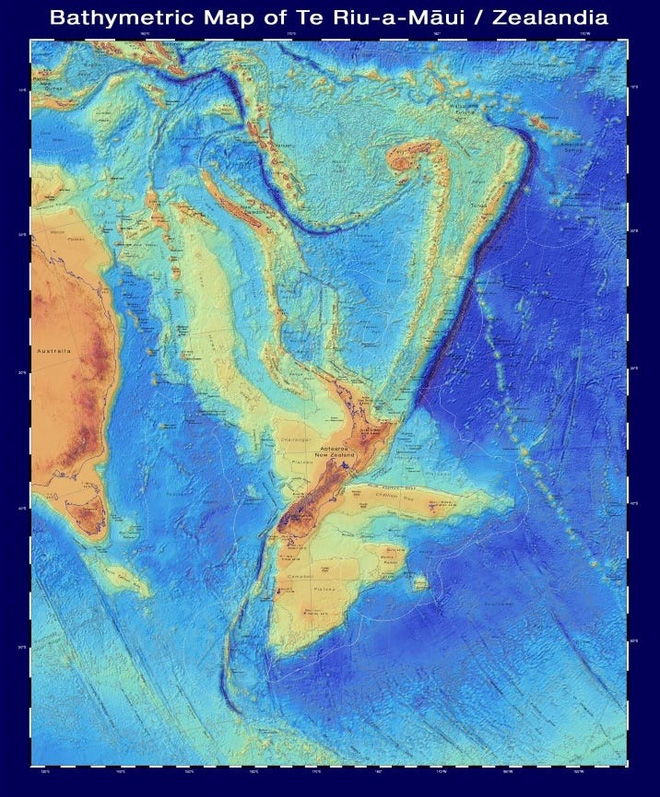
Thus, surveying and mapping the continent of Zealandia is truly a challenging task for researchers. To better understand this submerged continent, Mr. Mortimer and his team mapped the depth of both Zealandia and the surrounding ocean floor, showing how close the mountains and ridges of this continent are to the water’s surface. At the same time, this map also describes the coastline, territorial boundaries, and main characteristics of the Zealandia continent.
The second map created by GNS scientists describes the layers of crust that make up the continent, their ages, and major faults, helping to better understand the tectonic history of Zealandia. The older continental crust is represented in red, orange, yellow, and brown. The younger oceanic crust is colored blue. The red triangle marks the locations of volcanoes.
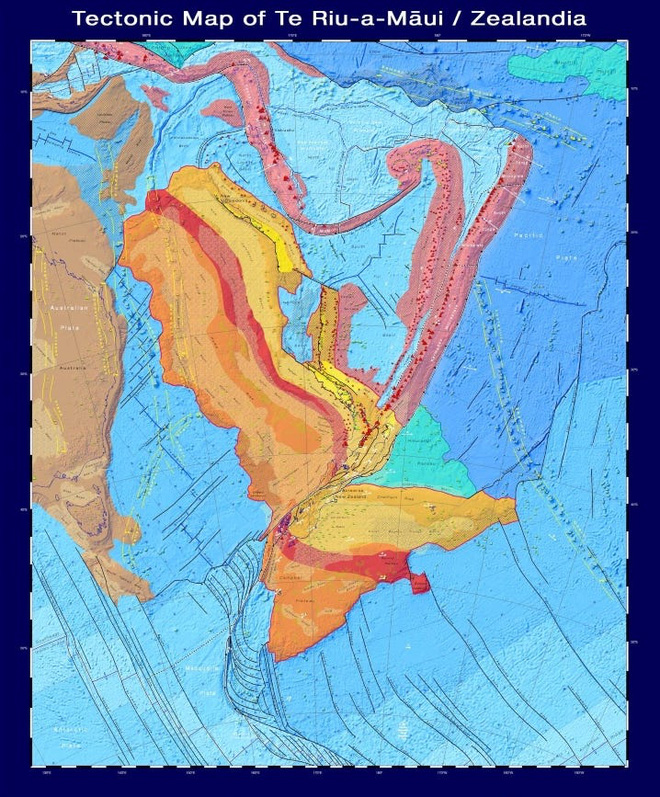
This map also shows that Zealandia lies on different tectonic plates. These plates are being pushed against each other in a process called “subduction.” Studying the tectonic processes of Zealandia today may reveal clues about how this continent formed in its early days.
Source: Business Insider