


Are we all just living in a computer simulation, a video game programmed by someone “out there”? The question may seem absurd. However, many intelligent people, including Elon Musk, Nick Bostrom, and John Wheeler, a physicist from the Einstein era, believe this is entirely possible.
Nick Bostrom is a philosopher at the University of Oxford. He is famous for an argument regarding the simulation hypothesis, which states that at least one of the following three propositions is likely true:
1) All civilizations similar to human civilization in the universe go extinct before developing a technology capable of creating simulated realities.
2) If any civilization reaches this technological level, none of them would care to create a simulated world (Perhaps they are concerned with other matters beyond what we are thinking).
3) Advanced civilizations would have the capability to create many simulated worlds. Just as we are producing countless video games in our world, this implies that there would be more simulated worlds than actual ones.
We cannot know for certain which of these three scenarios is happening, Bostrom concludes. But everything he suggests could become reality. And if so, scenario three could even be the most plausible outcome.
In a universe where there are more virtual worlds than real ones, the probability that the world we exist in is virtual is greater than that we are in a real world.
It’s quite perplexing, isn’t it? But to delve deeper into Bostrom’s argument, Rizwan Virk, a computer scientist and video game designer, wrote and published a book in 2019 titled “The Simulation Hypothesis“.
“The idea that we are all just characters in a video game created by an advanced civilization is fantastic,” Virk said. “I reached out to Bostrom and asked if he could explain that idea to me in more detail.”
As a result, Virk has a whole book discussing the hypothesis that our world is a simulation. He also outlined a technological development path toward a “Simulation Point“, where humans could create new simulated worlds indistinguishable from our own, just like in The Matrix.
In an interview with Vox, here’s what you can learn about the simulation hypothesis from Rizwan Virk. His interview answers have been lightly edited for clarity.

Rizwan Virk: The simulation hypothesis is a modern version of an idea that has existed for quite some time. That idea states that the physical world we are living in, including Earth and the rest of the physical universe, is actually just a virtual simulation on a computer.
You can think of it like a high-resolution video game, achieving a great level of realism in which we are all characters. The best way to visualize the simulation hypothesis in Western culture is to compare it to The Matrix.
Many people have seen this movie, and even if they haven’t, they have at least seen images or concepts from The Matrix somewhere. The Matrix has now become a cultural phenomenon beyond the film industry.
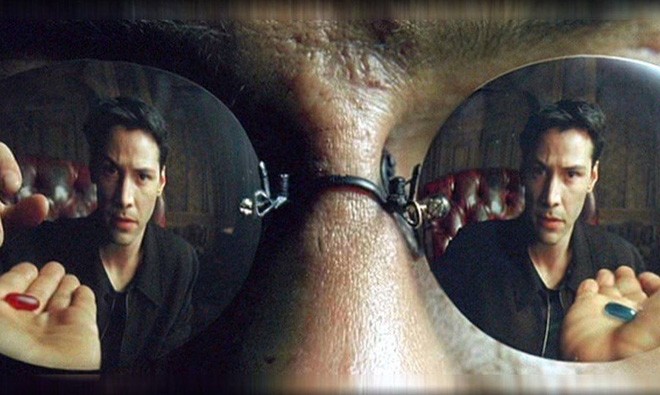
In the film, Keanu Reeves plays the character Neo, who meets a man named Morpheus, named after the god of dreams in Greek mythology. Morpheus offers Neo two choices: to take a red pill or a blue pill.
If Neo takes the red pill, he will wake up and realize that his entire life, including his job, the building he lives in, and everything else, is just part of a complex video game. By taking the red pill, Neo will awaken in a world outside the game.
That is the basic version of the simulation hypothesis.

There are many mysteries in physics that can be explained by the simulation hypothesis but not by material theories.
The truth is there are many things in this reality that we cannot comprehend, and I think it is quite possible that we are in some kind of simulated universe. This reality could be a much more complex video game than all the games we have ever produced. It’s similar to how World of Warcraft and Fortnite today are much more complex than Pac-Man or Space Invaders.
Game developers have spent decades figuring out how to model 3D physical objects. Then they had to use old computers to render them. The result is the online video games we have today.
I think there is a very high likelihood that we are living in a simulation, even though we cannot be 100% confident in saying that. But there is a lot of evidence supporting this hypothesis.

Well, there are several different aspects, one of which is a mystery that people call quantum uncertainty. It is the idea that a particle can be in many different states at once, and you cannot know which state it is in unless you observe that particle.
Perhaps a better way to understand quantum uncertainty is the famous example of Schrödinger’s cat. It is a cat that physicist Erwin Schrödinger imagined. He placed it in a box with a radioactive substance that has a 50% chance of decaying and emitting radiation within an hour.
If the substance emits radiation, it will trigger a Geiger counter. This Geiger counter will drop a hammer that shatters a vial of cyanide poison in the box, killing the cat.
Conversely, if no radiation is emitted within an hour, the cat will still be alive.
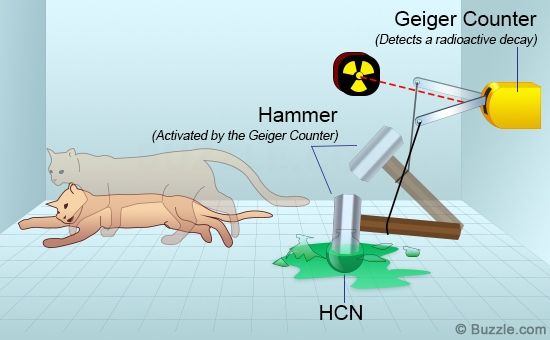
Now, at some point before opening the box, common sense tells us that the cat must be in one of two states: either alive or dead. We know it must have a state; we just don’t know what that state is since we cannot look inside the box.
This means that only when the box is opened will it reveal whether the cat is alive or dead at the exact moment the box is opened. Reversing all the time the box remains closed, we know nothing.
But with quantum physics, we will know that the cat is both alive and dead while it is in the box. This is certainly a truly new idea. The cat can be simultaneously in both states of alive and dead until someone opens the box to observe it, and one state exists while the other disappears.
The fundamental principle here is that the universe only renders the images that you need to see.

The entire history of video game development has been about optimizing limited resources. If you asked someone in the 1980s whether I could render a game like World of Warcraft, a 3D game, or a virtual reality game, they would say “No, it would require all the computational power in the world. We cannot display all those pixels in real time.”
What we have achieved today is entirely thanks to optimization techniques. The core of all optimization work is to “only render what is being observed.”
Doom, a famous video game from the 1990s, was the first heavyweight game to do this. It is a first-person shooter and only renders lights and objects that are clearly visible from the camera’s viewpoint.
This is an optimization technique, and it’s one of the things that makes me imagine our real world is just like a virtual game.

Now, going back to Schrödinger’s cat, we do not know if it is actually alive or dead because the universe will not render images we do not see. This is because the computer system creating our universe is optimized. When you look forward, the universe will cease to render everything behind you.
You might think: “Oh, I will just hold up a mirror.” However, the universe knows that you will look in the mirror and will render what is behind you in the reflection of that mirror.
You might think: “Then I will install a wide-angle surveillance camera that can see the entire room.” The universe will render a room, but just the images present in that room on the screen of the computer where you are viewing the video of the room at that exact moment you are watching it.
The entire room, the video footage of that room, the footage you fast-forward through without watching… in short, everything you do not see at any given moment is something the universe will not render for you just to optimize the machine it creates our world.

I will introduce a very famous physicist, John Wheeler. He was one of the last physicists to work with Albert Einstein and many great physicists of the 20th century. Wheeler once said that physics originally served the purpose of studying physical objects, that everything could be broken down into particles. This is often referred to as the Newtonian model.
But then we discovered quantum physics and realized that everything is a probability field rather than actual physical objects. This was the second wave in Wheeler’s career.
The third wave in his career was the discovery that at a fundamental level, everything is information, everything is based on bits. Therefore, Wheeler came up with the famous phrase: “it from bit“. This is the idea that everything we see, we think is a physical object, but in reality, they are all the result of bits of information.
Unfortunately, Wheeler did not live to see quantum computers become a reality, but his ideas surpass that.
At this point, I would say that if the world we see is not actually a physical world, if it is based on information, then a simple explanation could be that we are in a simulation created based on information and computer science.

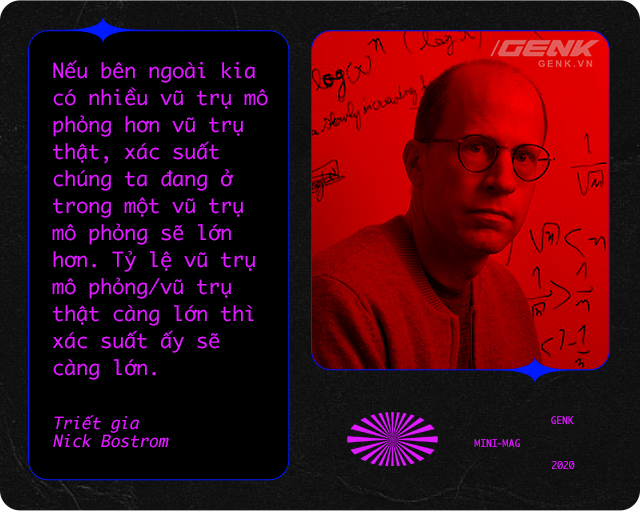
Well, there is an argument that philosopher Nick Bostrom from the University of Oxford raised. And that argument deserves to be reiterated here. He said that as long as there is a civilization that reaches a certain level to create a highly realistic simulation like the world we live in, they will be able to create billions of simulated civilizations in the literal sense.
Each of these civilizations contains trillions of beings, but creating a virtual world is always very easy because all you need is greater computational power. Think about planting a real tree outside, waiting for it to grow into a full tree over ten years, versus creating a billion simulated trees in a computer that just requires copy/pasting.
Therefore, Bostrom presents a statistical argument that, in reality, we will have more simulated beings than biological beings, simply because creating them is too quick and too easy. Thus, if we are conscious living beings, we are more likely to be a simulated entity than a biological being. That is certainly a philosophical argument.
Sean Illing: If we are living in a computer program, I think that program would include physical laws, and those laws could be broken or stopped by the beings or entities that programmed the simulation.

Computers adhere to laws, but the fact that those laws are always true does not necessarily exclude the possibility that you are in a simulation.
One of the concepts related to this issue is called incomputability. The idea is that to find something out, you cannot just compute it in an equation; you must really go through each step to determine what the final result will be.
And this is part of a branch of mathematics known as chaos theory. There is a notion that a butterfly flapping its wings in China can lead to a storm somewhere else in the world. To find that out, you have to actually go through and model each step from when the butterfly flaps its wings to when the storm forms.
Therefore, just because the laws seem to always be true does not mean that we are not in a simulation. In fact, it could be more evidence that we are in a simulation.

Sean Illing: If we are living in a simulation as realistic as The Matrix, is there a clear distinction between the simulation and the reality out there?

There is much debate surrounding this topic. Some of us wouldn’t want to know and prefer to take the “blue pill” like in The Matrix.
Perhaps the most important question regarding this is: Are we NPCs (non-player characters) or PCs (player characters) in this game? If we are PCs, that means we are playing a character in the video game of life, which I call the Great Simulation. I think many of us want to know this. We want to understand the parameters of the game we are playing to navigate better.
But if we are NPCs, or simulated characters, then I think there must be a more complex and frightening answer. The question arises: If we are all NPCs in a simulation, what is the purpose of that simulation?
Just think that we are in a simulation; I think the goal of the simulation as well as the goal of characters would still fascinate many. Now, let’s return to the case of the holodeck room in Star Trek. It is a room that creates a simulated world and simulated characters.
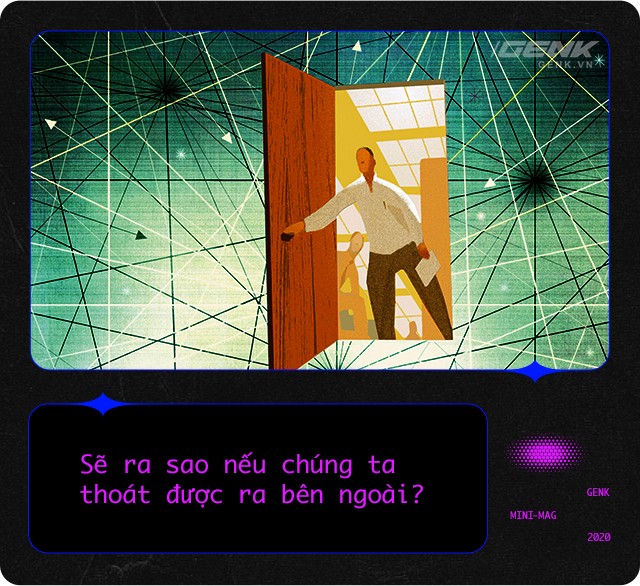
Imagine a simulated character in the holodeck discovering that there is a world “out there” (outside the ship) that he cannot reach. And then, putting yourself in his position, what would you think about a world outside this world that you cannot access?

I have outlined 10 stages of technological development that a civilization would have to go through to reach what I call the simulation point, which is the point at which we can create a hyper-realistic simulation like this world.
We are currently at stage five, revolving around virtual reality and augmented reality. Stage six is learning how to render images without needing to wear virtual reality glasses. It’s like a 3D printer that can print 3D pixels of every object and shows us that most physical objects can be broken down into information.
But the truly difficult part—and this is something not many tech developers talk about—is that in The Matrix, humans have wires connected to their brains, where information is transmitted. Brain-computer interfaces are a field where we have not made much progress yet. Currently, we have only developed early-stage brain-computer interfaces, but the field is making strides.
So my prediction is that within a few decades to 100 years, we will reach the simulation point.
Referenced from Vox