


In 1996, Herbert Fingarette was 75 years old. As a foreboding sign, the American philosopher wrote a book titled “Death: I Am Looking Forward to It from a Philosophical Perspective.”
In this book, Fingarette argues that all fearful thoughts about death are irrational. “Death is the end,” he wrote. Why should we be afraid when we ourselves will no longer exist to endure death and its fear?
Yet more than 20 years later, at the age of 97 and facing his own death, the philosopher now realizes that he was wrong. Death began to frighten Fingarette; it haunted his mind and made it impossible for him to stop thinking about it.
Ironically, Fingarette spent over 40 years teaching philosophy at the University of California, and he had also written extensively about the psychology of self-deception. Now, at the final threshold of life, he wonders whether he is deceiving himself about the meaning of life and death.
“It haunts me, the thought that I am about to die, whether there is a good reason or not”, Fingarette said in Andrew Hasse’s short documentary “At 97”. “I often walk around and ask myself: What is the meaning of this whole life?”
Hasse is Fingarette’s grandson, who filmed his grandfather’s final moments. The two were very close since Hasse was a child. Fingarette would often tell stories, record them on tape, and send them to Hasse, who lived 300 miles away.
Thus, even at a distance from his grandfather, Hasse could hear him telling stories before bed. “My grandfather is one of the most thoughtful men I’ve ever met,” Hasse said.
“At 97” is a profound film exploring the inner workings of old age and the struggle to accept the inevitable. Hasse quietly observes what is defining his grandfather’s existence: it could be stillness, the loss of mobility, and the acceptance that he now needs assistance.
“It is very hard for those who have not reached old age to understand the psychology of it, what is happening to their bodies and within their minds”, Fingarette said.
In one scene, Fingarette listens to a piece of music he once shared with his late wife. He had not listened to this music since her death 7 years ago. The loss of his wife was a significant blow in Fingarette’s life. It left him feeling empty, lonely, and “like half of me has died”.
“Her absence is now a presence for me”, Fingarette says in the film as the pain seems to swallow him again.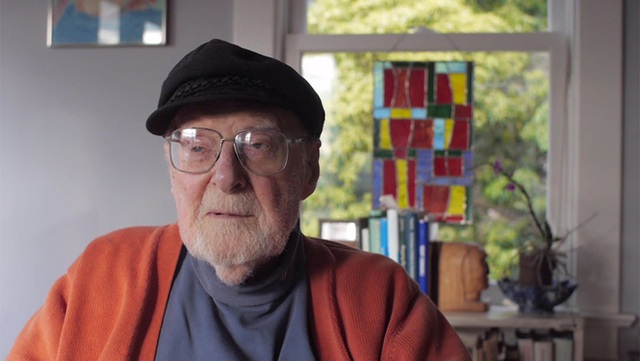
Hasse chose an artistic perspective to remove his own voice from the film. Therefore, while filming this scene, he had to suppress the urge to comfort his grandfather. Hasse said: “It is very hard to witness anyone in such pain without being able to comfort them, especially someone you care so much about.”
“I was sitting just a few feet away from him, but I couldn’t reach out because of the camera between us. All I wanted to do was put a hand on his shoulder, hold him, and be with him in that pain.”
After what seemed like an endless shot with Hasse, the filmmaker handed his grandfather a tissue to wipe his tears. In the film, you will see the footage ending just before this happens.
Fingarette also cried over very small and ordinary things in life. That was when he looked at the trees swaying in the wind right outside his porch. Fingarette recognized their wondrous beauty, despite having seen them his whole life.
It was only this time that the trees moved him. They transported him to a transcendent reality, an experience of a strong desire to live. “I think all our lives are like that,” Fingarette said. It is filled with ups and downs, happiness, and suffering. “Yet I still want to meander through life.”
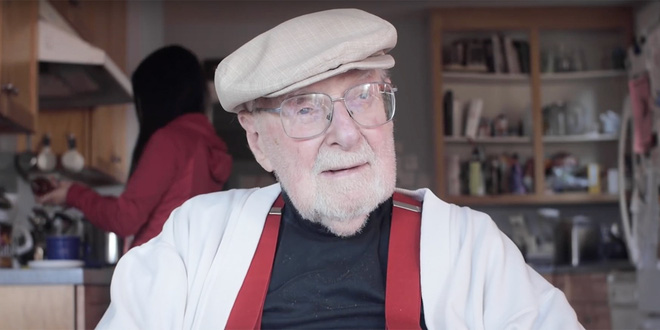
Fingarette passed away at the end of 2018 at the age of 97. Just weeks before, Hasse had shown him the ending of the documentary. “I think it helped him gain some insight into what he had gone through”, he said.
A day before he died, Fingarette said his last words. Hasse was there to witness it. After hours of silence, his grandfather suddenly looked up and said: “Well, that’s clear now!”.
Hasse himself was not sure what his grandfather meant. “But I want to believe that he was able to figure something out that transcended death,” he said.
Source: Atlantic