


The Earth is getting hotter. The past 7 years can be considered the hottest in human history. Since the period from 1850 to 1900, greenhouse gas emissions from human activities have caused the planet’s average annual temperature to rise by about 1.1 degrees Celsius. What we are experiencing is truly alarming, with a series of extreme weather conditions such as prolonged droughts, heavy rains, hurricanes, and terrifying floods. Natural disasters, which were already harsh, have become more brutal and intense than ever.
However, addressing climate change is not simple and cannot be achieved overnight. Just a few years, or even a few decades, are not enough for us to feel positive changes. However, for Earth-saving campaigns and environmental protection to occur in the most effective way, we need to foresee the future and sense what will happen with the highest accuracy.
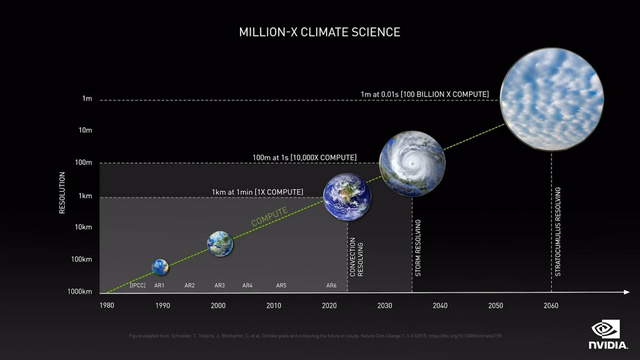
It may sound fictional, but that is precisely what NVIDIA is pursuing. At the GTC event held in mid-November, they unveiled the Earth-2 (E-2) project, the world’s most powerful AI supercomputer, a “twin” of our Earth on the Omniverse platform, a 3D simulation of the blue planet with the ability to make more accurate predictions about climate change.
According to CEO Jensen Huang, E-2 will utilize three advanced technologies: high-speed GPUs, deep learning, and AI supercomputing, along with a massive database about Earth. All of these will support the creation of ultra-high-resolution and the most accurate climate models.
In reality, there are many models like E-2 that exist, capable of determining factors such as air pressure, wind intensity, and temperature to create suitable equations, providing an objective view of climate patterns in specific areas. Such regions will be represented as a 3D grid. The smaller the area, the more accurate the calculations will be, and the simulation will be more realistic before it becomes unusable.
In other words, weather models need to solve more equations to achieve higher resolutions. However, taking on more equations can slow down the model, making it less efficient and gradually useless. This is also the problem that most current climate models face: a lack of both detail and accuracy.
The solution proposed by NVIDIA is a supercomputer that is larger, better, and faster. On the company’s blog, Huang wrote: “We need higher resolutions to accurately simulate changes in the global water cycle. We need meter-scale resolution to simulate how sunlight is reflected back into space by clouds. Scientists estimate that such resolutions require computational power millions to billions of times stronger than what we currently have.”
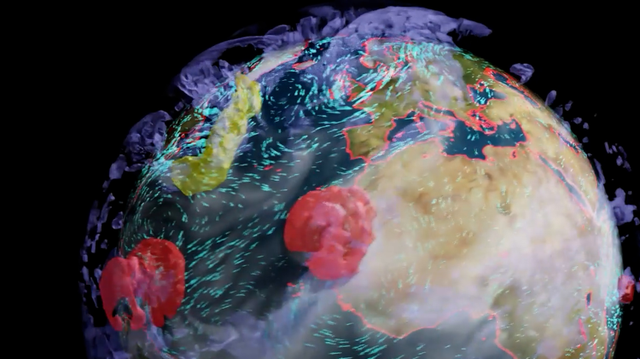
Returning to E-2, the digital twin of Earth is created to promote actions that both mitigate climate change and reduce its negative impacts on nature and humanity. Extreme weather phenomena such as storms, wildfires, heatwaves, or flash floods are becoming increasingly unpredictable, with even more devastating effects.
This situation could be somewhat improved if we could predict such natural disasters more accurately in the future. Huang hopes that NVIDIA’s model can forecast extreme weather changes decades in advance in many regions around the world. At that point, humans will have time to implement timely solutions, reasonable evacuation policies, or suitable projects to adapt well to such climate conditions.
E-2 will also be used to find reasonable solutions, simulating various plans to determine which approach yields the highest effectiveness at the lowest cost. This is also considered one of NVIDIA’s largest projects in recent years. Huang stated: “All the technologies we have created so far are essential to realize E-2. I am genuinely looking forward to the new features and more important tasks this model could undertake in the future.”
Not stopping at climate change.
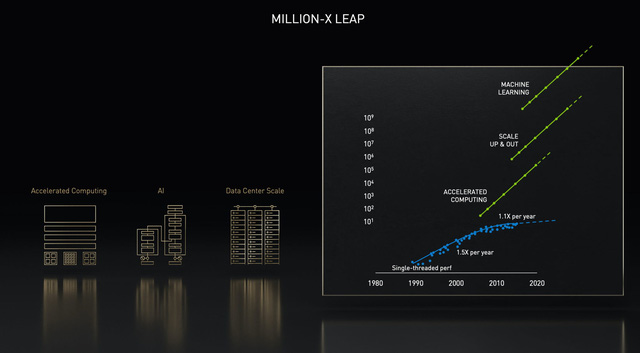
The combination of various technologies has allowed NVIDIA to create the most advanced and efficient Earth simulation while also solving many issues related to the speed of supercomputers, especially in research projects with vast databases.
Similar to E-2, NVIDIA has focused on developing three core technologies: high-performance computing, AI, and the scale of data centers. This not only helps them to simulate Earth but also to create many digital twins of cities and factories around the world. This large-scale simulation technology is still very new and full of potential.
Additionally, the research team at NVIDIA, Caltech, and startup Entos successfully combined machine learning with physics to create the OrbNet program. As a result, Entos can speed up the simulation of their new drug discovery by 1000 times, completing work that would have taken over 3 months in just about 3 hours.
According to VentureBeat, NVIDIA