


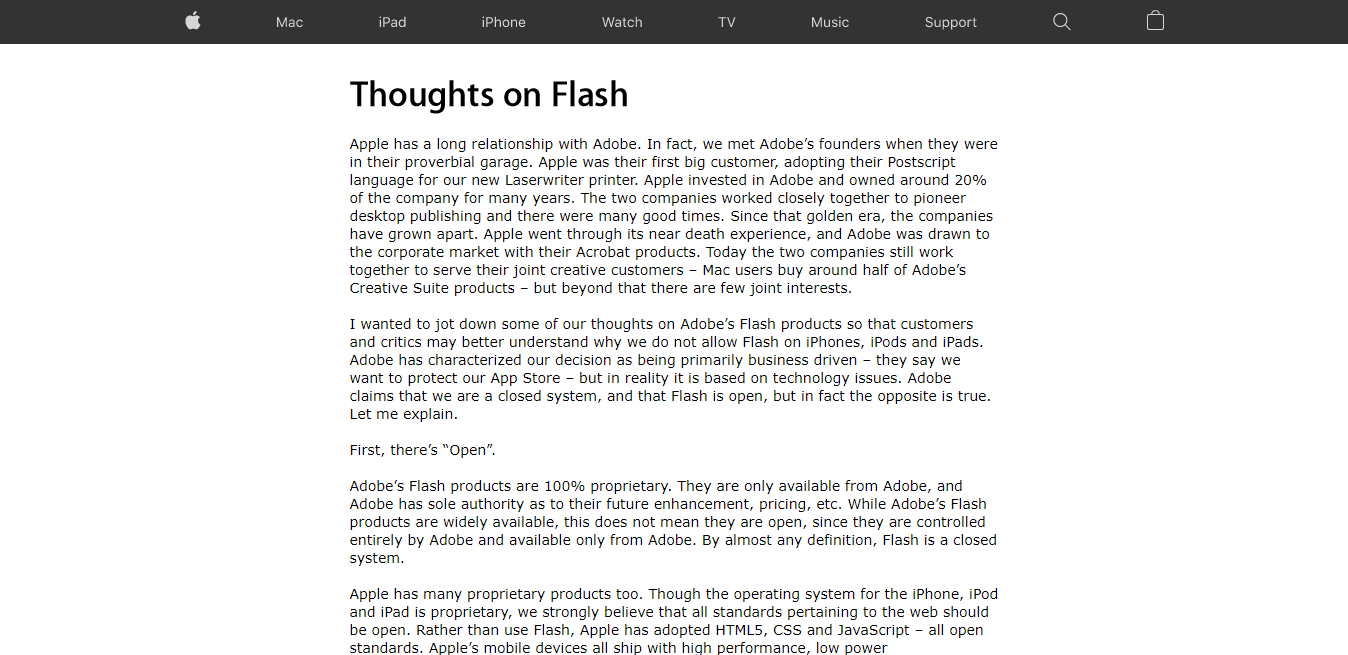
Ten years ago, on April 29, the late Apple CEO Steve Jobs wrote “Thoughts on Flash,” an open letter explaining why Adobe Flash was fundamentally bad. The letter marked the beginning of the end for the plugin that had been ubiquitous across web browsers for many years.
After this heavy criticism, Adobe CEO Shantanu Narayen fired back at Apple, disputing Jobs’ claims. However, the Apple CEO was very clear and insightful that iOS devices would never support Flash.

Jobs voiced several serious issues with Flash. He stated that it drained battery life, caused computer crashes, and had poor security. He also mentioned that the software did not work well on mobile devices as it did not properly support touch devices. Simply put, Jobs wrote that “Flash is no longer necessary to view video or consume any kind of web content.”
Apple also published this open letter signed by Steve Jobs on its website, which remains accessible to this day. Interested readers can revisit it here: Thoughts on Flash | Apple.
According to Bob Burrough, former software development director at Apple, the Cupertino-based company had tested the usability of Flash on the iPhone. But Jobs did not believe that Adobe would adequately address the software’s security issues.
However, the Adobe head countered Apple. He argued against the claims that Flash was terrible for battery life and stated that computer crashes were due to Apple’s own software faults.
At that time, tech experts had both Apple and Adobe embroiled in explosive debates. Some supported Apple’s complaints while others disagreed with them. However, a decade later, it seems that Jobs was entirely correct to raise concerns about Flash.
Accordingly, tech writer Walt Mossberg told Adobe CEO Narayen that Flash was also very poor on Android. In a July 2017 announcement, Adobe confirmed plans to retire Flash in 2020. In reality, Flash has almost “died” as it has been phased out from most websites over the past few years.
According to Techrum