


A research project related to amber fossils was published yesterday in Scientific Reports, providing quite a few unique images of spiders, ants, and even a pair of prehistoric flies in a mating embrace.
Amber fossils are fairly common in the Northern Hemisphere, especially in Myanmar, where various fossils have been discovered over the years. However, this new collection is one of the oldest amber fossils collected from the Southern Hemisphere, including excavation sites in Australia and New Zealand. The head of the research project is Jeffrey Stilwell from the Monash School of Earth, Atmosphere, and Environment.
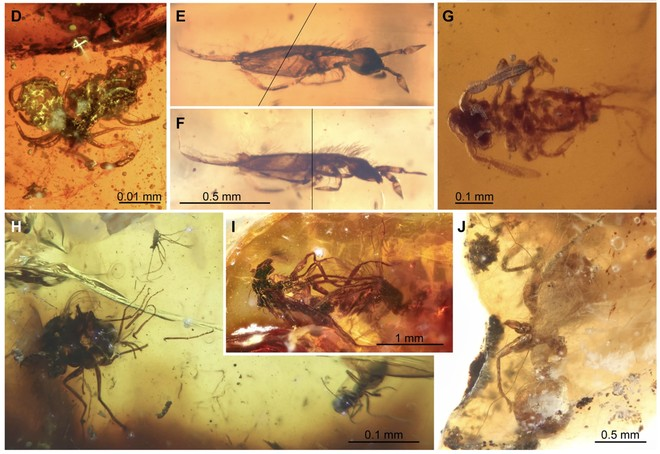
The new collection (see photo below) spans a long time frame, ranging from the Late Triassic about 230 million years ago to the Late Middle Eocene about 40 million years ago. Stilwell and his colleagues excavated thousands of amber pieces, many of which contain various animals, plants, and microorganisms.
Amber fossils are valuable because they show us a 3D model of specimens preserved indefinitely. In many rare cases, these fossils can even capture a specific behavior, such as mites crawling through dinosaur fur or a spider attacking a wasp. In this case, researchers found a pair of long-legged flies (Dolichopodidae) mating, which lived in southern Gondwana during the Late Middle Eocene, now known as Anglesea, Australia.
“This may be the first example of ‘frozen behavior’ in fossils ever found in Australia” – Stilwell said.
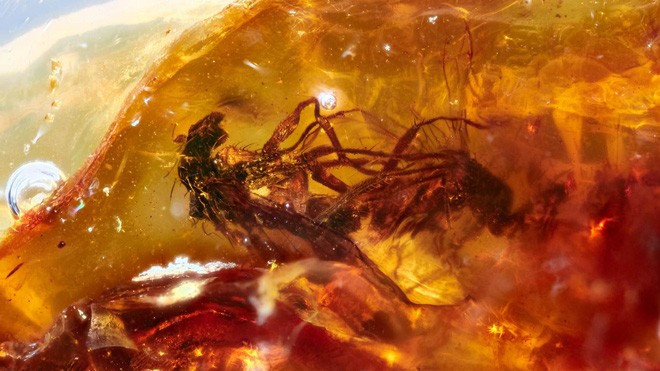
However, according to paleontologist Victoria McCoy from the University of Wisconsin, Milwaukee, these flies may not have actually been in that position when they died. “It’s possible one fly got stuck in amber, and the other found it appealing and attempted to mate” – McCoy said.
It sounds a bit ridiculous, but either way, these two flies have departed in peace!
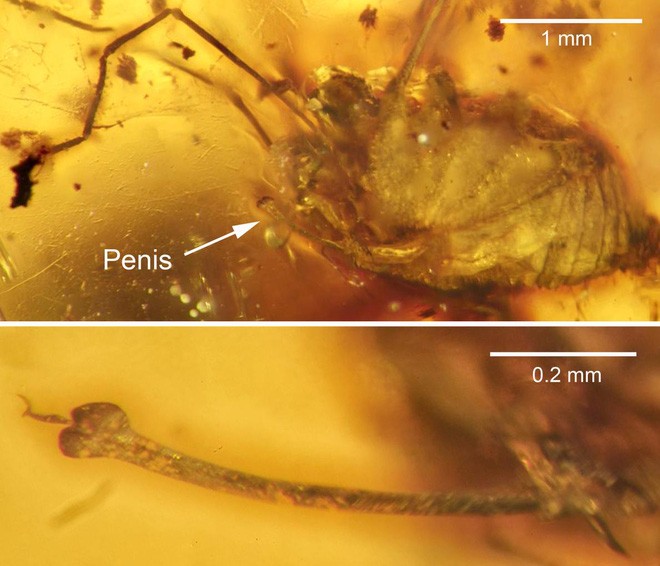
The story of these unfortunate flies caught in an awkward position for future generations to admire is still quite fortunate. In 2016, a 99-million-year-old amber specimen was discovered containing a long-legged spider (see below) with an erect penis – perhaps the longest and oldest erection in scientific history!
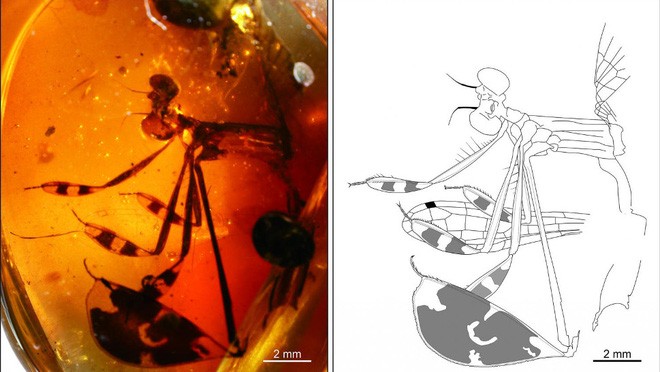
And another rather awkward moment is a 100-million-year-old fossil (see below) in China, where a male dragonfly is trying to mate with a female, and this unfortunate guy is also suffering from… blue balls (a condition causing testicular pressure that prevents ejaculation)! At least those long-legged flies had the chance to actually “get it on” with each other.
These amber fossils provide scientists with an unprecedented look at ecosystems that existed long ago in southern Pangea, southern Gondwana, and Zealandia. Starting from 200 to 175 million years ago, the lands that are now South America, Africa, Madagascar, India, Antarctica, and Australia began to separate from the supercontinent Pangea and formed the smaller supercontinent Gondwana.
In addition to the flies, the study also describes a newly discovered fossil ant species named Monomorium, and a small, wingless, myriapod species, both originating from southern Gondwana. Other species found in this amber collection include a swarm of baby spiders, several small insects, a type of plant called liverworts, and a few pieces of moss. Scientists even discovered a fossil dating back around 230 million years – the oldest ever seen in southern Pangea.
Scientists will continue to list the various animals found in amber, as many of them may be new species, and even new groups of animals altogether.
Source: Gizmodo