


A summary of an investigative report from Vice, conducted by technology reporter Jordan Pearson.
The sharp decline in oil prices is yet another testament to the impact of the Covid-19 pandemic on the global economy. The situation highlights instability across various sectors, but it inevitably reminds me of the time in 2017 when oil prices fell below $50 per barrel, when traders had to store oil in enormous but aging tankers.
I wonder: What if someone like me buys a large oil tanker, fills it with oil at bargain prices, to make a profit later? This idea is as strange as continuously extracting oil from the ground for consumption; let’s just “close our eyes and take the plunge,” and delve deeper into the economic factors related to storing large quantities of oil.
Price of the Tanker
According to a survey on Horizon Ship Brokers – a website for buying and selling ships for commercial purposes, brokers are offering several models of oil tankers. In most cases, you have to contact the seller to get a price; in a few instances where prices are publicly listed, a tanker typically costs around $10-20 million, and any tonnage is acceptable.
An ideal tanker should strike a balance between affordability and spacious cargo capacity; the oil market is very unstable now, so calculations must be made carefully.
The best deal currently is a 274-meter Suezmax crude oil tanker, priced at $17 million. This Suezmax was completed in 2000 by Daewoo Heavy Industries, and the vessel with a deadweight tonnage (DWT) of 159,057 tons is currently sailing somewhere in African waters. This is the largest tanker size capable of carrying oil through the Suez Canal.
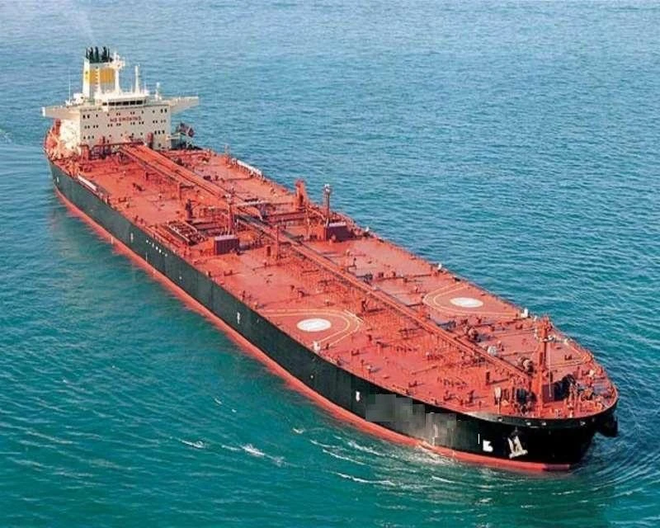
The deadweight tonnage does not represent the amount of oil in the cargo hold, as it includes equipment and personnel on board. The actual amount of oil a tanker can hold depends on many factors, but this remains a “within budget” option, considering the Suezmax’s cargo hold is quite spacious.
Be a savvy consumer; when inspecting the vessel, kick a few times on the hull and mutter a few times to appear knowledgeable.
Price of Oil
Now that we have determined the tanker to purchase, we need to consider how to store oil. Now, we ask questions like how much oil to buy, what type of oil, and how to buy it?
One trader told editor-in-chief Jason Koebler that buying oil is easy: just pay a reputable trader to handle the purchase of oil ownership contracts on your behalf. The key is that these contracts must be expired so that we can have real oil to load onto the tanker.
If you want to buy oil at the current price to have it “on hand” immediately, you would need to spend about $22 per barrel.
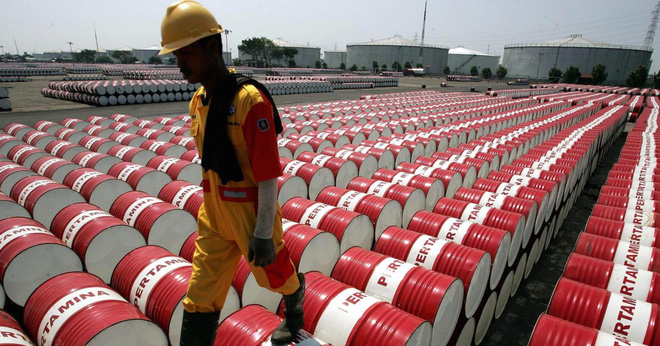
According to the U.S. Energy Information Administration, a quick calculation to convert the ship’s capacity to barrels of oil is to take 90% of the deadweight tonnage and convert it to barrels of oil per ton, plus or minus depending on the type of oil purchased. The Suezmax ship we just bought can hold approximately 143,151 tons of oil.
Different types of oil will have different weights, and varying levels of “sweet” (low toxicity) and “sour” (high toxicity). A type of crude oil that is both light and sweet like WTI will be the most profitable product.
Using a website that converts tons of oil to barrels, by inputting the specific gravity API of light sweet crude WTI and the current deadweight tonnage, we calculate a total of 1,088,741 barrels of oil. To purchase this amount of oil, we would need to spend $5 million, and if we are clever, we could even spend less on the oil.
If we cleverly purchase oil at -$37.61 (the price of oil one day before the original article was published), you would receive $40,969,323.83. This means that after buying the oil tanker, you would still have $24 million left to figure out how to load that massive amount of oil onto the ship, hire crew, and cover various other expenses. However, we could not act when oil prices were that low (the WTI price was at $16.94 per barrel at the time this summary was published).
So is there a profit?
Let’s do the math! According to the U.S. Department of Energy, crude oil is stored in salt domes to save costs. This method allows companies to store oil at a cost of about $3.50 per barrel, while each barrel placed on the ground costs about $15-18 per barrel.
We spend $17 million to buy the tanker, which can hold over 1 million barrels of oil; just calculating loosely, the storage cost per barrel will be around $17 per barrel. Not optimal, but not too bad either.
To make a profit, we would need to sell oil at a higher price than the cost of purchase and storage, which is currently at $23 per barrel. I won’t pretend to predict what future oil prices will be; let’s assume the price of light sweet crude WTI will return to the level of January 2020, which was $55 per barrel.
If that is the case, we would bring home a profit of 34,839,712 USD.
Conclusion
If you have $23 million on hand, a phone filled with contacts of reputable oil traders, and are ready to get rich during a pandemic, you are indeed the worst person in the world! Besides, you could also earn a little money by storing oil and selling it when prices rise.
These calculations miss many factors (like crew costs, operational maintenance, and many other expenses), but the point of this article is not to show that you can profit from investing in a rusty oil tanker. I am talking about how we are continuously extracting oil from the ground indiscriminately, and the idea of trading each barrel of oil on the stock market is indeed laughable.