


Have you ever heard of “Schrödinger’s Cat”? If you’re the type of person who “loves science,” then you might already know about it. Erwin Schrödinger was an Austrian physicist and one of the pioneering scientists who founded quantum mechanics, but what made him famous was an idea he never executed. And the main character of this idea is a cat (we’re starting to connect the dots here).
Schrödinger imagined placing a cat in a sealed box along with a device that has a 50% chance of killing it within an hour. When the hour of this experiment ends, he would ask: What is the state of the cat? From a normal person’s perspective, the cat could only be in one of two states: alive or dead, with a 50% probability for each.
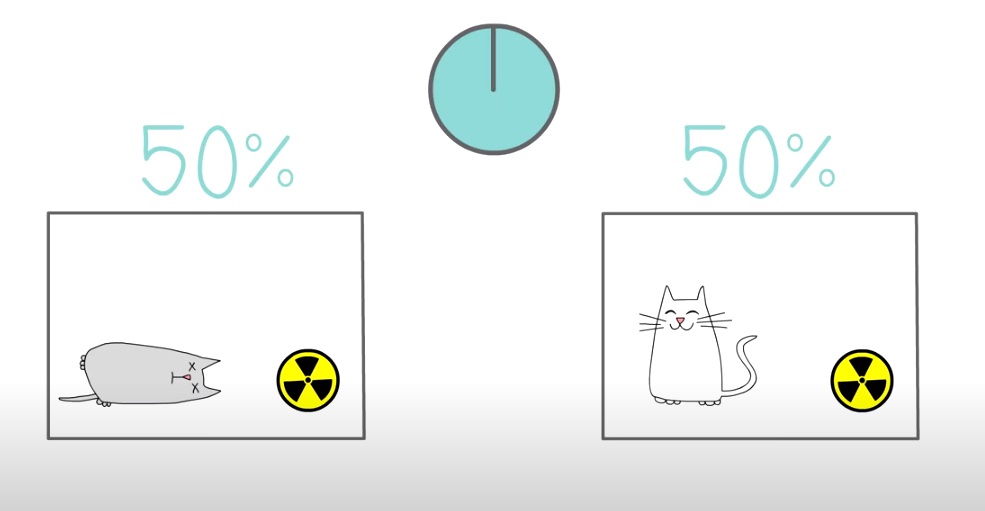
However, Schrödinger pointed out that according to quantum physics, at the moment before the box is opened to confirm the state of the cat, the cat would be both alive and dead. This means it would have two states of being alive and dead superimposed simultaneously. Only when the box is opened does the cat’s state become either alive or dead; before that, whether it is alive or dead is an unclear probability, half this and half that. It sounds absurd, but this is how quantum physics operates. It’s just that it contradicts common beliefs, which is why it seems unreasonable to you.
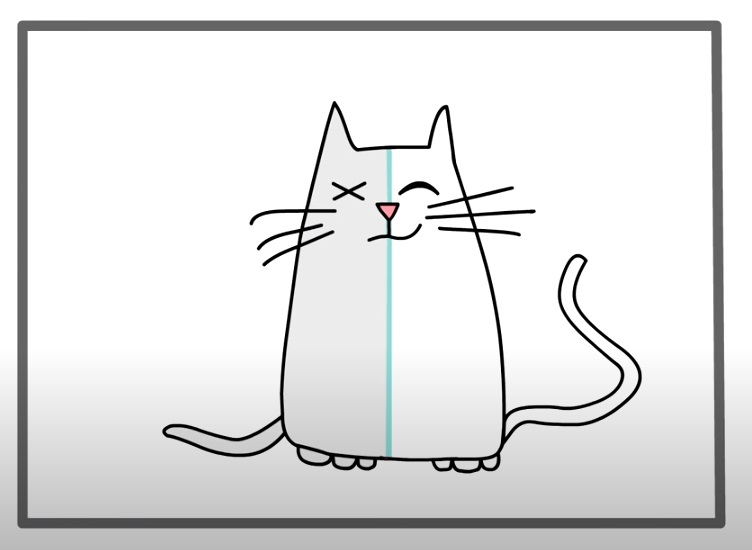
And even though it sounds ridiculous, Schrödinger’s thought experiment with the cat is very significant. In fact, if quantum matter could not exist in two states simultaneously (quantum superposition), there would be no computer or smartphone you are using to read this article.
Quantum superposition explains the wave-particle duality of matter. Thus, all matter moving in space will have both the properties of the corresponding propagating wave and the properties of the moving particles. The reason you don’t recognize it in daily life is that it is too small, too microscopic. It can only be easily observed at the atomic and subatomic levels.
If you’re interested, you can watch the original TED-Ed clip here:
An electron near an atomic nucleus moves in a dispersed orbital like a wave. When two atoms come close together to form a molecule, the electron does not choose one of the two atoms, it is not at A or B but at A + B, in both atoms simultaneously.

This superposition creates some chemical bonds of the molecule. In solids, electrons are not confined to any one atom but are shared among them. This colossal superposition determines how electrons move in materials, deciding the properties of conductive materials, insulating materials, and semiconductors.
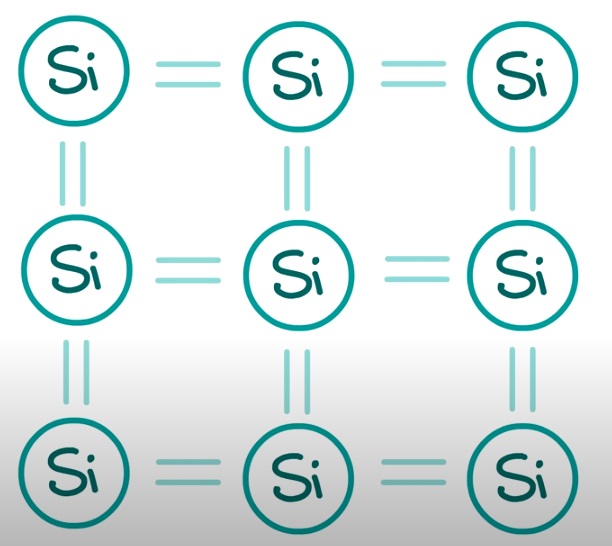
Understanding how electrons are shared among atoms will allow us to precisely control the properties of semiconductor materials, such as silicon. By properly combining multiple semiconductor materials, we can create semiconductor components like CPUs, GPUs, memory chips, and more. All of these contribute to the smart devices you are using to read this article.
There’s a joke that “the Internet exists for us to share information about cats” which sounds a bit silly and “cat-like,” but the truth is that the internet… no, the entire modern semiconductor technology owes its existence to that half-alive, half-dead cat in Schrödinger’s experiment, a cat that may not even exist.
Source: TED-Ed, translated by Gearvn