


In 2017, the oil painting titled Salvator Mundi (Savior of the World) was sold for $450.3 million at an auction held in New York; in certain respects, Salvator Mundi became the most expensive painting in the world after the successful transaction. It is believed to be one of the few paintings created by Leonardo da Vinci, yet many still question its authenticity.
The painting holds another mystery: Salvator Mundi depicts Jesus Christ holding a crystal orb symbolizing the celestial sphere of paradise. In reality, this transparent orb should function like a convex mirror, magnifying and reversing the garment behind it. However, the garment of Christ depicted in the painting does not align with this; the image appears only slightly distorted.
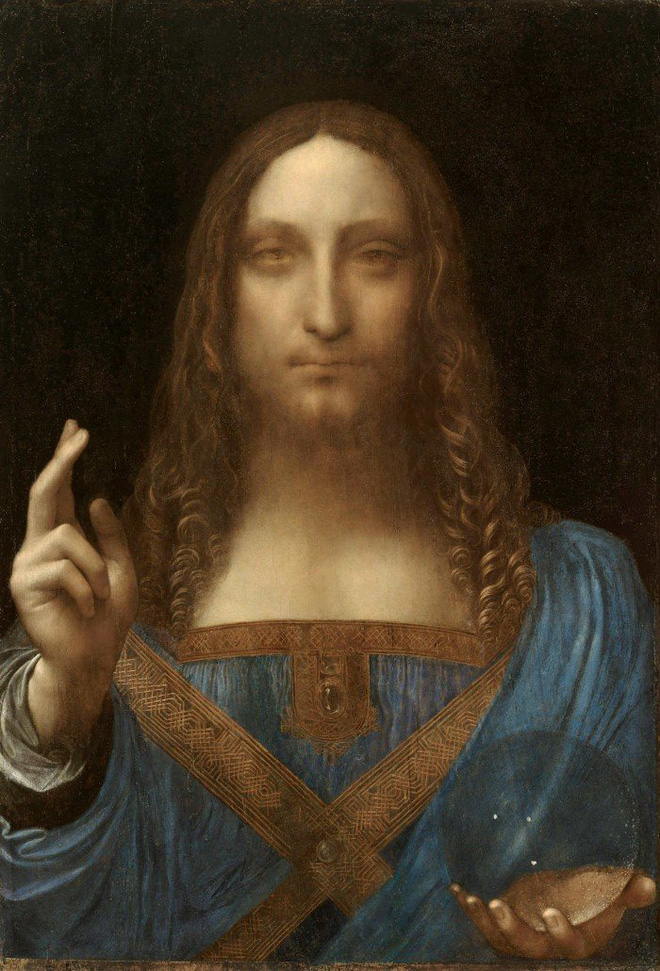
Genius Leonardo da Vinci had a deep understanding of light refraction; his writings extensively cover how light reflects off various surfaces. We must ask: Why did da Vinci paint it this way?
Thanks to researcher Marco Liang and his colleagues from the University of California, we finally have an answer. The team of scientists used computer graphics software to recreate the painting in a 3D environment to observe how light passes through the crystal orb.
After carefully analyzing multiple viewpoints, the research team concluded that the orb is not made of solid material. They demonstrated that the painting depicts the actual image of a hollow crystal orb with a diameter of 6.8 centimeters and a thickness of 1.3 millimeters.
To briefly discuss the technology applied in this new research, reverse rendering is a computer graphics technique used in image production based on reality, simulating how light interacts with objects. The main goal is to accurately recreate transparent or semi-transparent objects, such as items made from glass or water.
Initially, researchers created a 3D environment of the scene, incorporating the structures and textures of the objects illuminated by light. The 3D environment is viewed from a specific angle and includes a specific light source. An algorithm tracks the path of light and paints the overall scene of how light spreads in the environment, viewed from a predetermined angle.
Liang and his team recreated a digital version of Salvator Mundi to observe details more clearly. “We built a geometric model of the scene based on estimated body sizes and the details of the crystal orb and the hand holding it,” the research team stated.
Comparing it with the original hand, they estimated the diameter of the orb to be 6.8 cm, placed 25 cm away from the body. The research team also improved the geometric aspects of the hand so that it gently held the crystal orb, using Maya – a 3D modeling and animation tool.
Analyzing the shadows from the light source, the research team concluded that the subject of the painting is illuminated by direct light from above, which creates a light diffusion effect. They also estimated that the distance between the viewpoint and the subject is about 90 cm.
“With the digital scene, we tested whether the orb was solid or not by creating two virtual crystal orbs, one solid and one hollow,” the research team said.
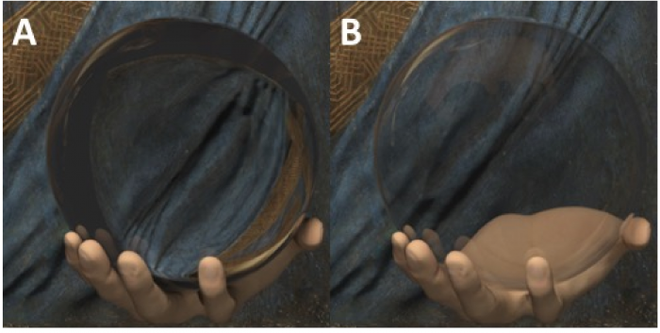
The results are quite fascinating: the only way for the research team to create an identical painting to the original was by using the hollow orb. Moreover, the hollow crystal orb would distort the image behind it in a specific way. For example, looking straight through the center of the orb, one would not see the object behind distorted. However, images not passing through the center would be distorted in a specific way, causing the edges of the object to become misaligned.
In the original painting, the Christ’s garment is folded with 5 pleats appearing behind the orb. However, 4 of the pleats have the upper part fanning out like a paper fan, converging downwards towards the center of the crystal orb. This suggests that da Vinci likely understood how the hollow orb distorts images.
After the research team experimented with crystal orbs of various thicknesses, they concluded that the glass cannot be thicker than 1.3 millimeters.
This discovery raises another question: Did Leonardo da Vinci possess such a crystal orb? Looking at the painting, it is evident that he did. Reading da Vinci’s notes, we see that he understood how light interacts with objects and how a hollow crystal orb distorts images. Additionally, hollow crystal orbs appeared in many contemporary paintings, not to mention that Renaissance artists excelled at recreating light effects in their works.
The research team concludes: “Our experiment shows that the recreated image with accurate light effects indicates that creating the painting was feasible with the materials, light sources, and scientific knowledge available to Leonardo da Vinci in 1500.”
Previously, Walter Isaacson – a researcher on da Vinci’s biography, also suggested that the orb in Jesus Christ’s hand was hollow. However, it was only through the experiments of researcher Liang and his colleagues that we could prove this. The conclusions of the scientists also dispel doubts that da Vinci painted incorrectly, once again affirming the solid scientific knowledge of this Renaissance genius.
The research report was published on arxiv.org.
Reference MIT Technology Review