


There are two beautiful times of day to witness a spectacular rocket launch: in the dawn light and at dusk. When night blankets the earth but light still lingers in the high sky, the smoke produced by the rocket’s exhaust can catch the sun and create glowing clouds.
At 5:21 AM local time on Saturday, SpaceX launched the Falcon 9 rocket carrying 58 Starlink satellites (part of Elon Musk’s global internet network project) and 3 high-resolution Earth observation satellites developed by Planet Labs.
This launch, named Starlink-8, is the eighth batch of satellites produced by SpaceX, and this successful launch marks the 540th time SpaceX has successfully sent satellites into orbit. This is yet another effort towards realizing the ambitious project of providing global internet coverage before December 2020.
Ascending from Cape Canaveral, Florida, and gliding across the skies of the Atlantic Ocean, the smoke emitted from the rocket created brilliant clouds. Lucky onlookers were able to capture stunning photos, as the sight before them was more beautiful than any Photoshop creation.
Join us in admiring this rare event, hoping it will grace the skies of every nation:
“An impressive display at Florida’s Space Coast this morning! @SpaceX #falcon9 #starlink @planetlabs @elonmusk” expressed user @johnpisaniphoto on Twitter.
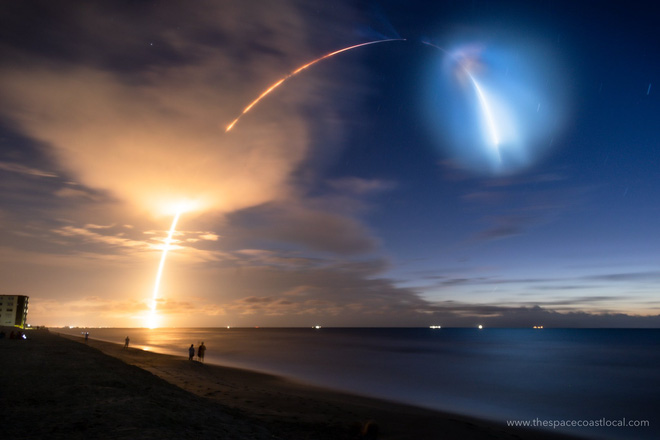
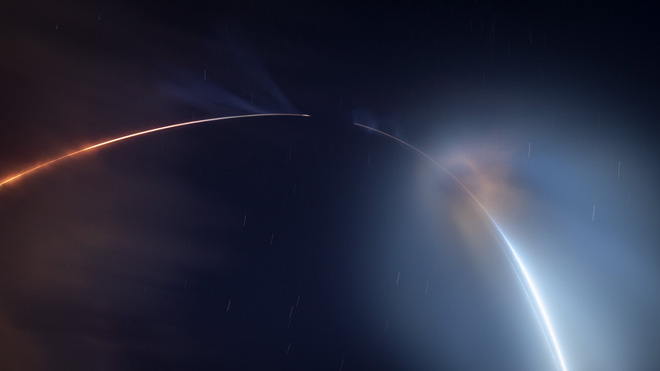
Time-lapse video of the Falcon 9 launch from Cape Canaveral before dawn, video by photographer John Kraus.
The dazzling sight over Cape Canaveral as SpaceX successfully launched 58 Starlink satellites and three SkySats from Planet Labs aboard the Falcon 9 rocket.
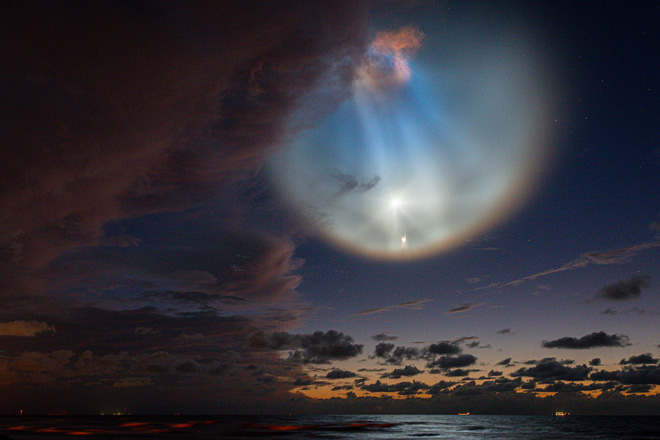
As the rocket ascends, it leaves behind a long, hot trail of smoke. The appearance of this smoke depends on the fuel used, which in this case was RP-1, a high-quality kerosene ignited by liquid oxygen.
The Falcon 9 rocket leaves a relatively small puff of smoke, but as it climbs higher into the atmosphere, the surrounding air pressure gradually decreases. At altitudes of around 20 km and above, where the atmospheric pressure is only about 1% of that at sea level, the hot smoke expands particularly wide.
When the necessary conditions are met, the mass of hot smoke can create water from the air, and then the cold of the high altitude immediately causes the water to freeze into tiny crystals. When time conditions are also satisfied, these crystals will reflect light, like a mirror placed before the Sun, casting down miraculous glowing spots in the night below.
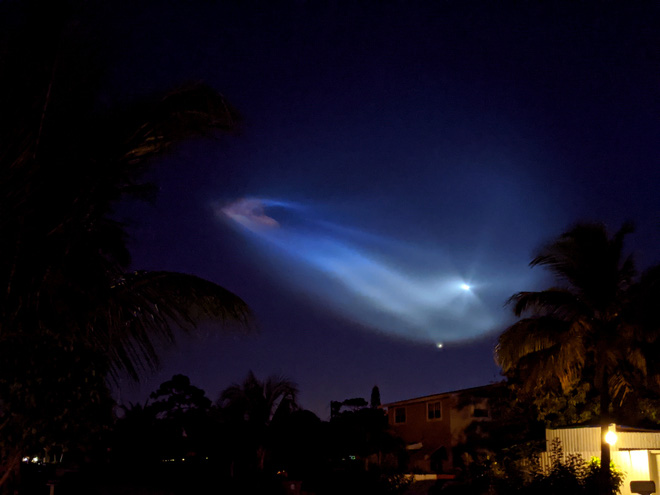
“I’m pretty sure all my neighbors were wondering why that crazy girl was standing outside screaming at 5 AM,” said Jamie Groh, the photographer and space news reporter.
Science refers to this as noctilucent clouds, which typically appear at the North and South Poles and are quite rare. However, if humanity progresses to the point where traveling to space is as easy as taking a taxi, then noctilucent clouds as a human-made phenomenon will reflect our dreams of reaching further.
Source: Business Insider