


Back in June this year at the WWDC event for developers, Apple announced that it would stop using Intel chips in its Mac computer line, opting instead for chips developed in-house (Apple Silicon). At that time, Apple promised that the first Mac models based on the Apple Silicon platform would be released in 2020.
Not missing the deadline, in November, Apple officially launched three Mac models featuring the M1 chip: the 13-inch MacBook Pro, MacBook Air, and Mac mini. The initial reviews have been extremely positive, with reviewers stating that the M1 chip has delivered a significant leap in both performance and battery life.
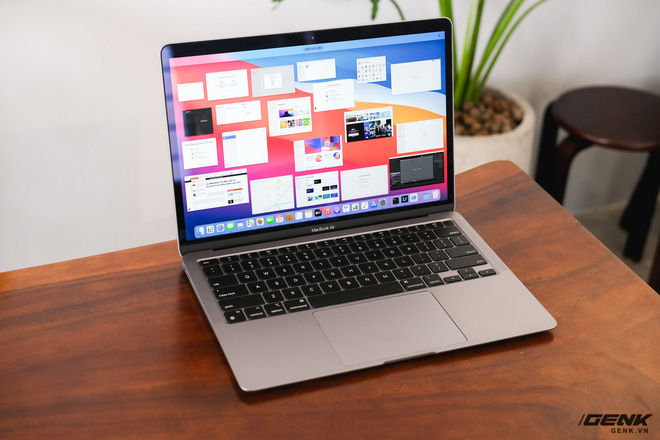
Despite being much more powerful than Intel chips, the new Mac models with the M1 chip are priced the same, or even cheaper. The MacBook Air M1 and MacBook Pro 13″ M1 are priced at $999 and $1299 respectively, unchanged from before. The Mac mini M1 costs $699, which is $100 less than the Intel model.
Users are selling their old Macs for fear of depreciation
Following the positive reviews of the M1 chip in the new MacBook models, many users have immediately put their Intel-powered MacBooks up for sale. Many of these are newer MacBook Air or MacBook Pro models (2019, 2020) that they have only used for a short time.

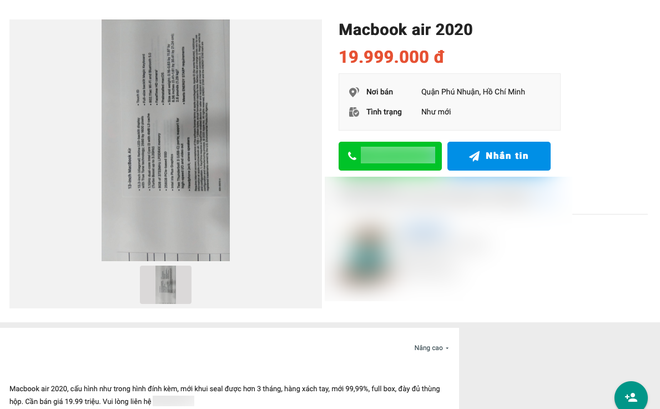
Dao Tuan, an office worker in Ho Chi Minh City, is selling his 2020 MacBook Air, which he bought less than 6 months ago. The machine is still functioning normally and meets his work needs, yet Tuan has decided to sell it due to concerns that its value will plummet quickly after the M1 MacBook Air is released.
“The M1 chip is too powerful compared to Intel chips. If I don’t sell it now, later no one will want to buy these Intel machines anymore. Or if someone does, they will be undervalued, and selling it will result in a big loss,” Tuan shared with us.
Currently, a used 2020 Intel MacBook Air is being sold on the market for about 19-22 million VND, while the 2020 MacBook Pro is priced around 27-30 million VND (depending on the version). This price has not shown significant fluctuations compared to before. However, in the near future, when M1 MacBooks flood the market, along with the presence of official models, the price of Intel MacBooks is predicted to drop sharply.
Don’t sell if the machine meets your needs
For those who are considering buying a new Mac at this time, clearly choosing the Intel chip version is not a wise decision. Unless users need to run Windows, most Mac applications have been running relatively well on M1 Mac models (including both ARM-compatible and x86 emulated apps via Rosetta 2).
For those who already own a Mac, upgrading depends on the needs and performance of the model they are currently using. If users feel their machine is sluggish, especially the MacBook Air or MacBook Pro models from 2017 and earlier with only 2-core CPUs, upgrading to the M1 MacBook is entirely worth it. Additionally, if users feel that the battery life of their current MacBook does not meet their needs, upgrading to a new MacBook is also very worthwhile.
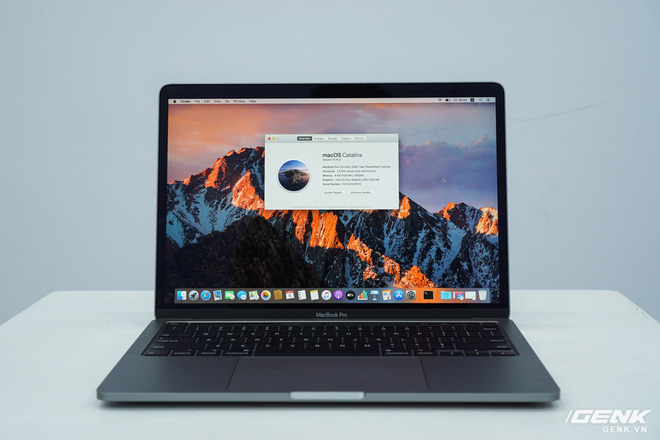
On the other hand, for those who feel their MacBook meets their needs, selling the machine at a loss in a short time, then having to add extra funds to buy an M1 model is completely not worth it. Even though it is not as powerful as the M1, most Intel-based Mac models from the past 1-2 years are still good enough to perform daily tasks for the next 2-3 years.
Therefore, if you are still satisfied with your current machine, continue using it until your needs exceed what the machine can deliver. Once users have exhausted its “depreciation,” selling the machine for an upgrade will be more worthwhile.
Additionally, users should remember that the current M1 MacBook models are still only Apple’s first-generation products. Based on the history of previous products such as the iPhone, iPad, or Apple Watch, the second generation of products always surpasses the first generation by a significant margin.