


Diamond batteries have the ability to generate electricity for 100 years and are being considered for use in space probes and underground mining equipment.
These batteries use artificial diamonds to produce electricity when placed in a radioactive field. If the radiation can be controlled and prevented by encasing these batteries in aluminum or other metal plates, they could be safely commercialized.
Satoshi Koizumi, the leader of the Wide Bandgap Semiconductor group at the National Institute for Materials Science in Japan, stated: “This is a beautiful crystal. We can harness the potential of diamonds.”
As one of the hardest substances in the world, diamonds are widely used in industry and can even be converted into semiconductors. The team has produced a P-N junction diode, one of the simplest semiconductor devices, by attaching a thin diamond film to a diamond substrate to generate electricity.
Diamond batteries, or betavoltaic batteries, generate electricity as long as they are in a radioactive field where they can receive beta rays from isotopes like carbon-14 and nickel-63. This type of battery has such a long lifespan because carbon-14 and nickel-63 only decay half of their amount in approximately 5,700 years and 100 years, respectively.
By using silicon carbide (SiC), many American companies and others have brought betavoltaic batteries into practical use. Although diamonds have a higher thermal exchange rate than silicon carbide, producing semiconductors from diamonds is much more challenging.
The diamond batteries produced by NIMS are the result of technology and expertise that the national research and development institute of Japan has accumulated since the 1990s. The thermal exchange rate of the material is about 28%, the highest in the world and close to the theoretical limit, although at the elemental level.
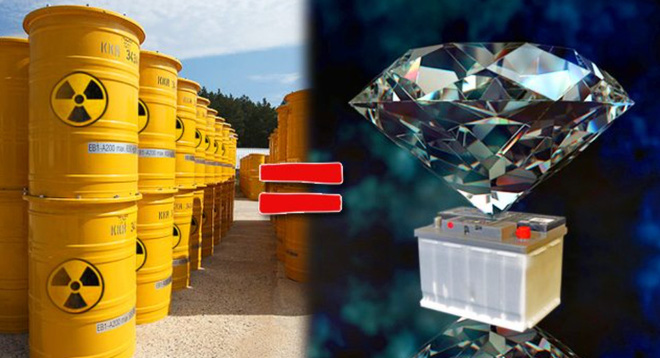
The research team at NIMS has used electrons in devices like electron microscopes instead of beta rays to produce electricity, but they plan to start using nickel-63 from now on.
A major issue that developers have yet to solve is increasing the efficiency of the batteries by raising the electricity output. Currently, these batteries only generate electricity at the microwatt (μW – 1μW equals one millionth of a watt) level.
Nevertheless, the potential of batteries using artificial diamond material is enormous. In 2020, the UK Atomic Energy Authority and the University of Bristol announced they are researching the use of carbon-14, an isotope that commonly exists on the surface of graphite during nuclear power generation. They can be obtained when nuclear power plants are decommissioned.
The UK is considering producing diamond batteries from the decommissioning of these plants. Although there are no details about the plan, if successful, it could generate electricity for thousands of years.
Nuclear batteries include those that use heat from the radioactive element plutonium. Such batteries are often installed in space probes. Although they generate a relatively large amount of electricity, handling plutonium to avoid contamination risks is very difficult.
In contrast, diamond batteries have high thermal resistance, a simple structure, and are safer.
Researcher Koizumi from NIMS stated: “They can operate even at high temperatures, and their use in space devices, mineral exploration probes, and other equipment is feasible.”
Research on diamond batteries opens up significant opportunities for the energy and space industries in the future.
Source: Nikkei