


You may not know this, but your electronic devices, especially your PC, contain gold inside. In fact, electronics is one of the largest consumers of gold. So, if so much is consumed, how much gold is actually in your PC? Could selling it make you a billionaire? In this article, let’s find out together.
PC Components that Contain Gold
Almost all computers and electronic devices contain rare metals, including gold. It usually appears on PCB (printed circuit board), processors, and other components. In fact, some electronic devices contain quite a lot of gold. If we’re just talking about gold, here are some typical PC components that contain it:
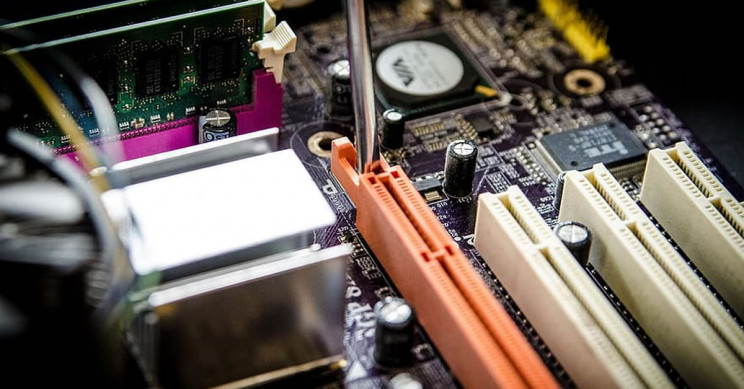


The Motherboard in Particular and Circuit Boards in General: This is usually where the most gold is found in a PC. The edges of most components on the board will have contact pins and connections made of gold. Additionally, you will see a thin layer of gold on the surface of the motherboard.
CPU: Typically, a CPU will have hundreds of gold-plated pins along the edge and on the underside.
RAM: The pins are usually gold-plated, which is immediately visible. Furthermore, there is often a thin layer of gold on the PCB surface as well.
Of course, in addition to gold, these components also contain other metals such as Silver, Platinum, Palladium, Copper, Nickel, Aluminum, Tin, Zinc, and more. However, this article will focus solely on gold.
Gold is Widely Used in PC Components due to Its Unique Properties
Many of you may wonder why gold, which is so valuable, is used to manufacture electronic components. The reason gold is used frequently in this case is because it has some quite interesting and useful properties, outshining other metals. Solid-state electronic devices usually operate on very low voltage and current. Therefore, they can easily be affected by corrosion and tarnishing at contact points.

To address this issue, gold is an excellent candidate because it conducts electricity very well, can transmit small currents, and is highly resistant to corrosion. For this reason, contact points, relays, and connecting wires are often made of gold or gold-plated to enhance durability and signal stability.
So, How Much Gold is Actually in a PC?
By now, many of you might be wondering if extracting gold and some precious metals from the CPU and other components could make you rich. The short answer is no.
Some articles suggest that an entire old PC might contain gold worth up to $9, but that’s not accounting for the extraction costs. Other sources estimate that a typical PC today will contain about 0.2 grams of gold (worth approximately $12). Meanwhile, laptops usually have only half that amount.

Depending on the specific component, the amount of gold can vary. For instance, older CPUs like the Intel Pentium Pro ceramic version contain up to 0.43 grams of gold, the gold cap version of Intel Pentium contains up to 0.48 grams of gold, or surprisingly, the plastic version of Intel Pentium Pro contains up to 0.55 grams of gold.
Older CPUs Generally Have More Gold than Newer CPUs

Computer chips produced after 1998 usually contain very little gold, as most of these CPUs no longer use the solid gold wire bonding technology or gold-plated caps as before. Nowadays, CPUs, especially Intel CPUs and soon AMD Ryzen Zen 4 CPUs, typically no longer use pins; instead, they only have a thin layer of gold-plating at contact points to connect with the socket on the motherboard. In fact, some CPUs in laptops and smartphones even lack contact points; these types use “solder bumps” to solder and connect directly to the motherboard.

Extracting Gold from Computer Components Has More Downsides than Benefits
In short, while your PC does contain gold, the amount is very small, and the complex extraction process means you should primarily consider this for reference. If you only process a few chips, the costs for the various steps can often exceed the amount of gold you would retrieve. Therefore, selling the entire CPU with some components might actually be much more profitable.

To be more specific, refining gold and other precious metals like Silver, Platinum, and Palladium from CPUs and electronic components is often only profitable if you have professional tools and a large supply of components. Additionally, refining gold is very hazardous due to exposure to toxic chemicals like mercury, nitric acid, and hydrochloric acid. Therefore, it’s best left to experts.
I hope this information helps you discover new things about the world of technology. If you have any suggestions or additions, please share them with me in the comments below. Thank you for your interest in this article.
According to GVN360