


Searching for the phrase “intercept messages on Facebook, Zalo” yields over 1.2 million results in just 0.26 seconds. Recently, various groups and advertisements for services claiming to intercept messages on Facebook and Zalo have proliferated on social media. But what is the truth behind this service?
A survey of several advertising sources offering message interception services on Facebook and Zalo revealed an average price ranging from 3 to 15 million VND, depending on the type of service such as monitoring, location tracking, or message interception.
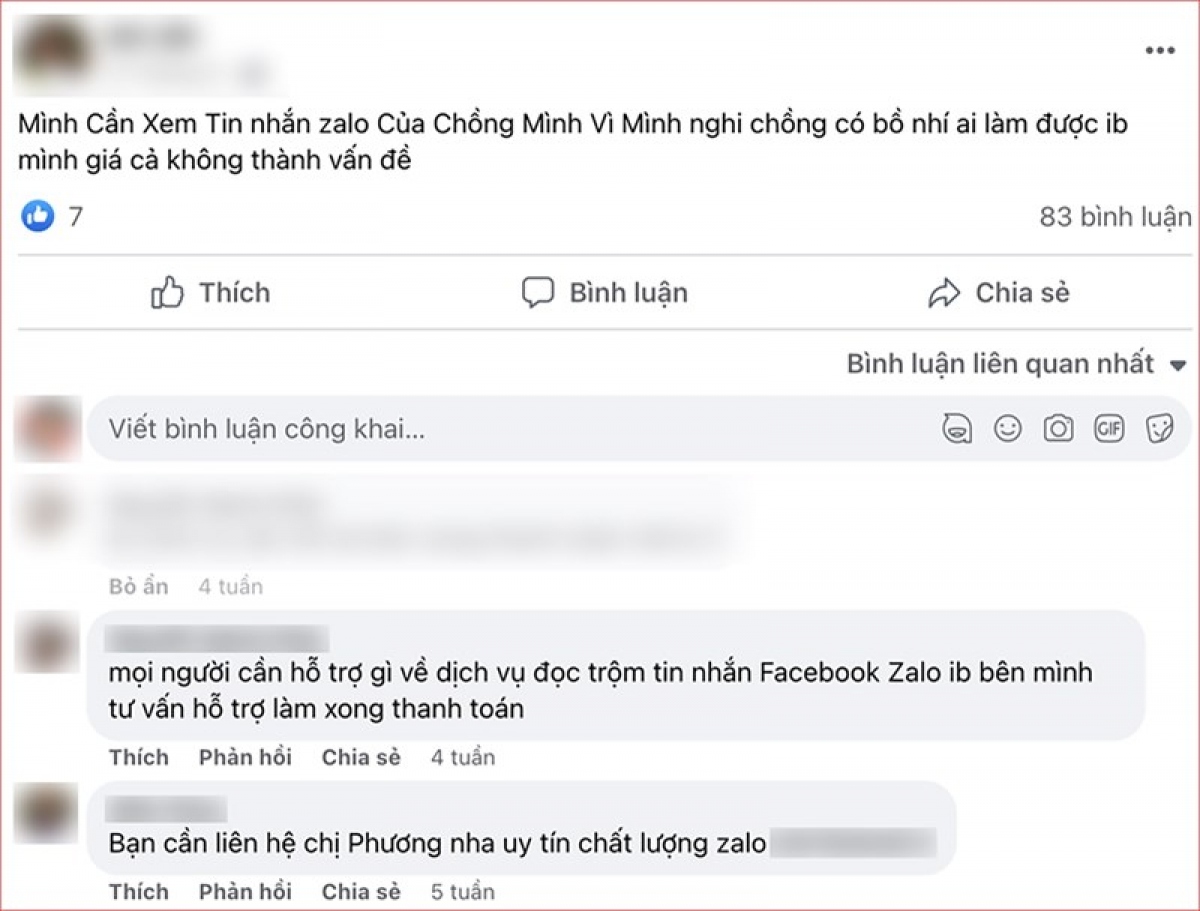
Most of these services advertise similar content: “Support for intercepting Zalo and Facebook messages, account recovery, payment only after completion, no upfront deposit required.” However, when contacting them directly, these individuals state that the service fee is 500,000 to 1 million VND, and payment must be made upfront to finalize the order.
According to cybersecurity expert Ngo Tuan Anh, there have been cases where, after making a deposit or transferring money upfront, the service provider immediately blocks the Facebook or Zalo account of the person who hired them. Typically, the victim is also afraid to share information about being scammed because their initial intent was to illegally read messages on Zalo or Facebook, thus they end up “biting the bullet.”
In some rare cases, the scammer can successfully intercept messages due to users being careless and entering their account information and password into fake links sent to steal their information. At that point, the scammer completes the task of intercepting all information and sends it back to the client.
“It is impossible to intercept messages or locate the owner of a Facebook or Zalo account when the account owner is in control of their own account. All of these advertisements are purely fraudulent, designed to scam users out of their deposits. The only feasible method involves using software and fake accounts to report an account as fraudulent simultaneously. In that case, Facebook will lock that account, and the scammer can claim to have taken it down (RIP),” Mr. Tuan Anh stated.
Expert Ngo Tuan Anh also warns that clicking on strange links and providing account information and passwords leads to account theft, a problem that has existed for a long time, yet many users still fall into the trap and become victims of scammers.
“Some lucky individuals may be able to recover their accounts quickly and in time. However, even then, the personal information and some important data shared by users on the platform may still be stolen. Therefore, users need to be aware of protecting their accounts. They should use two-factor authentication when logging in,” Mr. Tuan Anh recommended.
Additionally, users should limit logging into their accounts on unfamiliar devices, avoid enabling the automatic password save feature, and regularly check their activity logs to identify any unusual activities on their accounts.
Users should not expose or publicly share their phone numbers, email addresses, or images of their identification used to register Facebook or Zalo on their walls, personal pages, or anywhere else. Be cautious with trendy new features on Facebook that require clicking on links or using unreliable applications.
When using internet cafés or logging into Facebook or Zalo on unfamiliar devices, it is best to use incognito mode or log in as a guest on the browser and remember to log out after use.